

Clocks fall back on Sunday, November 1, 2026, and ENERGY STAR suggests timing the heating check-up around the fall time change, before contractors get busy. That date makes a good anchor for a winter home maintenance checklist, because most of the jobs on it depend on each other. A tighter house needs a furnace that vents properly, and a frozen-pipe plan assumes the heat stays on through the coldest nights.
The order, in one line: the heating tune-up and alarm dates in late October, air sealing and the dryer vent in early November, outdoor water lines before the first hard freeze, gutters after the leaves drop, and the heating bills from December to March. That makes seven jobs, grouped below into three stretches of the season. Each step says when to do it, what to look at, and one number from an official source checked in October 2026, then points to the detailed guide on this site. Work on gas lines, combustion venting, wiring or a roof appears here only as a job to understand and hand to a licensed pro.
The winter home maintenance checklist at a glance
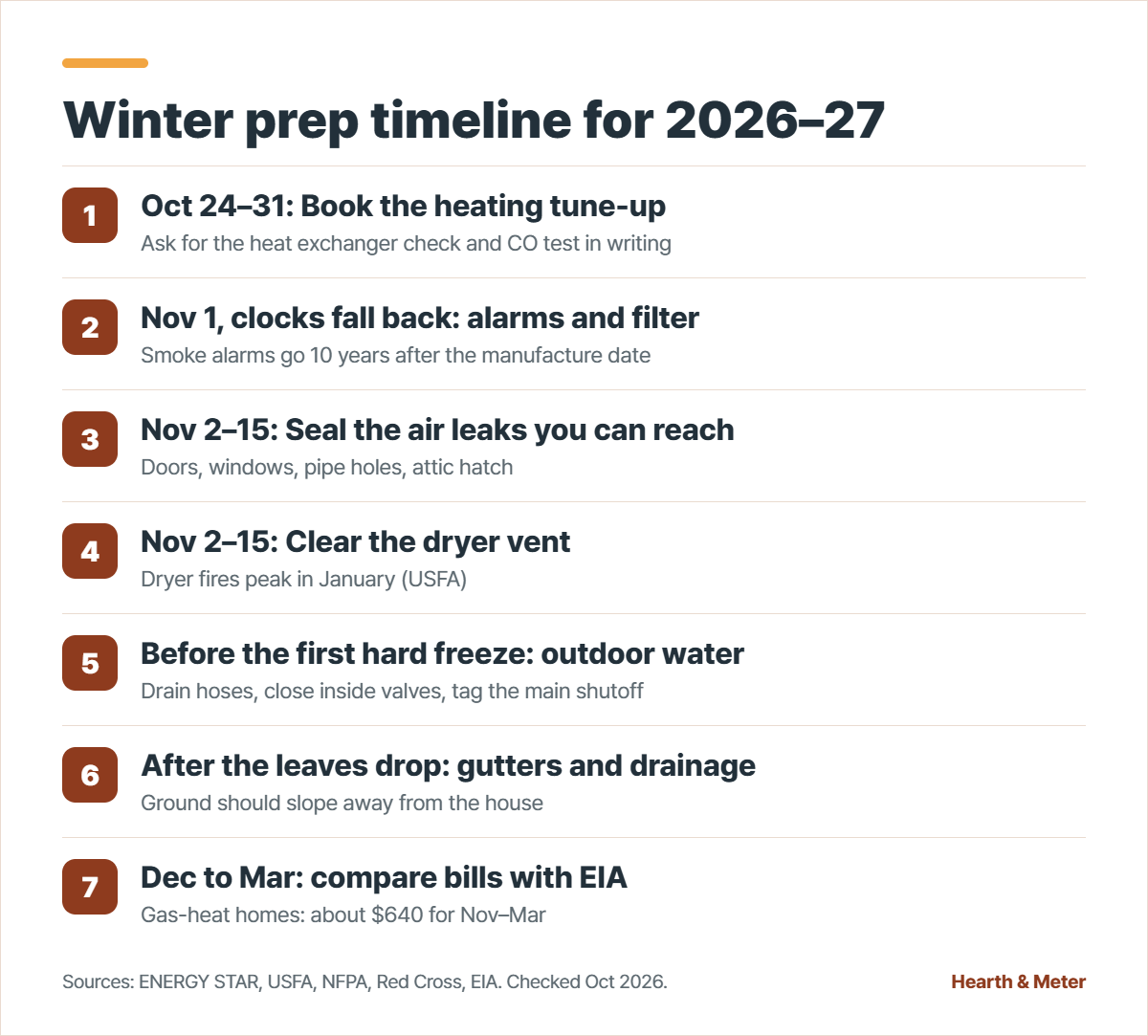
The dates assume a house in a heating climate. In mild southern climates most of it can wait a few weeks. In the northern tier, move the freeze step ahead of air sealing if your local forecast already shows nights well below 32°F.
Late October to mid-November: heat, alarms, air leaks, dryer vent
The first four jobs share one logic: get the combustion equipment checked, confirm the alarms that back it up, and only then tighten the house and clear its biggest lint hazard.
1. Late October: book the furnace or boiler tune-up
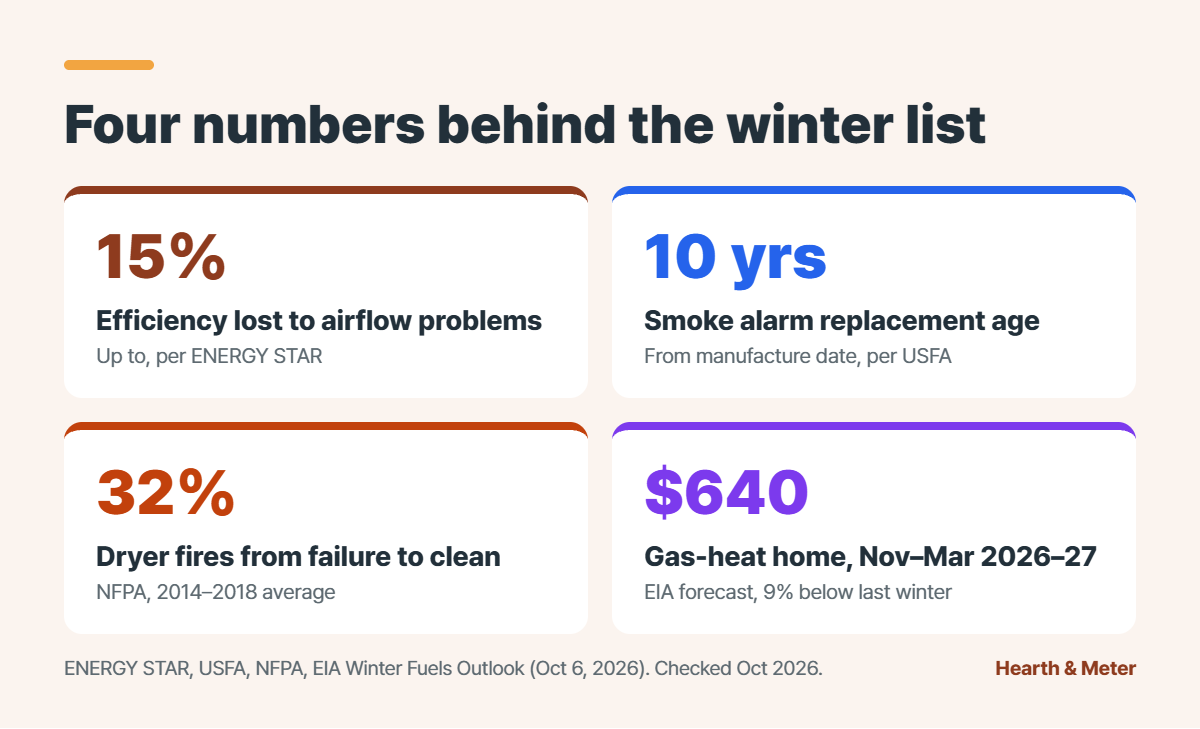
ENERGY STAR’s maintenance checklist has the contractor check gas or oil connections, gas pressure, burner combustion and the heat exchanger, because a dirty burner or a cracked exchanger makes the equipment run less safely. It also notes that blower airflow problems can cut a system’s efficiency by up to 15 percent. Book the visit before November 1 if you can, and ask for the heat exchanger inspection and a carbon monoxide test in writing.
Boilers burn gas or oil too, so the combustion and venting items on that list apply to them, and all of it is contractor work. Your own job is the filter, which ENERGY STAR says to inspect, clean or change once a month. Our furnace tune-up checklist with 2026 cost ranges lists every item a real tune-up covers and the red flags to look for in the technician’s report.
The monthly filter look is where most households slip. ENERGY STAR treats three months as the outer limit, and DOE Building America guidance lists pets, four or more occupants, allergies and long run seasons as reasons to change it sooner. EPA says most systems can take a MERV 13 filter if it is replaced often, but a technician should confirm what yours can handle. Our guide on how often to change a furnace filter, and which MERV to buy works through three example homes and EPA’s MERV table.
Heat pump homes have one more item for this step: learn what the thermostat’s “AUX” and “EM HEAT” labels mean before the first cold snap. AUX is the backup strips helping a running heat pump, which is normal in deep cold, while EM HEAT shuts the outdoor unit off and heats with the strips alone at roughly twice the electricity for the same warmth. Our guide to heat pump emergency heat explains when to switch it on and how to estimate the hourly cost.
If the house has a wood-burning fireplace or stove, put the chimney on the same late-October list. NFPA 211 says chimneys, fireplaces and vents should be inspected at least once a year, and the Chimney Safety Institute of America sets the cleaning trigger for a masonry fireplace flue at 1/8 inch of sooty buildup, or sooner if glazed creosote shows up. Book a certified sweep before the first fire; our guide on how often to clean your chimney walks through five common chimney myths and HomeGuide’s 2026 sweep and inspection prices.
If a CO alarm sounds, get everyone outside to fresh air right away, then call 911 from outside. The Consumer Product Safety Commission says more than 200 people in the U.S. die every year from accidental non-fire CO poisoning tied to consumer products.
2. The same weekend: read the date on every smoke and CO alarm
The U.S. Fire Administration says smoke alarms need to be replaced 10 years from the manufacture date printed on the back, even if the test button still beeps. It also asks for an alarm in every bedroom, outside each sleeping area and on every level, including the basement. Test each one monthly, and swap 9-volt batteries and hardwired backup batteries at least once a year.
CPSC wants CO alarms on every level and outside sleeping areas, and interconnected units are best because one alarm sets off the rest. USFA says only qualified electricians should install hardwired smoke alarms, so treat battery units as the do-it-yourself swap and hardwired ones as an electrician’s job. Our guide on when to replace smoke detectors and CO alarms follows a hypothetical seven-alarm house through the dates and the 2026 replacement cost.
3. Early November: seal the air leaks you can reach
ENERGY STAR estimates that air sealing plus insulation in the attic, over crawl spaces and at basement rim joists saves an average of 15 percent on heating and cooling costs, or 11 percent of total energy costs. Its model shows the biggest savings in cold climate zones and much smaller ones near the Gulf Coast. Start with what you can see and feel: door weatherstripping, window sashes, plumbing holes under sinks, then the attic hatch.
Do this after the tune-up rather than before. A house with a gas furnace, boiler or water heater needs its venting confirmed before you tighten it, which is why our plan for sealing air leaks in your home puts four safety checks, including combustion appliances, ahead of any attic work.
Once the reachable leaks are sealed, the attic floor is the next thing to check. Our guide to how much attic insulation you need lists ENERGY STAR’s R-value targets by climate zone and what they mean in inches.
In snow country this attic work doubles as ice dam prevention. University of Minnesota Extension describes an ice dam as snow melting over a roof section that averages above 32°F and refreezing at an eave that stays below 32°F, so sealing and insulating before the first snow keeps the whole deck cold. Our guide on how to prevent ice dams on your roof compares that work with heat cables and roof rakes, using dated cost ranges.
4. Early November: clear the dryer vent before the heavy-laundry months
NFPA’s Home Dryer Fires report (June 2020) estimated 13,820 home fires a year involving dryers in 2014 to 2018, and failure to clean caused 32 percent of them. An older USFA study of 2008 to 2010 data found that dryer fires rose in fall and winter and peaked in January, at 11 percent of the year’s total.
Clean the lint screen on every load and get the duct itself cleared now, before the sweaters and blankets start. A quick check from outside tells you a lot: the vent flap should open while the dryer runs. If drying times keep creeping up, our guide to the signs of a clogged dryer vent explains the outdoor airflow test, the 35-foot duct limit in the residential code, and why a gas dryer’s venting belongs to a pro.
Before the freeze and after the leaves: water lines and gutters
The middle of the list depends on your weather, not the calendar. Watch the forecast for the first nights below 32°F and for the week most of your trees are bare.
5. Before the first hard freeze: outdoor water lines and the main shutoff
The American Red Cross names the pipes that freeze most often: outdoor hose bibs, pool and sprinkler supply lines, pipes in unheated basements, crawl spaces, attics and garages, and pipes along poorly insulated outside walls. Before the cold arrives, drain and store the hoses, close the inside valve that feeds each outdoor faucet, and leave the outdoor faucet open so leftover water has room to expand. If you travel this winter, the Red Cross says to leave the heat on and set no lower than 55°F.
If you have not found that valve yet, do it now rather than with water on the floor. Utilities such as the North Penn Water Authority and Parker Water & Sanitation District say it usually sits where the service pipe comes through the foundation on the street-facing side, while warm-climate and slab houses often have it outdoors or in the garage. Our guide on how to find the main water shutoff valve covers those location rules, gate versus ball handles, and a once-a-year turn test.
Our fall checklist for preventing frozen pipes adds pipe insulation prices, the yearly heat tape inspection, and what a burst pipe repair tends to cost. While you are standing at the main shutoff valve, run a leak check too. EPA WaterSense says the average household’s leaks waste more than 9,300 gallons a year and that fixing the easy ones saves about 10 percent on water bills. The two-hour water meter test for hidden leaks shows how to turn any meter movement into gallons and dollars.
The water heater often sits in the same basement or utility room as the main shutoff, so check it on that trip. DOE puts most storage tank models at 10 to 15 years, and the serial number on the rating plate usually encodes the build date. Water in the drain pan or under the tank is the sign to call a plumber before winter. Our guide on how long a water heater lasts follows each age bracket to a repair-or-replace answer.
In-ground sprinklers need their own shutdown in the same window. Shut off the irrigation water supply and set the controller to rain mode, then clear the lines with drain valves or a compressed-air blowout; Colorado State University Extension tells cold-climate owners not to rely on drain valves alone. HomeGuide (February 3, 2026) puts a professional blowout at $50 to $150 for systems up to 12 zones, and our guide on how to winterize a sprinkler system compares the three methods and prices a 5-zone yard.
6. After the leaves drop: gutters and where the water goes
On a wooded lot, a cleaning done before the trees are bare may have to be repeated, so book a date after most of the leaves are down. This Old House puts professional gutter cleaning at $100 to $450 per visit in 2026, about $275 on average, and notes that two- and three-story homes cost more to clean because of the added height.
Clean gutters only help if the water then moves away from the foundation. ENERGY STAR’s water management checklist for certified new homes asks for ground that slopes at least half an inch per foot away from the house for 10 feet, a handy yardstick when you see puddles by a downspout after rain. Check what you can from the ground and leave second-story ladder and roof work to a pro. Our gutter cleaning cost breakdown for a two-story house compares three price guides and runs the numbers on gutter guards.
December to March, and who does what
7. December to March: hold your heating bills against the forecast
EIA’s Winter Fuels Outlook 2026–27, released October 6, expects homes that heat mainly with natural gas to spend about $640 from November through March, 9 percent less than last winter. For electric-heat homes it forecasts $1,196 in winter electricity spending (up 4 percent), and for heating oil homes $2,115 (up 21 percent). EIA cautions that a fuel with a lower average bill would not necessarily cost your household less. Our 2026–27 winter heating bill outlook breaks the forecast down by region and shows how to estimate your own bill from last winter’s statements. As a hypothetical example, a Midwest gas-heat household that paid $700 from November through March last winter would land near $630 if its bill moved with EIA’s 10 percent regional drop; a bill well above that, in a winter no colder than forecast, is worth a second look at steps 1 and 3.
When the first winter statement arrives, check what you paid per unit before you hold it against that forecast. On an electric bill, dividing the total by the kilowatt-hours used folds the customer charge, delivery lines, riders and taxes into one price you can compare month to month, and a long billing period or an estimated read can make a normal month look expensive. Our line-by-line electric bill example walks through the supply and delivery charges, billing days and the price to compare.
The free lever is the thermostat. Energy.gov says turning it back 7 to 10°F for 8 hours a day can save as much as 10 percent a year on heating and cooling. On bitter nights when pipes are at risk, the Red Cross advises holding the same temperature day and night instead, so skip the setback during a hard cold snap.
If the tune-up report from step 1 hinted at replacement, compare running costs before you sign anything. ENERGY STAR’s heat pump criteria require at least 7.8 HSPF2 for split systems, and the cold-climate label for ducted models asks for 8.1 HSPF2 plus a COP of at least 1.75 at 5°F. Our heat pump vs gas furnace cost comparison turns those ratings and EIA prices into dollars per million Btu, state by state.
Which jobs are yours and which go to a licensed pro
- Heating tune-up: filter checks and clearing vents and registers are yours; the burner, gas pressure, heat exchanger, venting and CO test go to a licensed technician.
- Smoke and CO alarms: monthly tests, battery alarms and reading dates are yours, while hardwired alarms go to an electrician.
- Air sealing: weatherstripping, caulk and door sweeps are DIY work. Attic work near flues and the combustion safety test belong to a licensed contractor.
- Dryer vent: you can handle the lint screen, short duct runs and the outdoor flap. Long or hidden runs and gas dryer connections need a licensed pro.
- Frozen pipes: hoses, hose bib valves, foam sleeves and the meter test are yours; heat tape wiring and burst pipe repair are licensed work.
- Gutters: look for overflow, sagging and puddles from the ground, and leave second-story and roof-edge work to a licensed pro.
This list leaves out chimney sweeping, roof repairs and storm kits, which need their own guides. If you plan to run a portable generator during an outage, CPSC says to keep it outdoors only, at least 20 feet from the house, with the exhaust pointed away.
What to do this weekend
Call for a heating tune-up date and ask what the visit includes. Then pull down one smoke alarm, read the manufacture date on the back, and find your main water shutoff so it is tagged before the first freeze. None of the three needs tools, and together they set up the rest of this list.
This checklist is general information, not professional advice. Hire licensed contractors for gas, electrical, roof and HVAC work, and check local codes and permit rules before you start.
Leave a Reply