
People usually go looking for the main water shutoff valve with water already on the floor. It sits where the supply pipe enters the house, most often on the street-facing wall close to the meter.
That one sentence gets you to the right wall. The rest of this page is about how to find the main water shutoff valve when the layout is less obvious, how to tell which kind of handle you have, how to test it once a year without snapping the stem, and when the valve out at the curb belongs to the water utility instead of you. Replacing a valve or repairing the service line is plumber work and is not covered here.
Where-to-look guidance comes from five water utilities’ public pages, read on Oct 31, 2026. Cost ranges are from HomeGuide’s valve replacement guide dated Oct 29, 2025.
Where is the main water shutoff valve in most houses?
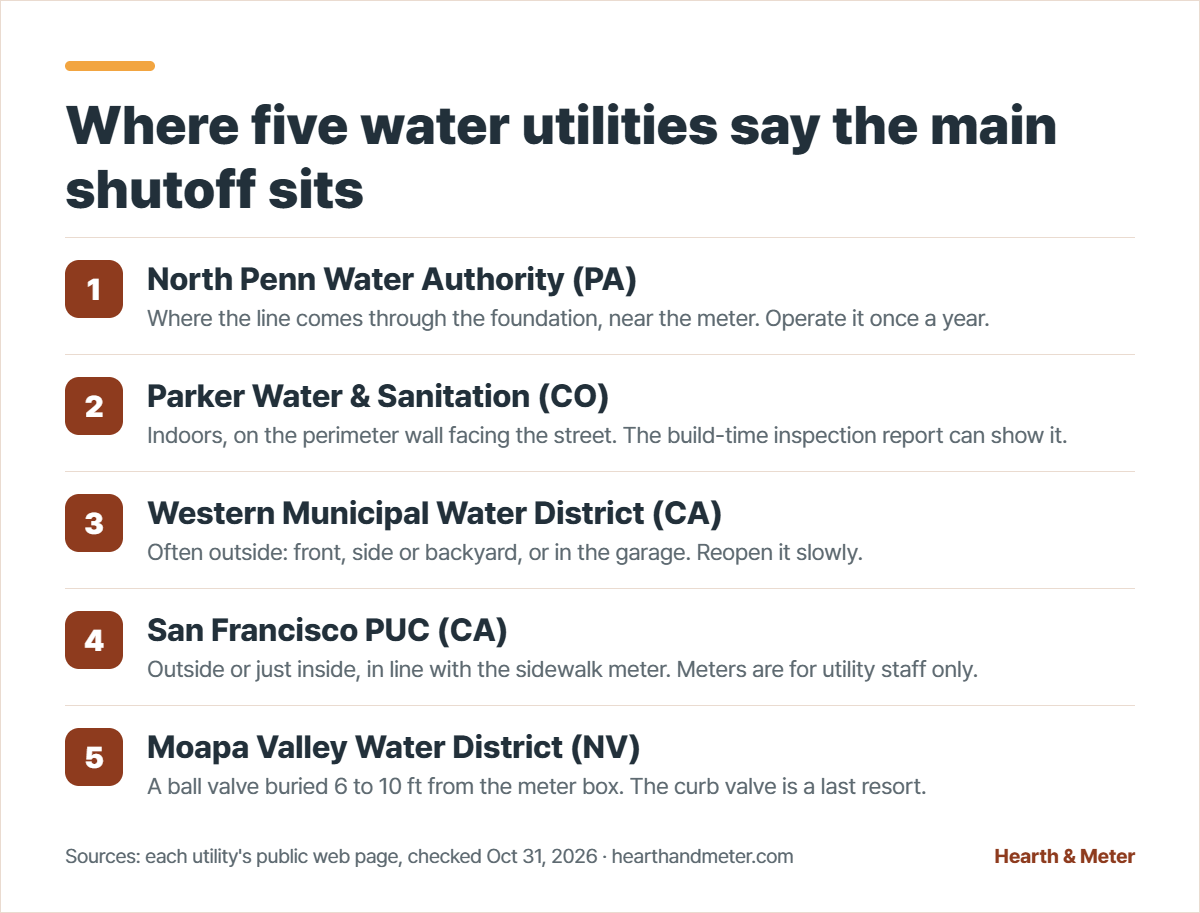
Trace the incoming pipe first. The North Penn Water Authority in Pennsylvania says the master valve is usually where the water service comes through the foundation, next to or near the meter, and in houses with an indoor meter that is usually the basement or utility room. Parker Water & Sanitation District in Colorado gives a similar rule: indoors, on the perimeter, on the side of the house that faces the street.
Warm-climate and slab houses move it outdoors. Western Municipal Water District in Southern California says the master valve is typically outside in the front, side or backyard, or inside the garage. The San Francisco Public Utilities Commission describes most main valves as sitting on the exterior or just inside the property, in line with the sidewalk meter, and usually the largest valve coming out of the wall.
Some valves are buried. Moapa Valley Water District in Nevada installs a ball valve underground about 6 to 10 feet from the meter box, on the customer side, and warns that landscaping can swallow it over the years until nobody remembers where it is. If you cannot find yours, Parker suggests checking the property inspection report from when the house was built; your water utility may be able to pull a copy.
In a condo or apartment, the valve you can reach may serve more than one unit, or there may be none inside your walls at all. Ask the landlord or association where the valve for your unit is and who is allowed to close it, before you need it.
Gate valve or ball valve: which one do you have?
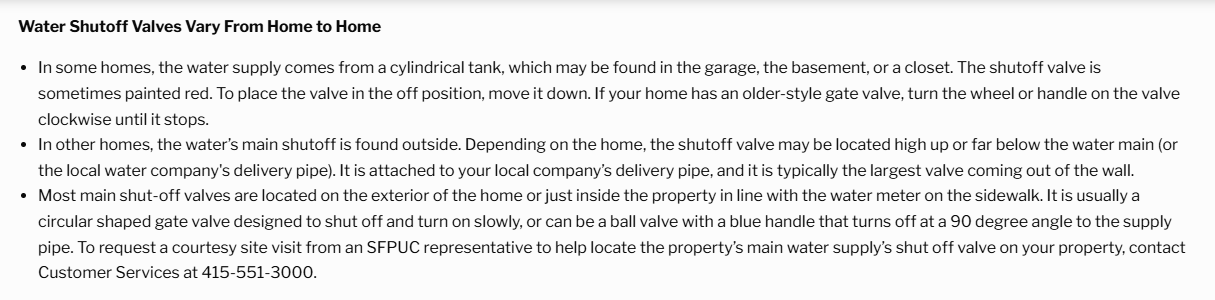
Look at the handle. A round wheel means a gate valve, which HomeGuide says is common in older homes; a flat lever means a ball valve, which it says is found in most newer homes, often on copper or plastic supply pipe. Western Municipal’s instructions: turn a gate valve clockwise until the water is off, and turn a ball valve lever a quarter turn. Moapa adds the check that matters for a ball valve: it is closed when the handle sits crosswise, perpendicular to the pipe.
The SFPUC page puts both types side by side, including the blue-handled ball valve it describes:
A gate valve needs several full turns to close, so count them the first time and write the number on the tag. A ball valve moves 90 degrees and is easier to read at a glance, and HomeGuide calls it the preferred type for a main shutoff.
How do you test the valve without breaking it?
North Penn recommends turning the master valve off and on at least once a year, because a valve that never moves can stick or break off the moment you need it. A test takes about ten minutes:
- Pick a weekday morning, when a plumber can come at regular rates if the stem breaks, and tell everyone in the house the water will be off briefly.
- Close the valve with steady hand pressure: a gate wheel clockwise until it stops, a ball lever a quarter turn. Moapa warns that jerking or forcing the handle can damage the valve.
- Open the hose bib or faucet nearest the valve. Western Municipal uses this as the confirmation step: the flow should slow and stop. A steady trickle means the valve no longer seals.
- Leave the water off and unused for a few minutes, then listen as you reopen. North Penn notes that a rush of water refilling the line points to a leak somewhere downstream; the meter test in our high water bill guide confirms it.
- Reopen slowly and all the way. Western Municipal says opening too fast can damage pipes, and North Penn says the valve should end fully open so flow is not restricted.
- Run the nearest faucet until it stops sputtering, which clears the air Western Municipal says gets trapped in the lines.
Once it passes, mark it. North Penn hands out shutoff tags at its counter; a luggage tag or a strip of bright tape on the pipe does the same job.
What if the handle is stuck or the valve drips afterward?
Stop if the handle does not move under steady pressure. Moapa’s guidance is not to force a jammed handle, and North Penn’s warning about valves breaking off applies to any valve that has not moved in years. A snapped stem on the house side of the meter can leave you unable to close anything except the curb valve.
Two other signs mean the valve is near the end: water seeping from around the stem after you turn it, and a valve that will not fully stop the flow in step 3. HomeGuide says corrosion or leaking around the valve usually means it is due for replacement and puts a typical lifespan at 10 to 20 years. Neither is an emergency on the day you find it, but book the repair before winter, since a valve that leaks by is useless when a pipe freezes.
When should the utility close the curb stop instead?
The curb stop is a second valve on the service line near the property line, often in a box with the meter. Utilities treat it differently from the house valve, and the rules vary by town:
- North Penn will close it for planned plumbing repairs if you schedule a site visit, Monday to Friday 8:30 a.m. to 4:30 p.m., at no cost during those hours; after-hours charges may apply.
- The SFPUC says its water meters should only be accessed by its field staff, and offers a courtesy visit to help you locate your own valve (415-551-3000).
- Parker says that in an emergency, customers who cannot find their valve can call and the district will shut water off at the curb stop.
- Moapa calls the curb valve in the meter box a last resort, because the meter and its electronics belong to the district and a damaged valve can leave you without water longer.
Before the cold sets in, look up your own utility’s emergency line and write it on the tag. If your provider says customers may operate the curb valve, it also tells you what tool to use; Moapa, for example, mentions a curb key sold at hardware stores.
How much does it cost to replace a main water shutoff valve?
HomeGuide’s guide (dated Oct 29, 2025) puts the national range at $250 to $600, with an average of $425. Easy-to-reach valves in basements or next to the meter often cost $350 or less, while buried valves or valves in vaults can run $1,000 or more. Its other inputs: valves themselves cost $10 to $50 for brass, plumbers charge $75 to $150 an hour on scheduled visits and $100 to $350 or more for emergency calls, and plumbing permits run $30 to $500 where a city requires one.
Here is how those numbers stack up for a hypothetical house: a 1960s house with a basement gate valve that would not close during a fall test, replaced in a job HomeGuide says usually takes one to two hours when the valve is easy to reach. Assume 1.5 hours of labor.
- Scheduled weekday visit: 1.5 hours at $75 to $150 is $112.50 to $225, plus a $10 to $50 brass valve, for $122.50 to $275 before any permit.
- Add a permit if the city requires one ($30 to $500): $152.50 to $775.
- Same job as an emergency call: 1.5 hours at $100 to $350 is $150 to $525, plus the valve, for $160 to $575 or more before a permit.
The math is the argument for testing in October instead of discovering the problem during a January freeze. The valve and the labor time stay the same; the hourly rate is what changes.
What should you close first when a pipe bursts?
Close the main valve if you can reach it from a dry spot, and then work out where the water is coming from. If the leak is at one toilet, sink, or washing machine, Western Municipal points out that fixtures have their own supply valves; closing that one lets you turn the main back on for the rest of the house. Our running toilet guide shows where the toilet valve sits and what to check before you trust it.
Safety first: if water has reached outlets, cords, the electrical panel, or the basement floor around a water heater or furnace, do not wade in to reach the valve. The Electrical Safety Foundation International says to stay out of flooded areas until the electric utility confirms the power is off, and to have any equipment that got wet inspected by a qualified professional before it goes back into service. Call your water utility to close the curb stop and your electric utility to cut power instead.
If a hard freeze is what you are preparing for, our frozen pipe prevention guide covers insulating the risky runs, and what to do when a pipe has already split.
Who else in your house can find it?
A tagged valve only helps if the person home when a pipe lets go knows where it is. Parker’s own winter list includes making sure you know where the master valve is, and North Penn asks customers to show everyone in the household.
This week, walk each adult and any teenager to the valve, have them close and reopen it once with you watching, and take a photo of it with the tag visible. Save that photo with the utility’s emergency number in a shared note or on the fridge, so a house sitter or a visiting relative can find it without calling you.
Related guide: the winter home maintenance checklist puts this test in order with the other pre-freeze jobs.
This article is general information, not professional advice. Valve replacement, service line repairs, and any work near wiring, gas lines, or water heaters should go to a licensed plumber or electrician, and many cities require a permit for main valve work. Check your local code and your water utility’s rules before operating any valve at the meter or curb.
Leave a Reply