
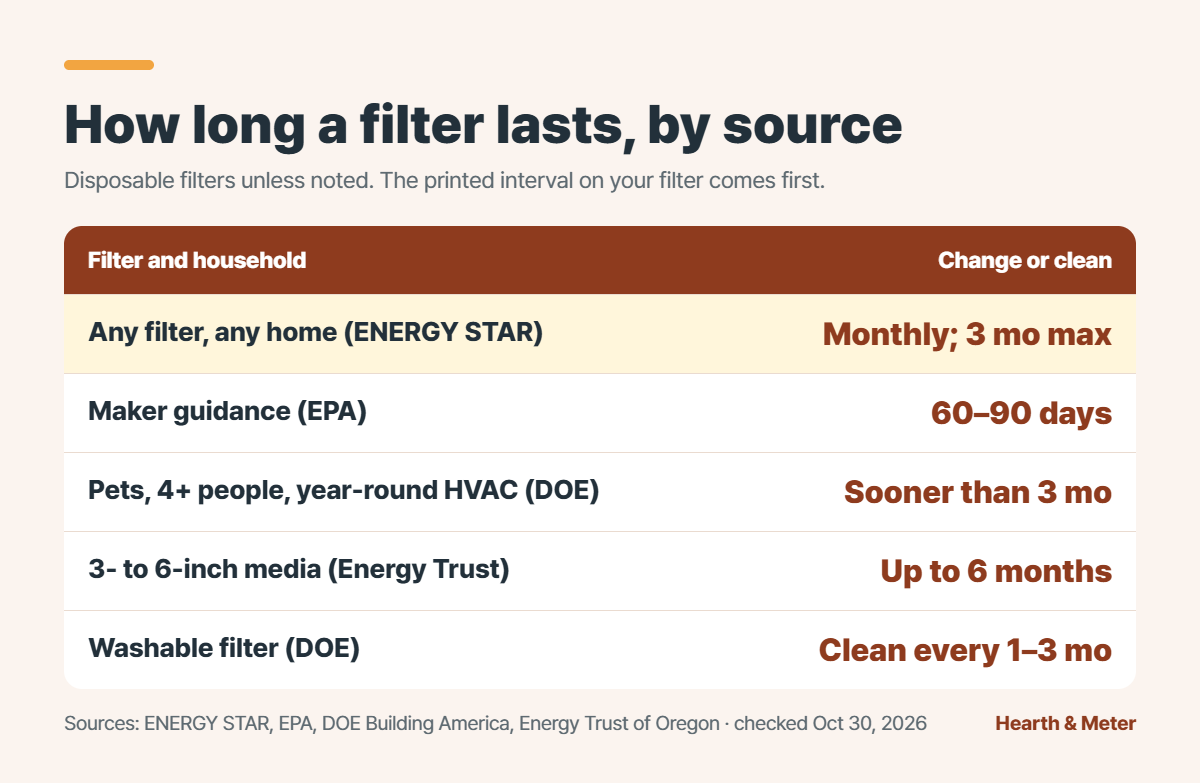
How often to change a furnace filter: look at it every month, swap it when it looks dirty, and treat three months as the outer limit, per ENERGY STAR. The “90 days” printed on many packages is that limit. A house with two dogs and a 1-inch filter can load one well before then, while a 4-inch media filter in a quiet house may go twice as long.
Guidance compared across EPA, ENERGY STAR, the DOE Building America Solution Center and Energy Trust of Oregon on October 30, 2026.
Three homes, three different filter schedules
These are hypothetical households, built to show how far apart the right answer can land.
Home A has a 1-inch pleated filter behind the hallway return grille, two dogs, and a gas furnace that runs most of the day in January. DOE’s Building America guidance on high-MERV filters lists pets, four or more occupants, indoor smoking, allergies and equipment that runs six to twelve months a year as reasons to change filters more often than every three months. Home A checks on the first of each month and changes the filter whenever it comes out gray.
Home B has a 4-inch media filter in a cabinet beside the furnace, two adults and no pets. Energy Trust of Oregon says filters 3 to 6 inches thick can last up to six months or even longer, and that the interval printed on the filter is the one to follow. Home B still gets the monthly look ENERGY STAR recommends; it just passes more of them.
Home C is a condo whose heat pump air handler sits in a closet and runs through both summer and winter, with a 1-inch filter in the return grille. No pets, but the fan moves air for most of the year, so it belongs on Home A’s schedule more than Home B’s.
One label printed on a package cannot fit all three. What follows is how to work out which one you are.
How often to change a furnace filter, by thickness and household
The sources agree on the floor and differ on the wording. ENERGY STAR’s rule is to check the filter every month, especially in winter and summer, change it if it looks dirty after a month, and change it at least every three months. EPA’s Guide to Air Cleaners in the Home says to follow the manufacturer, notes that manufacturers typically recommend 60 to 90 days, and adds that a filter that comes out heavily soiled is a sign to shorten the cycle.
When you are not sure, Energy Trust of Oregon gives a simple test: hold the used filter up to a light. If light no longer comes through, replace it. The same page says to check more often during wildfire smoke, sharp temperature swings and pet shedding season, since all three load a filter faster than the calendar suggests.
Where the filter sits and what its frame tells you
Most furnaces hold the filter in a rack in the blower compartment near the bottom, though some put it behind a door near the top or on the side. If there is nothing at the furnace, look behind a return air grille on a wall or ceiling; those usually come off with a screwdriver. Energy Trust of Oregon notes that the size is stamped on the edge of the frame, which is the number to copy before you shop.
The frame also carries an arrow. It shows the direction of airflow and should point toward the furnace or air handler, per the Building America guide. Since April 1, 2019, California has required filter makers to print the MERV, the particle capture by size and the pressure drop on the filter itself. Look for that label on the edge or the pleats; it is the quickest way to compare two filters with the same MERV. EPA adds that filters come 1 to 5 inches thick and should fit snugly, with no gaps for air to slip around and no bending to force them in.
What MERV rating should you use?
MERV, short for Minimum Efficiency Reporting Value, rates how well a filter catches particles between 0.3 and 10 microns, using a test method from ASHRAE. EPA’s MERV page lists the minimum capture each rating has to show. FPR and MPR, the scales some store brands print, are proprietary systems, while MERV comes from a national consensus standard, according to the same EPA guide.
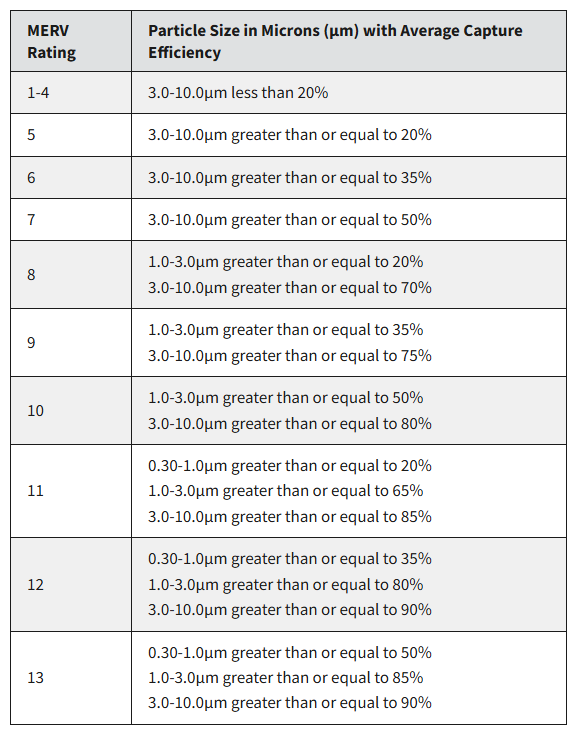
Matching EPA’s table to the programs that cite it gives a short map of where common ratings fall:
| MERV | Minimum capture in EPA’s table | Who points to it |
|---|---|---|
| 1 to 4 | Under 20% of 3 to 10 µm particles | Typical 1-inch spun fiberglass filter (DOE) |
| 6 | 35% or more of 3 to 10 µm | ENERGY STAR new-home minimum (DOE) |
| 8 | 20% of 1 to 3 µm, 70% of 3 to 10 µm | EPA Indoor airPLUS and DOE Zero Energy Ready Home minimum |
| 11 | First rating with a floor for 0.3 to 1 µm (20%) | No program minimum in these sources |
| 13 | 50% of 0.3 to 1 µm, 85% of 1 to 3 µm | EPA’s suggested minimum if you upgrade |
EPA’s position is that most furnaces and HVAC systems can take a MERV 13 filter without equipment problems, provided the filter is replaced frequently, and that an HVAC technician can confirm the highest rating your system handles. That condition, a filter replaced often, is where most problems start.
When a higher MERV works against your blower
A denser filter resists airflow, which engineers measure as pressure drop in inches of water column. The Building America guide puts the filter at 20% to 50% of a system’s total pressure drop and says most home systems run efficiently when the total stays at or below 0.4 to 0.5 inches. In its example, three MERV 7 filters from one maker rated 0.20 inches at 1 inch thick, 0.13 at 2 inches and 0.12 at 4 inches, all at the same airflow. Deeper pleats mean more media and less resistance at the same rating.
Too much resistance hurts in two ways, per the same guide. Variable-speed (ECM) blower motors push harder to keep airflow up and can burn out, while older PSC motors simply move less air, which stretches run times and can overheat a furnace or ice an AC coil. Dirt raises resistance too, and the guide notes that clogging and collapsed pleats are more likely with higher-MERV filters, so a MERV 13 filter needs the monthly check more than a basic one does.
If you want MERV 13 and your slot only takes 1 inch, read the pressure-drop figures on the label and ask the technician to measure total static pressure with a manometer at your next service visit. Our furnace tune-up checklist lists the other readings worth asking for on the same visit.
Washable and electronic filters
Washable filters are usually electrostatic, made of aluminum mesh or foam. The Building America guide says to take them out every one to three months, rinse them, let them air-dry completely and reinstall them, and warns that a filter put back damp can grow mold. Electronic air cleaners, filter plates and UV add-ons are a different category: Energy Trust of Oregon notes some need a contractor to install, and EPA advises avoiding any device that intentionally produces ozone, a lung irritant, while noting that some electrostatic precipitators and ionizers can emit it.
A year of filters, priced out
HomeGuide’s furnace cost guide (dated August 27, 2025, checked October 30, 2026) puts filters alone at $10 to $70 or more depending on brand, size and pack quantity, and a filter replacement done as a paid service at $100 to $175. Using assumed prices inside that range for the hypothetical homes above:
- Home A, 1-inch MERV 8 at $12, changed every two months: 6 × $12 = $72 a year.
- Home B, 4-inch MERV 11 at $45, changed every six months: 2 × $45 = $90 a year.
- Home A paying a technician for each of those six changes: 6 × $100 to $175 = $600 to $1,050 a year.
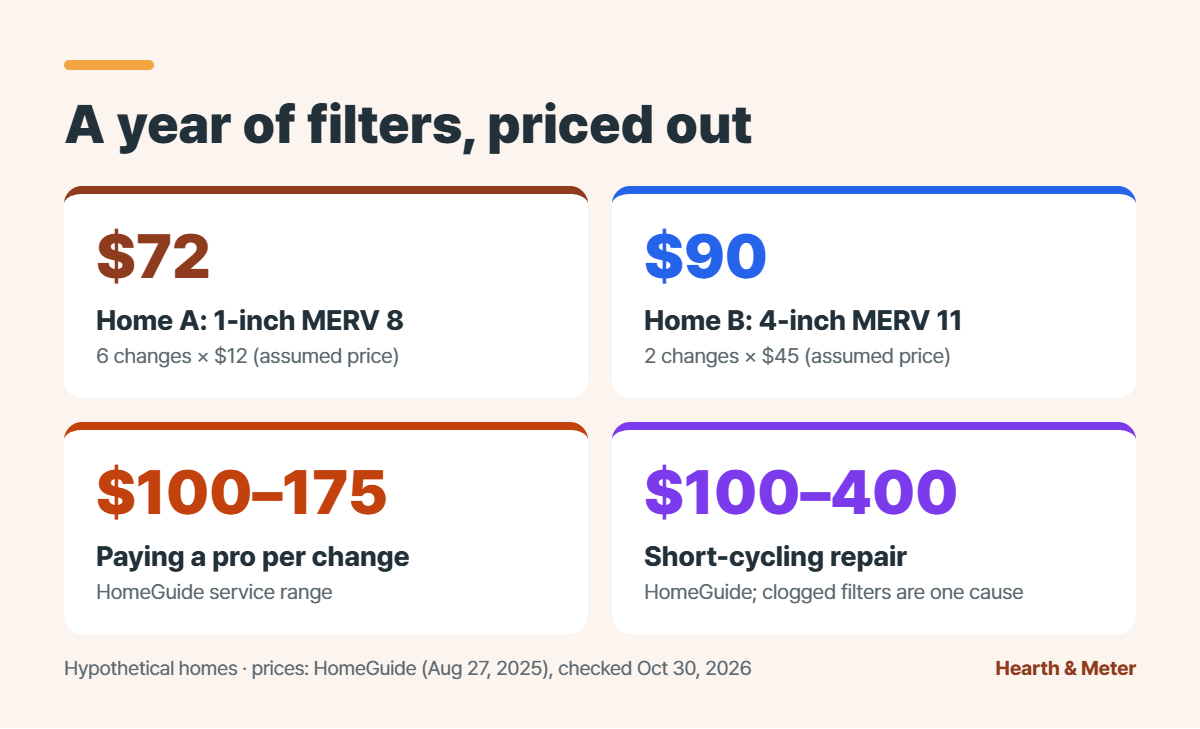
For scale on the other side, ENERGY STAR’s maintenance checklist warns that a dirty filter raises energy costs and can damage equipment. HomeGuide prices a short-cycling repair at $100 to $400 and lists clogged filters among its causes, and a blower motor replacement at $500 to $2,300. Filter spending is the smallest line on that list.
Swapping the filter in five minutes
This is the one heating job ENERGY STAR assigns to the homeowner. The steps below combine Energy Trust of Oregon’s instructions with the Building America installation notes:
- Turn the system off at the thermostat so the blower cannot start while the slot is open.
- Slide the old filter out and copy the size and the arrow direction from its frame. If the arrow is unreadable, the dirtier face was the side the air came from.
- Take the plastic wrap off the new filter but keep the cardboard frame. Mind the wire mesh on some pleated filters; the ends can be sharp.
- Slide it in with the arrow pointing toward the furnace or air handler.
- Write today’s date and the next check date on the frame with a marker.
- Put the slot cover or grille back. It should fit snugly but should not be taped or caulked shut, since you will open it again next month.
- Turn the system back on at the thermostat.
Safety: open only the filter slot or the return grille. The burner compartment, gas valve, flue pipe and wiring are work for a licensed HVAC technician. If you smell gas (a rotten-egg odor), leave the house without touching light switches or using a phone inside, then call 911 or your gas utility from a neighbor’s home or another spot well away, as PHMSA advises. If a carbon monoxide alarm sounds, or someone gets a headache, dizziness or nausea near a running furnace, get everyone outside to fresh air first and then call 911, per CPSC.
When a clean filter does not fix the problem
The Building America guide says to replace a filter immediately if it is clogged, its pleats have collapsed, it bangs when the system starts, or it is damp or moldy. If a fresh filter does not change anything, the cause is elsewhere: a furnace that still shuts off before the house reaches the thermostat setting, rooms that stay cold with the fan running, water pooling under the unit, or soot and odd smells near it all call for a licensed technician. Those visits cover what ENERGY STAR lists as contractor work, including gas connections, burner combustion and the heat exchanger.
If the furnace is one item on a longer pre-winter list, our winter home maintenance checklist puts the jobs in the order they come due.
Tonight, pull the filter, take a phone photo of the size and MERV printed on its frame, and write today’s date on the replacement. That photo is your shopping list next time, and the date tells you when to look again.
This article is general information, not professional advice. Hire licensed contractors for gas, electrical, roof and HVAC work, follow your equipment manufacturer’s filter instructions, and check local codes and permits before changing ductwork or adding air-cleaning equipment.
Leave a Reply