
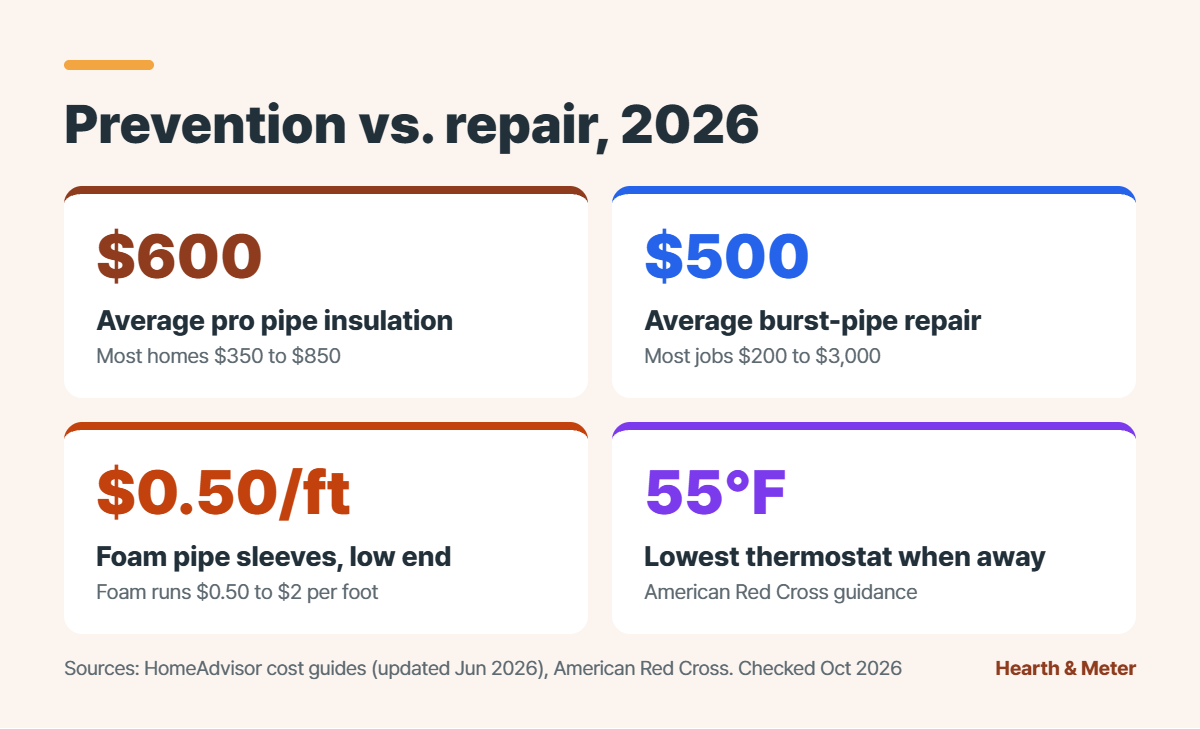
A water pipe that freezes can split, and the leak often shows up only after the ice melts and water starts moving again. HomeAdvisor’s burst pipe cost guide (updated June 2026) puts the average repair at $500, with most jobs between $200 and $3,000, and it tells readers to budget separately for water damage cleanup. Insulating the exposed pipes in a typical house costs about $600 when a pro does it, and foam sleeves for a short run start at $0.50 a foot.
This guide is for homeowners and renters anywhere that sees a few nights below freezing, including places where winter is usually mild and pipes run through attics or crawl spaces. It is organized around the questions homeowners ask in the order they come up, from why pipes split to what a plumber charges. Prevention steps follow Red Cross, Ready.gov, and CPSC guidance, and repair costs were checked in October 2026. It does not cover insurance claims or mold cleanup. Anything involving electrical work or a burst line is written at the “know what to ask a licensed pro” level.
Why does a frozen pipe split?
Water expands as it turns to ice. The American Red Cross explains that this expansion puts enough pressure on the pipe to break it, and that this is true for metal and plastic pipes alike. A stronger pipe does not solve the problem.
So the risk comes from three conditions at once: still water inside the pipe, air around it below 32°F, and nothing keeping it warm. Every fix in this guide removes one of those. Draining a line takes away the water. Insulation and air sealing slow the cold. A steady thermostat, open cabinet doors, and a dripping faucet keep heat and movement in the pipe.
Which pipes in my house are most likely to freeze?
Start with the pipes the Red Cross says freeze most often. Use this list as a walk-through route with a flashlight and a tape measure, and write down the rough length of every exposed run you find. You will need that footage to price insulation.
- Outdoor hose bibs, sprinkler lines, pool supply lines. They sit directly in outside air, so drain and shut them off before the first freeze.
- Crawl spaces and basements. Unheated and often drafty. Insulate the pipes and seal the gaps around them.
- Attics. Unheated space. Pipe insulation is the first step; ask a plumber whether rerouting makes sense.
- Garages. Unheated, and doors get left open. Keep the door closed and insulate the lines.
- Kitchen and bath cabinets on outside walls. The wall behind often has little or no insulation, which is why the Red Cross suggests opening the cabinet doors on cold nights.
- Where the water line enters through the foundation. Named by the Red Cross as a likely freeze spot. Insulate the exposed pipe and seal the gap around it.
Pipes that run along an exterior wall with little insulation are on the Red Cross list too. You often cannot see those, but a sink that runs slow on the first cold morning is a hint that the supply line sits in a cold wall.
What should I fix before the first hard freeze?
Do these on a mild weekend in October or early November, while crawl spaces are still comfortable to work in and before the first cold snap arrives.
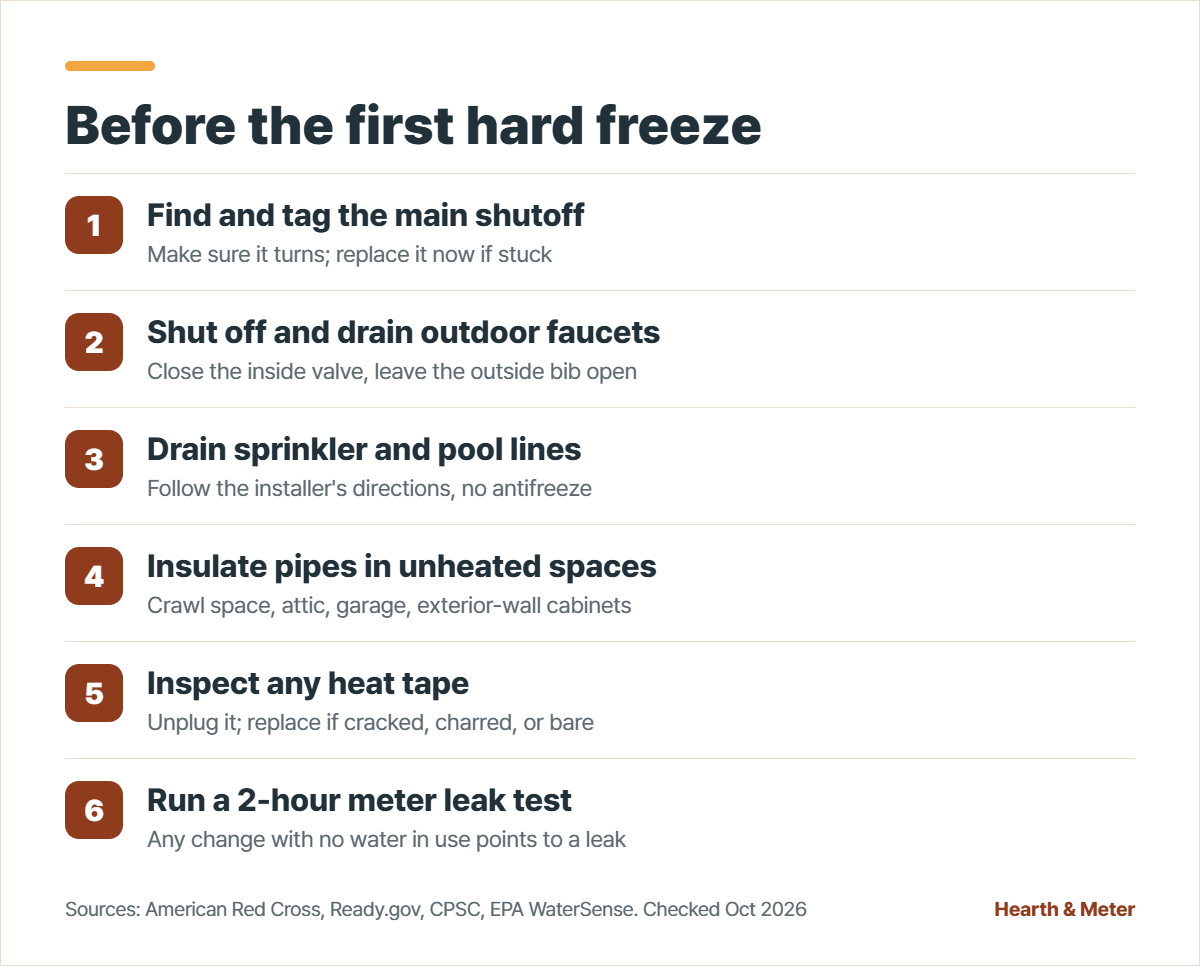
- Find the main water shutoff and tag it. If a pipe bursts, this valve is how you stop the flow. Make sure it turns and that everyone in the house knows where it is. If it is stuck or drips when you move it, have a plumber replace it now instead of during an emergency. If you have never located it, the walkthrough on how to find the main water shutoff valve covers where utilities say it usually sits and a yearly turn test.
- Shut down the outdoor faucets. Disconnect, drain, and store garden hoses. Close the inside valve that feeds each hose bib, then open the outside faucet so the line can drain, and leave it open so any leftover water has room to expand. Ready.gov gives the same advice for places that rarely see hard winters.
- Drain sprinkler and pool supply lines following the manufacturer’s or installer’s directions. Skip antifreeze unless those directions call for it; the Red Cross warns it is dangerous to people and pets and harms wildlife and landscaping.
- Insulate exposed pipes in unheated spaces, both hot and cold lines. HomeAdvisor’s pipe insulation guide (updated June 2026) lists foam sleeves at $0.50 to $2 per linear foot, rubber at $2 to $4, and mineral wool at $2 to $6. Tee and elbow fittings cost $0.50 to $2 each. A handyperson can cover about 100 feet in two hours, which HomeAdvisor prices at $90 to $400 in labor.
- If your pipes have heat tape or heat cable, inspect it before you need it. The Consumer Product Safety Commission tells owners to unplug the tape and check its full length every fall. Replace it if you see cracked or charred covering or bare wire. For new tape or cable, the Red Cross advises a UL-listed product.
- Seal the air leaks around pipe entries. The DOE Energy Saver Guide names plumbing and utility openings and sill plates (where the house sits on the foundation) among the main places to air seal. Sealing those gaps keeps outside air off the pipes right behind them.
- Finish with a leak test. With no water running anywhere, read your water meter, wait two hours, and read it again. The EPA WaterSense program says any change probably means a leak. EPA estimates that the average household’s leaks waste more than 9,300 gallons a year and that fixing the easy ones saves about 10 percent on water bills.
Safety: heat tape is an electrical product. CPSC says never to wrap it over existing pipe insulation, never to overlap it on itself unless the instructions allow it, and to cover it only with non-flammable insulation when the maker says to. If the cable runs under a mobile home or in a crawl space you cannot reach safely, have a licensed electrician inspect it.
Insulating hot water lines also cuts energy use. DOE’s guide estimates that insulating hot water pipes saves 3% to 4% a year on water heating, and it puts water heating at about 18% of a home’s energy use. If you are already in the basement with a box of foam sleeves, cover the hot side too.
An in-ground sprinkler system needs more than an open faucet. Our guide on how to winterize a sprinkler system compares manual drains, automatic drains and a compressed-air blowout, and shows where extension services disagree on which one to trust.
What do I do on nights below freezing?
Insulation slows heat loss but does not add heat. On the coldest nights the Red Cross recommends a short routine:
- Keep the garage door closed if water lines run through the garage.
- Open kitchen and bathroom cabinet doors so warm room air reaches the pipes. Move cleaners and chemicals out of reach of children first.
- Let cold water drip from any faucet served by exposed pipes. Even a trickle helps keep the line from freezing.
- Hold the thermostat at the same setting day and night. You will pay a little more for heat, but the Red Cross notes a burst pipe costs far more to fix.
- If you travel, leave the heat on and set it no lower than 55°F.
A nighttime setback that normally trims your heating bill should be paused during a hard freeze; switch it back on once the forecast warms up. That is the trade the Red Cross describes: a slightly higher bill for a few nights against a much larger repair.
Is your freeze prep finished? A checklist
- Main shutoff found, tested, and tagged
- Hoses off; inside valves to hose bibs closed; outdoor faucets left open
- Sprinkler and pool lines drained per the installer
- Exposed pipes in unheated spaces insulated, hot and cold
- Heat tape unplugged and inspected, or flagged for an electrician
- Gaps around pipe entries and sill plates sealed
- Two-hour meter test done
- Cold-night plan: garage closed, cabinets open, faucet dripping, no setback, 55°F minimum when away
How do I thaw a pipe that froze anyway?
The first sign is usually a faucet that gives only a trickle. Likely spots, according to the Red Cross, are against exterior walls and where the water service comes through the foundation. Its thawing guidance, in order:
- Keep the faucet open, so melting ice and water can move through the pipe.
- Warm the frozen section with an electric heating pad, a hair dryer, a portable space heater kept away from anything flammable, or towels soaked in hot water.
- Keep applying heat until full water pressure comes back.
- Check the other faucets in the house. When one pipe freezes, others often do too.
- Call a licensed plumber if you cannot find the frozen spot, cannot reach it, or cannot thaw it.
Never use a torch or any open flame on a frozen pipe. Kerosene heaters, propane heaters, and charcoal stoves are also on the Red Cross “do not use” list. If the pipe has split and water is reaching outlets, cords, or the electrical panel, stay away from them, close the main shutoff only if you can reach it without touching wet electrical equipment, and call a licensed plumber or electrician.
What does a frozen or burst pipe cost to fix?
When a plumber is needed, HomeAdvisor’s June 2026 figures show what the visit tends to cost. Labor makes up nearly 80% of a burst pipe bill, and plumbers charge $45 to $200 an hour or a flat fee.
- Thawing a frozen pipe: often a $100 flat fee.
- Emergency call-out fee: adds $100 to $300.
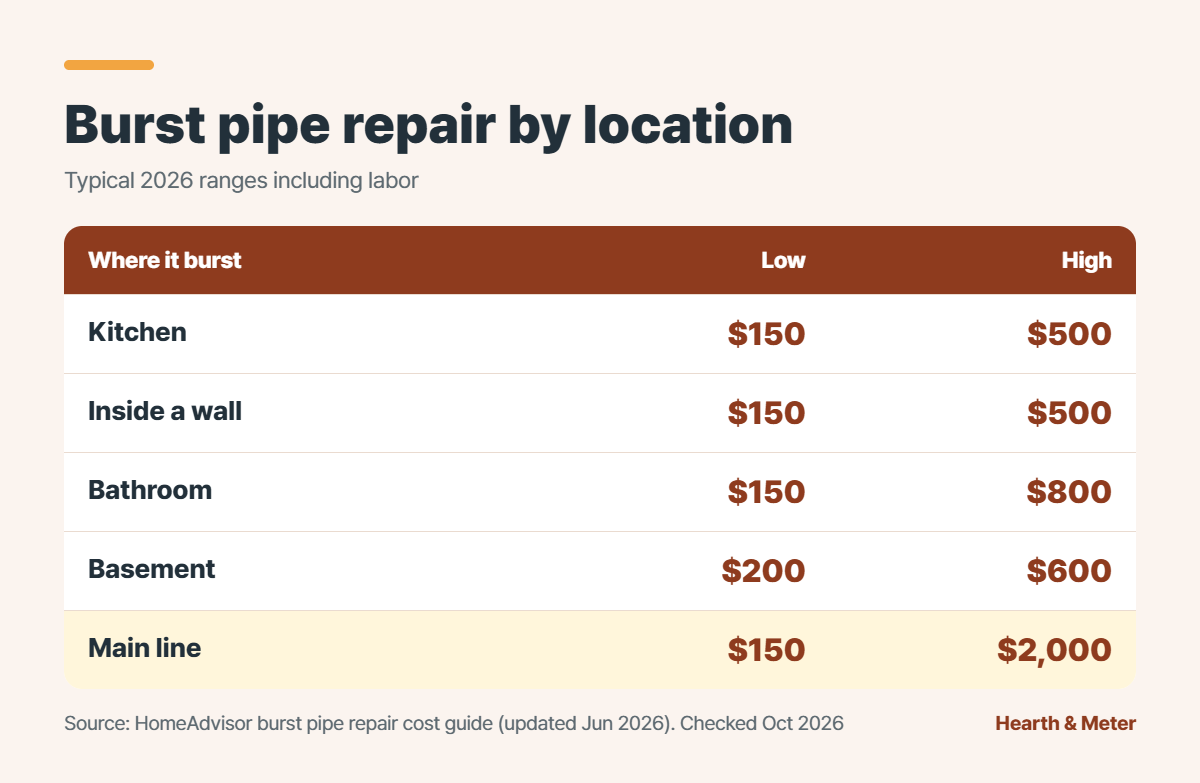
- Burst pipe repair, most jobs: $200 to $3,000, with an average of $500.
- Burst pipe by location: kitchen or in-wall $150 to $500, bathroom $150 to $800, basement $200 to $600.
- Main line: $150 to $2,000, with an average of $1,080.
What moves your number: how much drywall or flooring has to come out to reach the pipe, the pipe material (older cast iron costs more per foot), whether the call is after hours, and local labor rates. Water damage cleanup is a separate bill.
A slow leak from a split pipe inside a wall can show up on the water bill before you ever see a stain. Our two-hour water meter test for hidden leaks shows how to confirm one from the meter before any drywall comes out.
Gutters belong on the same fall list. When they clog, rain and snowmelt overflow next to the foundation instead of draining away. If yours need clearing before the freeze, gutter cleaning cost for a two-story house is broken down in a separate guide.
What should I ask a plumber this fall?
- Which exposed lines in my crawl space, attic, or garage would you insulate first, and with what material?
- Is my main shutoff in good shape, and are the valves that feed my outdoor faucets working?
- Could any pipe in an outside wall or attic be moved to a warmer spot? The Red Cross suggests relocating exposed pipes where it makes sense.
- Do you charge hourly or a flat fee, and is there a trip charge? HomeAdvisor lists flat fees of $100 to $1,250 and travel fees of $50 to $300.
- Is the heat tape on my pipes UL-listed and installed the way the manufacturer specifies?
Freeze prep is one step in a longer sequence; our winter home maintenance checklist shows what to finish before it (furnace, alarms, air leaks) and after it (gutters, bills).
Related guide: a furnace that quits during a cold snap is a common reason pipes freeze, so get the heating checked before winter. Our furnace tune-up checklist lists what the visit should cover and what it costs.
With only one free hour this weekend, spend it on the main water shutoff: find it, give it a quarter turn to confirm it moves, and hang a tag on it.
This article is general information, not professional advice. Hire licensed contractors for plumbing, gas, electrical, roof, and HVAC work, and check local codes and permits before you start a project.
Leave a Reply