

Every gutter quote this fall comes down to three choices: check and clear what you can safely reach yourself, hire a crew for the whole house, or pay once for gutter guards and clean about once a year instead of twice. The numbers below are meant to make that choice for one realistic house, then for yours.
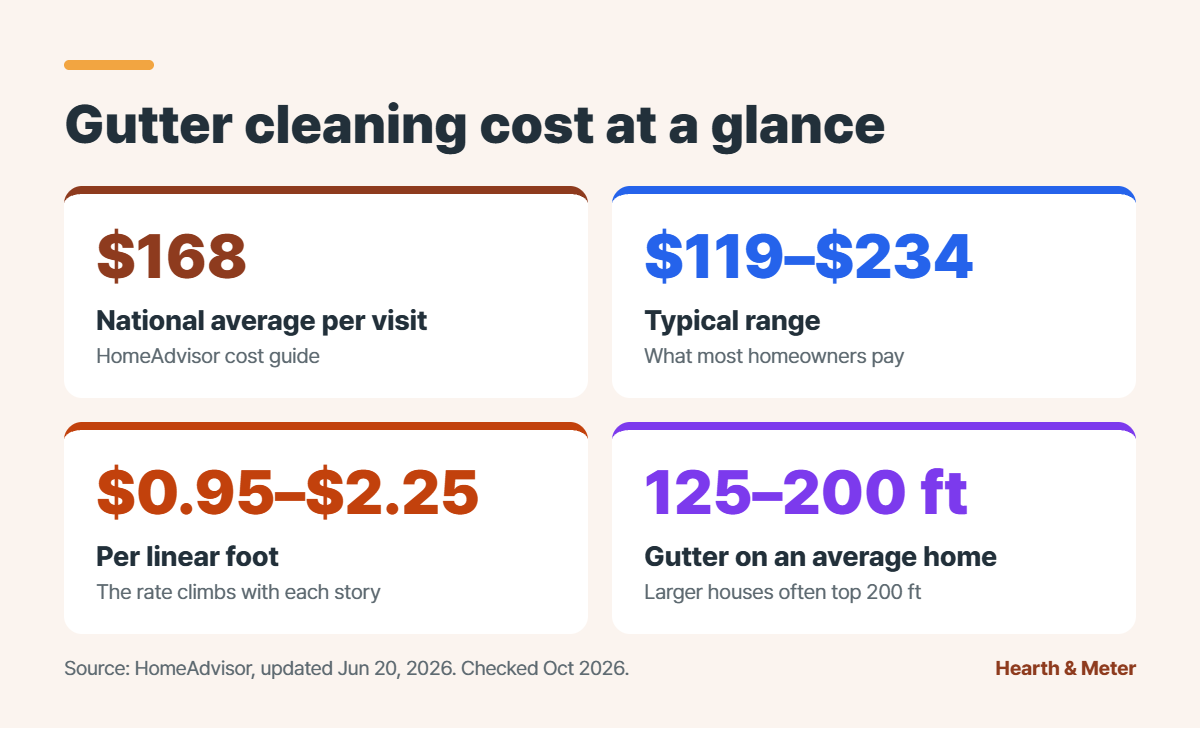
The average gutter cleaning cost in the US is $168 per visit, and most homeowners pay between $119 and $234, according to HomeAdvisor’s cost guide (updated June 20, 2026). Your quote can land well outside that range. A second story, a year of packed leaves, and clogged downspouts all push the number up, and late fall is when gutter crews are busiest.
This guide is for homeowners who want to know what a fair quote looks like before they call anyone. It prices one hypothetical two-story house (House A) line by line, then works through the two decisions that matter: what stays DIY and what goes to a pro, and whether guards pay for themselves. Prices come from the HomeAdvisor, This Old House, and Homewyse cost guides, checked in October 2026.
Gutter cleaning cost: what three price guides say
Published cost guides do not agree, and the gap is bigger than most people expect. We put three of them side by side, using the figures each page showed when we checked it in October 2026.
| Source (last updated) | Typical cost per visit | Per linear foot | Notes |
|---|---|---|---|
| HomeAdvisor (Jun 20, 2026) | $119 to $234, average $168 | $0.95 to $2.25 | Based on a survey of more than 30,000 customers |
| This Old House (Jun 17, 2026) | $100 to $450+, average about $275 | $0.95 to $1.25 (1 story) up to $1.25 to $2.25 (3 stories) | Says its figures come from 2026 Angi estimates |
| Homewyse (Jan 2026) | Not given as a per-visit total | $1.10 to $1.35, first floor only | Basic work, gutters no higher than 10 ft, repairs not included |
The per-foot rates line up fairly well. The per-visit averages do not, because each guide assumes a different typical house and a different mix of add-ons. That is why the most useful number is your own footage times a per-foot rate, which is how House A is priced next.
Gutter cleaning cost for a 2-story house: the House A example
House A is made up for this guide. It is a two-story home with 170 linear feet of gutter: 120 feet along the main eaves at second-story height and 50 feet over an attached one-story garage. It has five downspouts and a large oak in the side yard, and nobody has cleaned the gutters in about 18 months. That makes it a middle-of-the-road case, since HomeAdvisor puts the average home at 125 to 200 feet of gutter.
The quote starts with a tape measure, not a ladder. Walk each roof edge that has a gutter and pace or tape it at ground level, writing down which runs are at first-story height and which are higher. House A splits into the 50-foot garage run and the 120-foot main eaves.
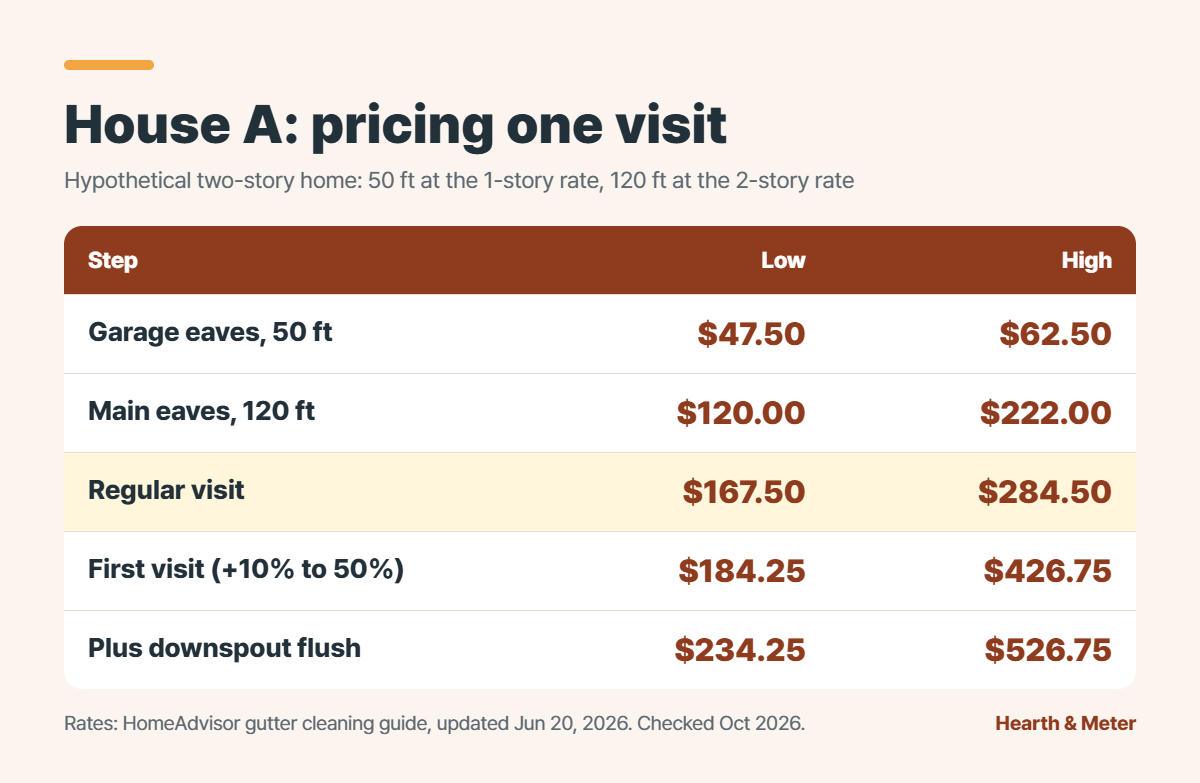
Each height gets its own rate. HomeAdvisor lists $0.95 to $1.25 per foot for one story and $1.00 to $1.85 for two. The garage run comes to $47.50 to $62.50 (50 × $0.95 and 50 × $1.25), and the main eaves come to $120.00 to $222.00 (120 × $1.00 and 120 × $1.85). Added together, a regular visit for House A should land around $167.50 to $284.50. If a company charges the two-story rate on every foot, the same house would be $170.00 to $314.50, so ask how they price mixed heights.
The first visit costs more. Skipped cleanings can raise the bill by 10% to 50% because of the extra debris, per HomeAdvisor, which moves House A’s first visit to $184.25 to $426.75. Downspout flushing, if it is not included, adds $50 to $100 (HomeAdvisor’s figure), and some crews skip the downspouts unless you ask. With it, House A’s first visit lands at $234.25 to $526.75.
Plan on the first year costing more than later years. HomeAdvisor recommends cleaning once or twice a year, in early spring and again in fall, and more often under heavy tree cover. If House A books one catch-up visit with a downspout flush and one regular visit, year one runs about $401.75 to $811.25. After that, two regular visits a year come to roughly $335 to $569.
To price your own gutters the same way as House A, and see how long guards would take to pay back, enter your measured runs below.
Gutter cleaning cost and guard payback calculator
Measure your gutter runs from the ground, split them by story, and enter the feet below. The calculator prices a regular visit, the first catch-up visit and the first year the same way House A is priced above, then works out how long gutter guards take to pay back.
How it works: a regular visit = one-story feet × $0.95 to $1.25 plus two-story feet × $1.00 to $1.85, the per-foot rates in HomeAdvisor’s gutter cleaning cost guide (updated June 20, 2026). Gutters skipped for over a year add 10% to 50% to the first visit and downspout flushing adds $50 to $100, both from the same guide. Year one = the first visit plus one regular visit; later years = two regular visits, since HomeAdvisor recommends cleaning once or twice a year. Guards: professional installation at $6 to $13 per linear foot (HomeAdvisor gutter guard guide, updated June 17, 2026). Homes with guards need cleaning about once a year instead of twice (This Old House), so the yearly saving is one regular visit. Payback years = guard cost ÷ one regular visit: fastest with cheap guards and expensive cleaning, slowest the other way. Figures checked October 2026; dollars rounded to the cent, payback to 0.1 year. Not covered: three-story or steep roofs, repairs, debris hauling, guard cleaning or removal fees, local price differences, and off-season discounts. These are national cost-guide ranges, not quotes; get three written quotes with the same scope. Hire an insured pro for anything above the first story. Estimate only.
Late-fall gutter checklist for your own house
- Measure your gutter runs from the ground and split them by story.
- Multiply by $0.95 to $1.25 per foot (one story) and $1.00 to $1.85 (two stories) for a ballpark.
- Add 10% to 50% if the gutters have not been cleaned in over a year.
- Budget $50 to $100 more if downspout flushing is not included.
- Confirm each downspout outlet sends water well away from the foundation.
- Ask for three quotes with the same scope written down.
- Run the guard payback math before saying yes to an upsell.
Decision one: what you can check yourself, and what goes to a pro
You can learn a lot without leaving the yard. This Old House lists the common warning signs: water spilling over the sides in a storm, gutters that sag or pull away from the fascia, plants growing in the trough, and pests nesting along the roofline.

Safety first: second-story gutters are ladder work at heights, and falls from portable ladders are one of the leading causes of work injuries and deaths, according to the OSHA Portable Ladder Safety QuickCard. OSHA’s basics include setting the ladder base 1 foot out for every 4 feet of height, extending it at least 3 feet above the point where it rests on the roof edge, keeping three points of contact, and keeping metal ladders away from power lines. For anything above the first story, hire an insured pro rather than climbing.
If you have an outdoor spigot near a downspout, this is also a good week to shut it off and drain it. Our fall checklist for preventing frozen pipes walks through that step.
When to book: drainage, ice dams, and leaf drop
Clean gutters only help if the water leaves the house. The ENERGY STAR Water Management Guidebook, written for builders of certified new homes, sets downspouts that end at least 5 feet from the foundation as the target on sites with expansive or collapsible soils, and it pictures a downspout ending right at the wall as the thing to avoid. The EPA’s Soak Up the Rain page suggests sending downspout water to a lawn, garden, or rain barrel instead of a driveway, and warns that disconnecting a downspout is not right for every lot, so check local rules first.
Ice dams are a separate problem that clogged gutters can make worse. The ENERGY STAR do-it-yourself sealing guide lists a history of winter ice dams as a sign of serious air leaks and a reason to call a contractor, because warm attic air melts roof snow that refreezes at the edge. Clearing the gutters gives meltwater somewhere to go, but the lasting fix is in the attic. Our guide on how to seal air leaks in your home covers that side.
On timing, the sources pull in two directions. This Old House calls autumn the peak season for gutter cleaning, and HomeAdvisor says booking in the off-season (early winter or summer) can save 10% to 50%. A practical middle path for wooded lots: book now for a date after most of your trees have dropped their leaves, since a cleaning done before the oak lets go may need repeating.
What to ask before you book a gutter cleaning
Get at least three quotes, as HomeAdvisor suggests. They are only comparable if each company answers the same questions, so read these out on every call:
- What is your per-foot rate for each story, and how do you price a house with mixed heights?
- Is downspout flushing included, or is it an add-on?
- Do you bag and haul away the debris, or leave it in the yard?
- Will you charge extra for heavy buildup, and how do you decide that before starting?
- Can you send photos of anything loose, sagging, or leaking, with a separate written price for repairs?
- Can you show proof of liability insurance?
- If you offer guards, which debris are they rated to block, and do they need to come off for cleaning?
Gutters come late in our winter home maintenance checklist on purpose: the step waits until most leaves are down, after the tune-up, alarms and freeze prep.
Decision two: gutter guards or twice-a-year cleaning?
Guards are the usual upsell on a cleaning call, so it helps to run the numbers before the conversation. HomeAdvisor’s gutter guard guide (updated June 17, 2026) puts professional installation at $6 to $13 per linear foot. For House A’s 170 feet, that is $1,020 to $2,210.
Guards cut down on cleaning without ending it. This Old House says homes with guards need cleaning about once a year instead of twice. For House A, then, the saving is one regular visit per year, or $167.50 to $284.50. Divide the install price by that saving and the payback runs from about 3.6 years (cheap guards, expensive cleaning) to about 13.2 years (pricey guards, cheap cleaning).
Rule of thumb from the House A math: guards pay back fastest when your cleaning quotes sit at the high end and the guard quote sits at the low end. If both quotes are average, expect a payback measured in many years, so weigh fall safety and convenience as part of the decision.
The payback can stretch further in practice. HomeAdvisor notes that grit and shingle granules still slip past guards and pile up, and its guard guide says some styles struggle with pine needles or let small debris through. Ask the installer which debris the product is built to block, and ask your cleaning company whether the guards have to come off during a visit and what that costs.
If the guard math leaves you undecided, let the cleaning quotes settle it. Measure your runs at each height this weekend, multiply by the per-foot rates above, and compare that yearly cleaning figure with a written guard quote for the same footage. A short payback points to guards; a long one points to booking the cleanings.
This article is general information, not professional advice. Hire licensed and insured contractors for roof, gutter, gas, electrical, and HVAC work, and check local codes and permit rules. Prices vary by region and change over time; confirm them with written local quotes.
Leave a Reply