
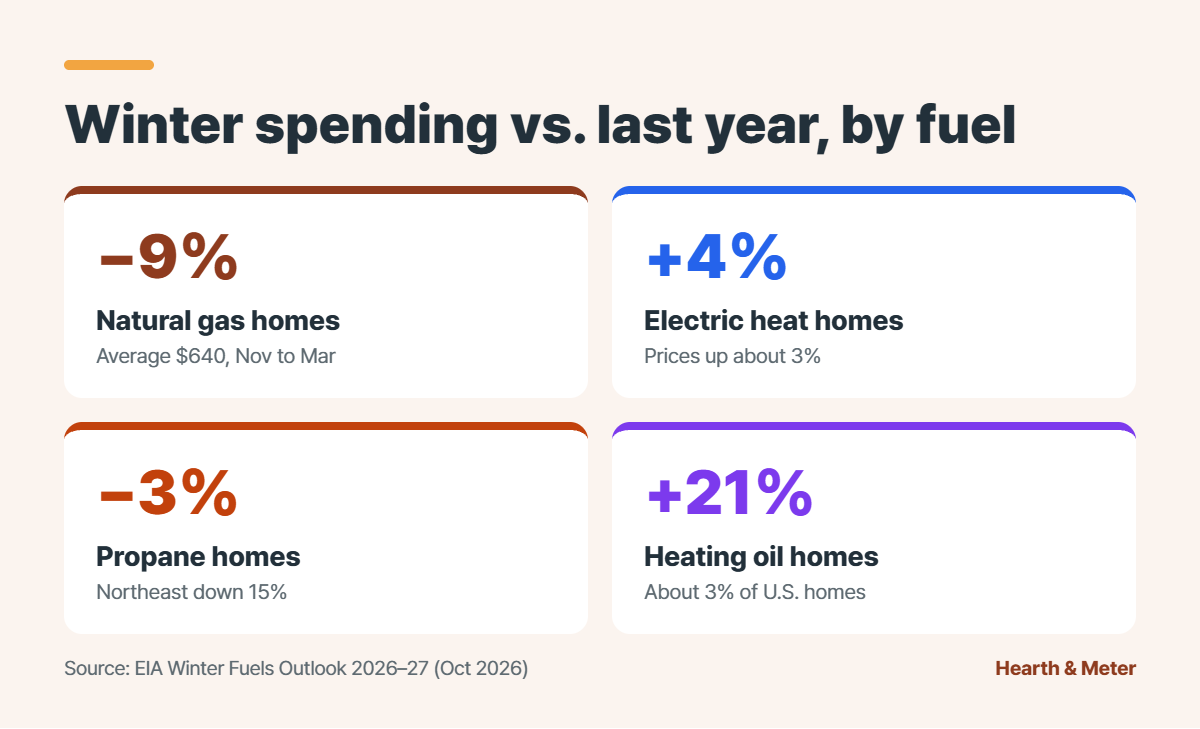
Heating oil homes are looking at about 21% higher spending this winter, while natural gas homes should spend about 9% less. That spread, from the same federal forecast, is why the first question about your 2026–27 heating bill is simply which fuel heats your home.
The U.S. Energy Information Administration’s Winter Fuels Outlook 2026–27, released October 6 and checked here in October 2026, expects natural gas and propane homes to spend less than last winter, electric-heat homes to spend a little more, and heating oil homes to take the biggest hit.
This page lines the fuels up side by side first, then the natural gas regions, then turns the forecast into an estimate for your own house and the cheapest ways to shrink it. If you are not sure which fuel you use, look at your furnace or boiler nameplate, or check which utility bill jumps in January.
Winter heating bills by fuel: the 2026–27 forecast
| Main heating fuel | Share of U.S. homes | Expected change vs. last winter |
|---|---|---|
| Natural gas | Most common fuel | 9% lower spending |
| Electricity | More than 40% | 4% higher bills (prices up about 3%) |
| Propane | Smaller share, mostly rural | 3% lower nationally, 15% lower in the Northeast |
| Heating oil | About 3%, mostly Northeast | 21% higher spending |
Natural gas and propane households together make up about half of U.S. homes, and EIA expects both to pay less, mainly because fuel prices are lower. EIA’s press release says natural gas inventories should enter the season about 2% above the five-year average, which helps keep prices down.
Heating oil is the outlier. EIA says heating oil prices are up more than 30% from last winter. A milder forecast for the Northeast is the only reason spending is expected to rise by 21% instead of more.
EIA’s forecast assumes national temperatures close to last winter and the 10-winter average. A colder winter than forecast raises every one of these numbers, so treat them as a baseline, not a ceiling.
Natural gas by region: prices, weather, and spending
For homes heating mainly with natural gas, EIA estimates average spending from November through March at $640 nationally, 9% lower than last winter. The regional picture is uneven:
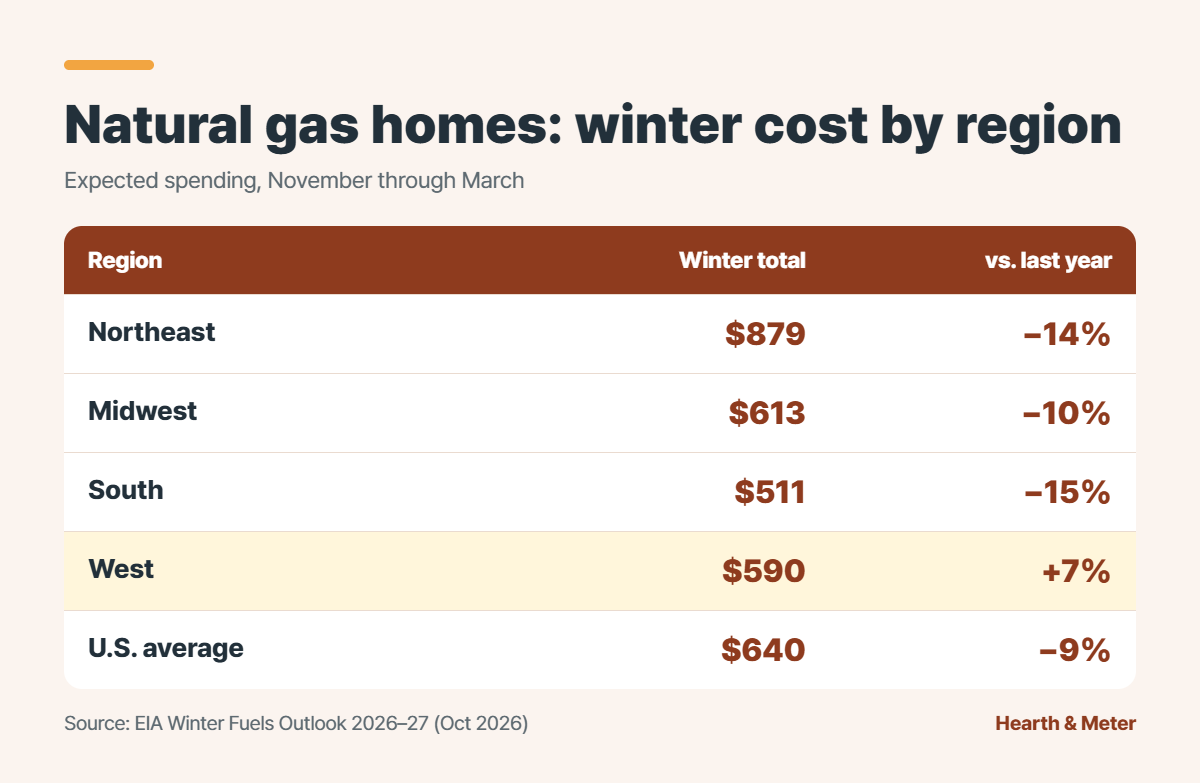
The West is the only region heading the other way. Prices there are lower too, but EIA expects a colder winter than last year, and the extra gas burned outweighs the price drop. The price and weather assumptions behind those regional numbers look like this: A drafty 3,000 sq ft house in Minneapolis and a tight townhouse in Atlanta will land far apart.
| Region | Average winter residential gas price (per thousand cubic feet) | Change in price | Weather vs. last winter |
|---|---|---|---|
| Northeast | About $16.12 | Down 5% | Milder |
| Midwest | About $10.38 | Down 8% | Close to last year |
| South | About $14.13 | Down 16% | Close to last year |
| West | About $15.10 | Down 8% | Colder |
Remember these are averages. A drafty 3,000 sq ft house in Minneapolis and a tight townhouse in Atlanta will land far apart.
Turn the forecast into your own estimate
National averages hide a lot. A better estimate starts from your own usage, because it already reflects your house, your thermostat habits, and your local weather.
Start with last winter’s usage. Add up the therms or hundred cubic feet (gas), gallons (oil or propane), or kWh (electric) on your November through March bills. Many utilities show a 12-month history in the online account.
Then apply EIA’s price change for your fuel and region from the tables above. A Midwest gas customer, for example, would start from an average price about 8% lower than last winter. Finally, adjust for weather: if your area is forecast to be colder than last winter, usage goes up. EIA expects a colder West and a milder Northeast, with the Midwest and South close to last year.
The result will not match your bill to the dollar, since fixed monthly charges and local rates differ, but it tells you whether to plan for a bigger or smaller January than last year.
For electric-heat homes, one quick way to see what those fixed charges add is to divide a bill’s total by its kilowatt-hours; our electric bill walkthrough shows how the customer charge, delivery lines and riders turn into one all-in price per kWh.
What each bill-cutting move costs and saves
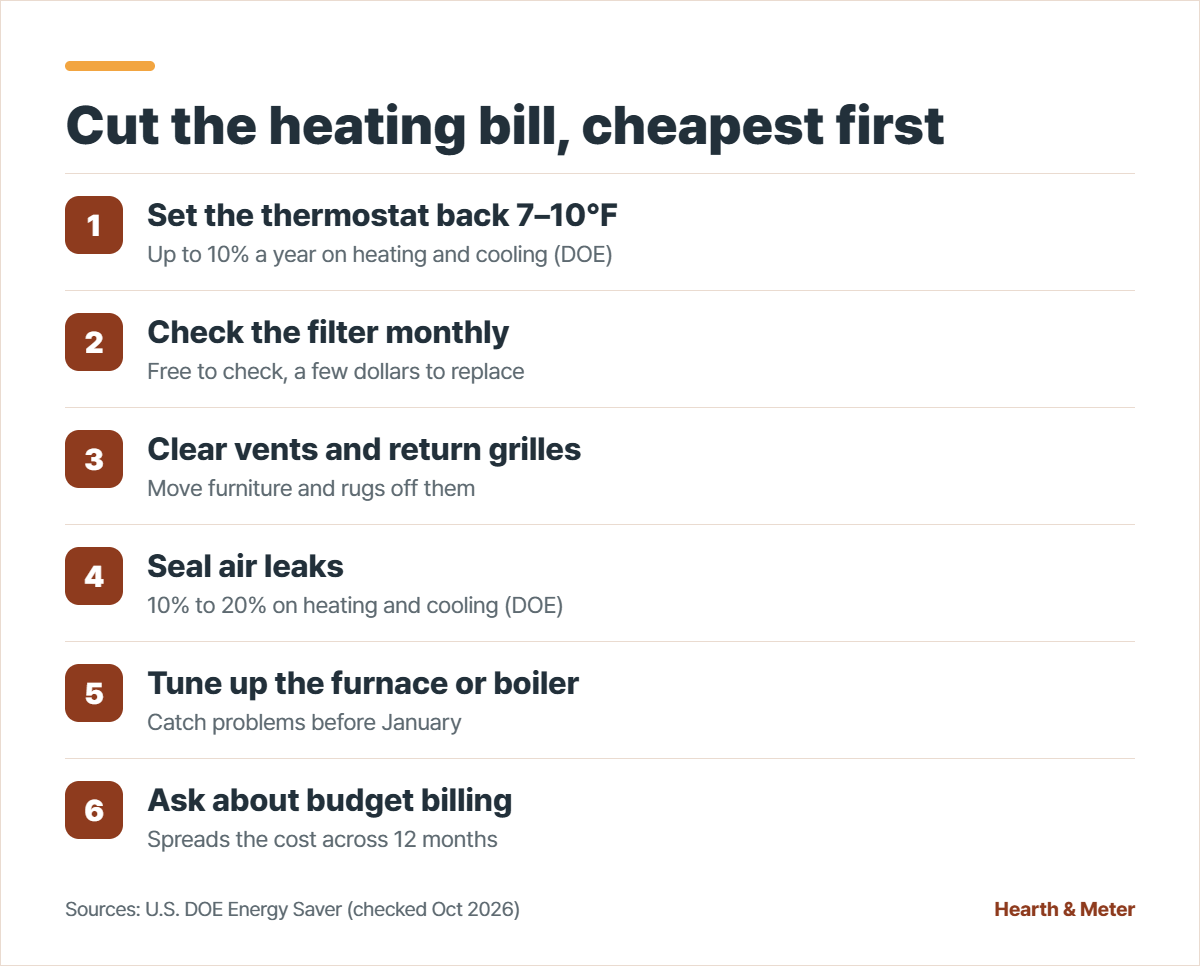
Fuel prices are out of your control. How much fuel your home burns is not. The four tiers below compare the moves with the best payback, from free to the big projects.
Free: set the thermostat back
The Department of Energy says you can save as much as 10% a year on heating and cooling by turning the thermostat back 7 to 10°F for 8 hours a day, such as overnight or while everyone is at work. The myth that a furnace burns extra fuel catching up is wrong: a cooler house loses heat more slowly, so the setback saves energy.
One exception: heat pumps. DOE’s Energy Saver guide says not to set back a heat pump without a smart or programmable thermostat designed for heat pumps. A large manual setback can push the system onto its backup electric heat during recovery, which eats into the savings.
Under $50: change the filter and clear the vents
A clogged filter makes the blower work harder and moves less heat. Check it monthly through the winter. Pull furniture and rugs off supply vents and return grilles so warm air can circulate.
Under $200: seal the air leaks
DOE’s Energy Saver guide puts sealing uncontrolled air leaks at 10% to 20% savings on heating and cooling bills. Start where leaks are largest: the attic hatch, plumbing and wiring holes into the attic, gaps around the chimney, and the rim joist in the basement. Weatherstrip doors that let in daylight. Our guide to sealing air leaks in your home covers how to find the leaks, which material fits each gap, and the safety checks to do first.
Bigger projects: insulation and equipment
The same DOE guide says new efficient heating equipment alone can cut energy use by 20% or more, and combining it with insulation, air sealing, and good thermostat settings can cut heating and cooling bills by about 30%. Those are spring and summer projects. For this winter, a furnace or boiler tune-up is the equipment step worth doing now.
If your system is near the end of its life and you are pricing a replacement, our heat pump vs gas furnace running-cost comparison uses EIA price data to show which one costs less to run in each state.
Heating bill checklist for November
- Confirm your main heating fuel
- Set a 7 to 10°F overnight or daytime setback (gentler with a heat pump)
- Check the furnace filter monthly
- Clear supply vents and return grilles
- Seal the attic hatch and obvious drafts before December
- Book the heating tune-up if it has been over a year
- Call the utility about budget billing if winter bills strain the budget
If the bill is more than you can pay
- Ask your utility about budget billing. Many utilities offer a plan that spreads the year’s cost into equal monthly payments, so January does not arrive all at once.
- Ask about a payment arrangement before you fall behind. Utilities generally have more options for customers who call early.
- Apply for LIHEAP. The federally funded Low Income Home Energy Assistance Program helps eligible households with heating bills and energy crises. DOE’s guide lists the National Energy Assistance Referral line, 1-866-674-6327, to find your local office.
- Check weatherization help. The Weatherization Assistance Program pays for efficiency work in eligible low-income homes, and states set their own criteria.
To see where these bill-cutting jobs fit in the season, our winter home maintenance checklist puts them in order from the October tune-up through March.
Related guides: our furnace tune-up checklist covers what a heating service visit should include. If you plan deep setbacks while you travel, read how to prevent frozen pipes first, since a cold house is where pipes split.
Keep last January’s bill where you can find it. Write down its usage in therms, gallons, or kWh, and set it next to this January’s bill when it arrives. Comparing usage instead of dollars shows whether your changes worked, whatever prices did.
This article is general information based on EIA’s October 2026 forecast, which can change with weather and markets. It is not financial or professional advice. Program eligibility for LIHEAP and weatherization varies by state; confirm details with your state agency or utility.
Leave a Reply