
For most US homes, the answer to “how much attic insulation do I need” is R-49 to R-60, roughly 14 to 20 inches of loose fill, per ENERGY STAR. Only the warmest zone gets by with R-30.
That range is for an attic with nothing in it. Most older houses already have a few inches, so the real question is how much to add on top, and the answer depends on your climate zone and what is already lying between the joists. The sections below walk through measuring it, converting R-value into inches, and pricing the job.
Targets come from ENERGY STAR’s retrofit table and cost ranges from HomeGuide’s January 13, 2026 guide; both were rechecked on October 27, 2026.
How much attic insulation do I need in my climate zone?
ENERGY STAR publishes recommended R-values for existing wood-framed homes, based on the 2021 International Energy Conservation Code. The page splits the attic column in two: one target for an attic that has no insulation, and a lower add-on target for an attic that already holds 3 to 4 inches.
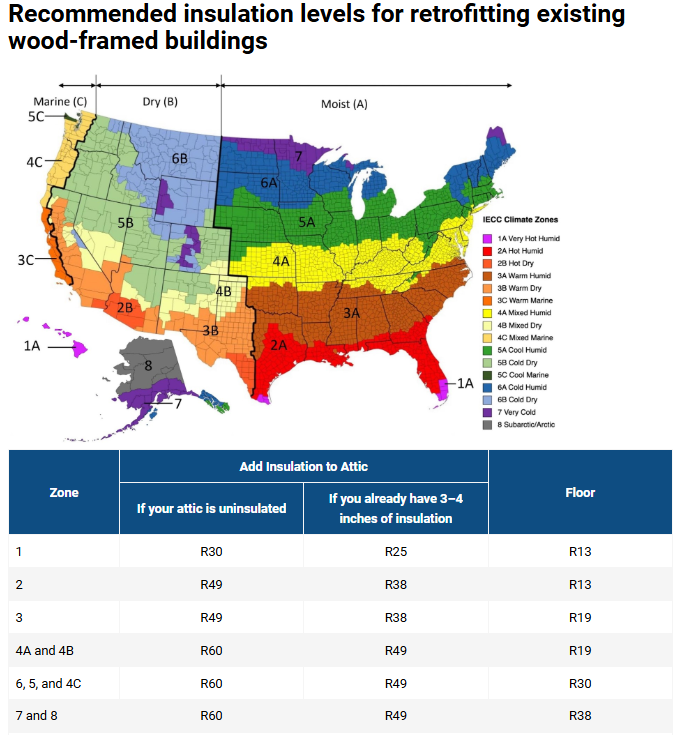
Read it like this. Zone 1 (southern Florida, Hawaii) tops out at R-30 for an empty attic. Zones 2 and 3, which cover most of the Gulf Coast and the South, call for R-49 empty or R-38 added to existing insulation. Zones 4 through 8, from the Mid-Atlantic to the northern tier and Alaska, call for R-60 empty or R-49 added. Find your county’s color on the map first, because state lines do not follow the zone boundaries.
How do you check what is already up there?
The attic check guide from ENERGY STAR asks for a flashlight, a ruler or tape measure, and a phone for a photo. There is no need to crawl in when the insulation is visible and reachable from the hatch. A few things to look at while the hatch is open:
- The joists. If the insulation sits level with or below the tops of the floor joists, you can see the wood, and you probably need more.
- The depth. Push the ruler straight down to the drywall and read it. Fiberglass, cellulose and mineral wool all run about R-3 to R-3.5 per inch, so ENERGY STAR suggests multiplying inches by 3 for a rough current R-value.
- The edges. Some attics have plenty in the middle and very little along the eaves, a pattern the ENERGY STAR adding attic insulation page calls out. Measure in two or three spots.
- The material. Pebble-like gray-brown or silver-gold granules are vermiculite. Stop there and read the safety note further down before anyone touches it.
Cathedral ceilings are the exception. With no attic space, the insulation sits against the roof deck behind drywall, and ENERGY STAR says to have an energy auditor or insulation contractor check it.
How many inches is R-38, R-49 or R-60?
Divide the target R-value by the material’s R-value per inch. The catch is that published per-inch figures disagree. HomeGuide’s cost guide lists 2.2 to 2.9 per inch for fiberglass, lower than ENERGY STAR’s rough 3 to 3.5, mostly because blown fiberglass is fluffier than batts. Here is what each set of numbers works out to:
| Material (R per inch) | R-38 | R-49 | R-60 |
|---|---|---|---|
| ENERGY STAR rule of thumb (3.0–3.5) | 11–13 in | 14–16 in | 17–20 in |
| Cellulose (3.1–3.8) | 10–12 in | 13–16 in | 16–19 in |
| Fiberglass (2.2–2.9) | 13–17 in | 17–22 in | 21–27 in |
| Mineral wool (3.2–4.1) | 9–12 in | 12–15 in | 15–19 in |
Per-inch ranges from ENERGY STAR and HomeGuide; inches calculated by Hearth & Meter and rounded. Treat them as planning numbers. The figure that counts is printed on the bag: federal rules make loose-fill makers publish a coverage chart showing the thickness and number of bags per 1,000 sq ft at set levels from R-13 up to R-49.
Can new insulation go on top of the old?
Yes, in most cases. ENERGY STAR says the new layer does not have to match the old type: loose fill can go over batts, and batts can go over loose fill. Fiberglass batts laid over existing insulation should be unfaced, with no paper or foil backing, so you do not trap a vapor layer in the middle of the pile.
Two cases where adding is the wrong move. Insulation that is wet, moldy, or soiled by pests usually comes out first, and HomeGuide puts removal at $1 to $2 per sq ft. And compressing batts to fit under a floored storage area lowers their R-value, so a floored attic often needs a different plan than simply piling on more.
What should be fixed before anyone adds insulation?
Several problems belong to a professional before any insulation goes in, according to the ENERGY STAR attic upgrade page: wet or damp insulation from a roof leak, moldy or rotted rafters, kitchen, bath or dryer vents that dump moist air into the attic instead of outdoors, little or no attic ventilation, and knob-and-tube wiring. Air sealing comes before insulation too. Insulation slows heat but does not stop air, and the gaps around plumbing stacks, wiring holes and the top plates of walls are cheaper to seal while they are still visible. Our guide on sealing air leaks before winter covers which of those jobs a homeowner can take on.
Safety first. If you find vermiculite, the EPA says to assume it contains asbestos, leave it undisturbed, keep stored items and children out of that attic, and hire a trained asbestos professional if the work would disturb it. Knob-and-tube wiring needs a licensed electrician’s evaluation before anything covers it. Insulation work near chimneys, flues and recessed lights also needs clearance, which is part of what you pay an installer for.
What does adding attic insulation cost in 2026?
HomeGuide’s attic insulation cost guide, updated January 13, 2026, puts professionally added insulation at $1 to $4 per sq ft, with an average full job of $1,000 to $2,700. Blown-in runs $0.90 to $2.40 per sq ft. The same guide lists the add-ons that change a quote:
Air sealing the attic floor runs $350 to $3,000. Baffles at the soffit vents, which keep blown insulation from choking the airflow, are $2 to $3 each. Removing old insulation adds $1 to $2 per sq ft, and asbestos testing alone is $250 to $850. Some companies also set a $1,500 to $2,000 minimum, so a small top-up can cost more per square foot than a full job.
What does the math look like for a real attic?
Take two hypothetical houses. Home A sits in zone 5 with a 1,200 sq ft attic floor and 4 inches of old fiberglass, about R-12 by the depth-times-3 rule. ENERGY STAR’s add-on target there is R-49. With cellulose at R-3.1 to 3.8 per inch, that means roughly 13 to 16 more inches, and at $1 to $4 per sq ft the job lands between $1,200 and $4,800 before any air sealing.
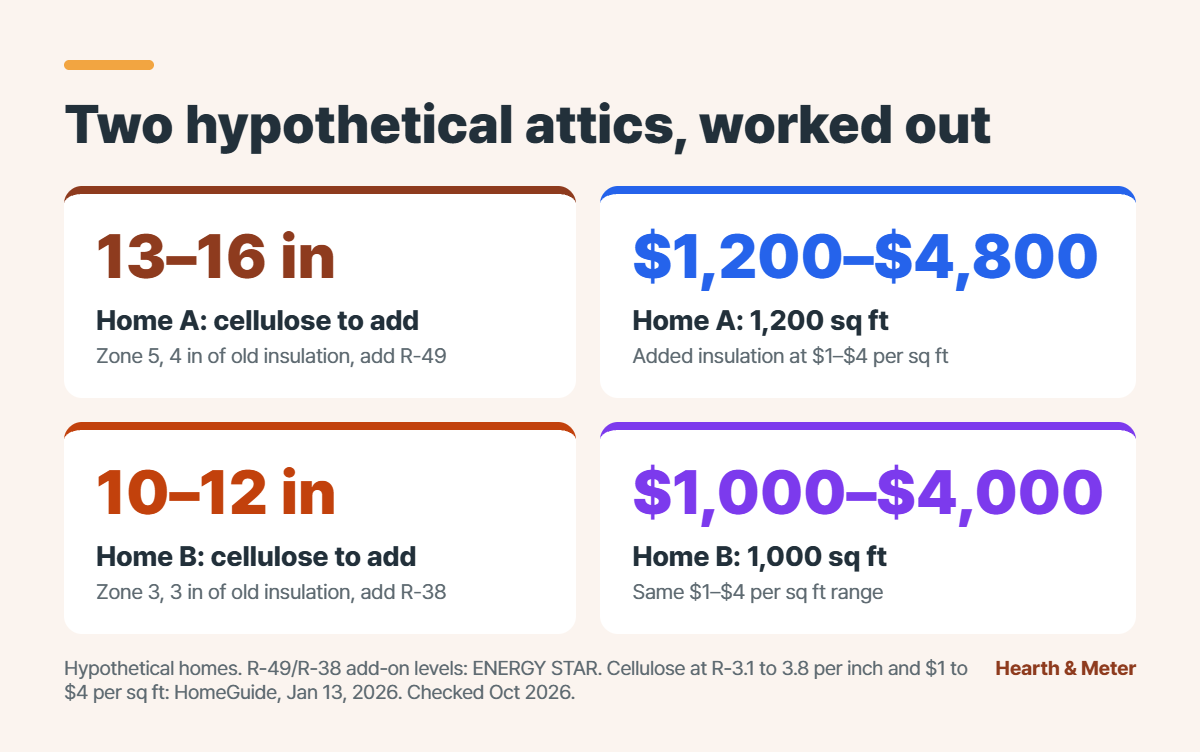
Home B is in zone 3 with 1,000 sq ft and 3 inches already down. Its add-on target is R-38, which is about 10 to 12 inches of cellulose and $1,000 to $4,000 at the same per-foot range. The spread in both quotes comes from access, the amount of air sealing, and whether old material has to come out first.
Is it worth it, and is there still a tax credit?
ENERGY STAR estimates that sealing air leaks and adding insulation can save up to 10% on annual energy bills. In dollars, a household spending $2,400 a year on energy would save up to about $240. Set against a $1,200 to $4,800 job, that ceiling implies a simple payback of 5 to 20 years, so cheaper quotes and colder climates make the strongest case. Comfort counts too: fewer cold ceilings and a furnace that cycles less often. To see your own cost per kilowatt-hour before running the numbers, our line-by-line electric bill guide shows where to find it.
The federal tax credit is a different story. As of October 27, 2026, ENERGY STAR’s attic page says the residential energy efficiency credit, which covered 30% of insulation cost up to $1,200, applied through December 31, 2025. Utility and state rebates are separate and still exist in some areas. Search your ZIP code in the ENERGY STAR Rebate Finder before you sign a contract.
What should you do before the first cold snap?
Open the hatch this week and measure. Write down the depth in two or three spots, take a photo, and note whether you can see the joists. Then find your zone on the ENERGY STAR map and compare. A shortfall of more than 4 to 6 inches is the point where the ENERGY STAR attic guide says adding more makes sense.
When quotes come in, ask each installer to state the R-value, the installed and settled thickness, and the bag count. Under the FTC’s home insulation rule, the receipt for loose fill must list coverage area, initial installed thickness, minimum settled thickness, R-value and the number of bags, so you can check the bag count against the coverage chart printed on the bag. If attic work is one item on a longer list, our winter home maintenance checklist puts it in order with the rest.
This article is general information, not professional advice. Hire licensed contractors for electrical, roofing, HVAC and gas-appliance work, use a trained asbestos professional for suspected vermiculite, and check local codes and permit rules before insulation work.
Leave a Reply