
How much water does a shower use in a real house? Picture three people sharing one house, each taking an eight-minute shower every morning under an older showerhead that pours 2.5 gallons a minute. That routine sends about 21,840 gallons a year through the shower, and roughly two thirds of it has already passed through the water heater. Swapping the head for a 1.8 gpm model would cut about $226 a year off the combined water, sewer and electric bills in that house at national average prices, or about $156 if the water heater burns natural gas. The math behind those figures is below, and you can run it with your own showerhead.
The short answer: the average U.S. shower lasts 7.8 minutes, according to the Water Research Foundation’s 2016 Residential End Uses of Water study, and EPA’s WaterSense program puts the average showerhead at 2.1 gallons per minute, so a typical shower uses a little over 16 gallons. Your own number is your showerhead’s flow rate times your minutes, so a 2.5 gpm head running for 10 minutes uses 25 gallons and a 1.8 gpm head uses 18.
How much water does a shower use per minute?
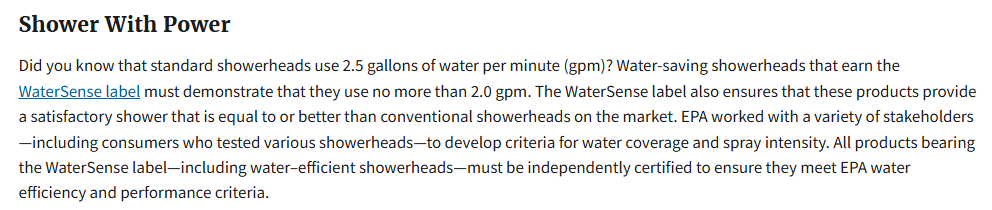
The flow rate printed on the showerhead, in gallons per minute (gpm), is a maximum measured in a lab. Federal rules in 10 CFR 430.32(p) cap any showerhead made after January 1, 1994 at 2.5 gpm when tested at a flowing pressure of 80 psi. Heads that earn EPA’s WaterSense label must use no more than 2.0 gpm and pass spray force and coverage tests. California is stricter: under Title 20, section 1605.3, showerheads manufactured on or after July 1, 2018 may not exceed 1.8 gpm at 80 psi, and a multi-nozzle head’s total flow counts against that limit.
Older fixtures are a different story. In a 2015 staff report, the California Energy Commission noted that showerheads ran 5 to 8 gpm before the state set its first limit in 1978. If your bathroom has never been remodeled and the head looks original to a house built in the 1970s, a ten-minute shower there could use 50 gallons or more.
Why the stamp and your shower can disagree
The rating assumes 80 psi of flowing pressure. Lower pressure at your tap usually means less flow than the stamp, and mineral buildup in the nozzles cuts it further. WaterSense heads are also tested for pressure compensation, meaning they have to hold a minimum flow across a range of household pressures. A head with no marking at all tells you nothing, so measuring is the only way to know.
Measure your showerhead in six seconds
EPA’s WaterSense program gives a kitchen-bowl version of a flow test in its “Showering Better” worksheet: hold a large bowl directly under the spray for six seconds, then multiply the amount you caught by 10 to get gallons per minute. If the result is more than 2 gallons, EPA says a WaterSense labeled head would save water. A measuring cup makes the conversion easy because a gallon is 16 cups.
- Turn the shower on at the setting you normally use, full hot and cold mix included, and let it run a few seconds to settle.
- Hold the bowl or a bucket under the whole spray pattern for six seconds by a phone timer.
- Pour the catch into a measuring cup. Four cups is a quarter gallon, which times 10 is 2.5 gpm. Three cups works out to about 1.9 gpm, and 2.9 cups to about 1.8 gpm.
Do it twice and average the two. If a hand shower and a fixed head share the valve, test each one, since the one you actually stand under is the one that sets your bill.
What one shower costs: water, sewer and the hot part
A shower is billed three ways at once. You pay for the water coming in, you usually pay a sewer charge on the same gallons going out, and you pay for the energy that heated the hot share. EPA’s WaterSense data page puts all three inputs in one place, and the figures below were checked there on Oct 26, 2026.
Water and sewer
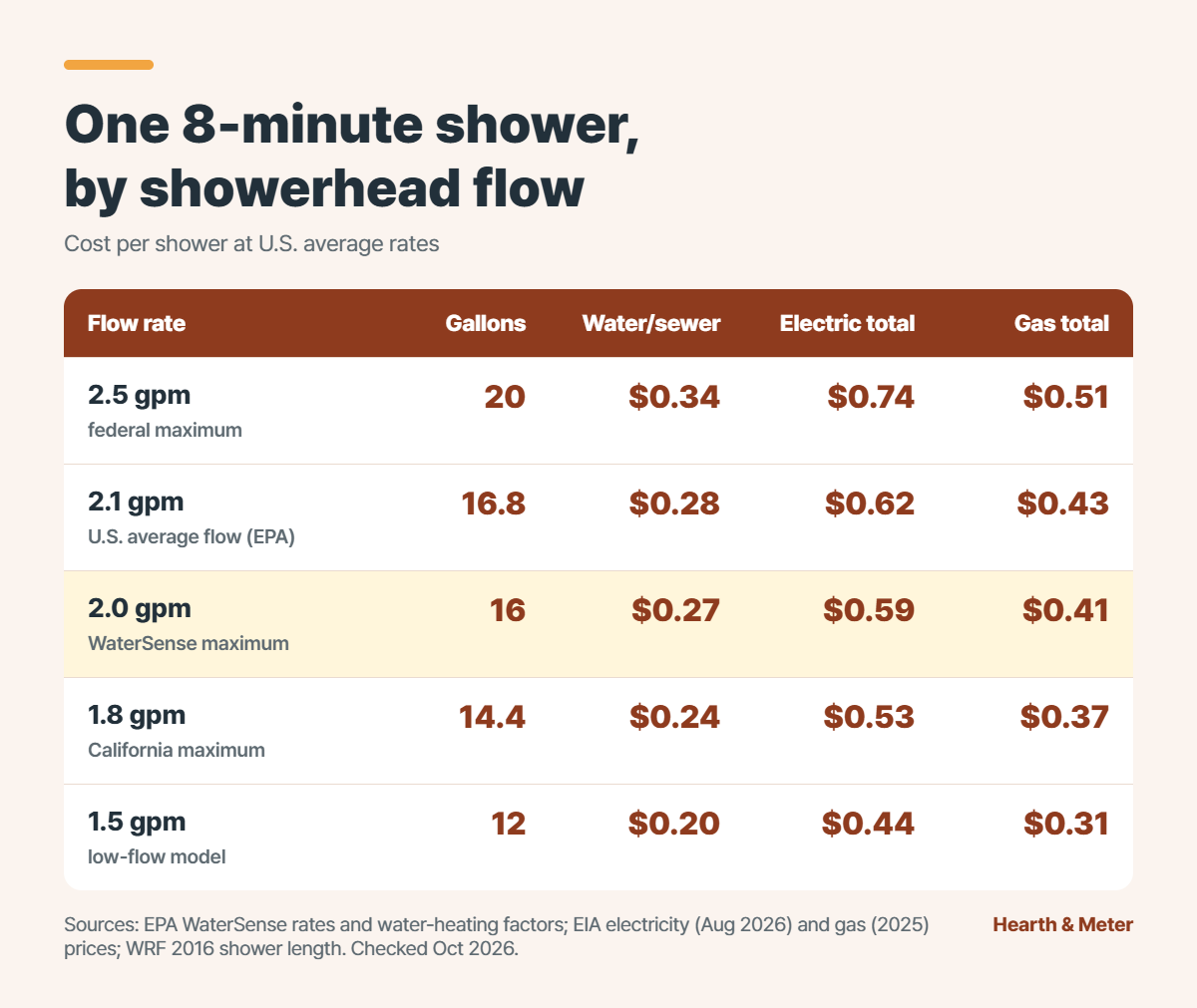
WaterSense’s 2024 estimate of the average U.S. residential rate is $7.74 per 1,000 gallons for water plus $9.09 for wastewater, or $16.83 combined. That works out to about 1.7 cents per gallon, so the average 16.4-gallon shower (7.8 minutes at 2.1 gpm) costs about 28 cents in water and sewer charges. Your utility may bill in hundred cubic feet (ccf) instead of gallons; one ccf is 748 gallons, and our guide to reading a water meter when the bill jumps walks through converting your own rate.
Heating the hot share
On the same page, EPA uses a weighted national average of 67.3% for the share of shower water that is hot, with an average rise of 63.5°F at the water heater. It estimates that heating one gallon takes 0.16452 kWh in an electric heater or 0.00084 thousand cubic feet (Mcf) of natural gas in a gas heater, based on fleet-average efficiency. EPA also counts 47.4% of homes as having electric water heaters and 52.6% as gas.
For prices, EIA’s Electric Power Monthly lists an average U.S. residential electricity price of 18.16 cents per kWh for August 2026, and EIA’s natural gas price table shows a 2025 average residential gas price of $15.34 per Mcf. Run that 16.4-gallon shower through those numbers and you get about 11 gallons of hot water. That’s 1.81 kWh, or about 33 cents, with an electric heater, and about 14 cents with gas. Add the water and sewer charge and one average shower comes to roughly 61 cents with electric water heating and 42 cents with gas.
Homes in colder regions pay more per gallon of hot water than the national average suggests. EPA’s regional figures show average inlet water temperatures from 47.7°F to 73.9°F, so the heater does more work where the incoming water is colder, and a larger share of the shower mix comes from the hot side.
A worked example: three people and a 2.5 gpm head
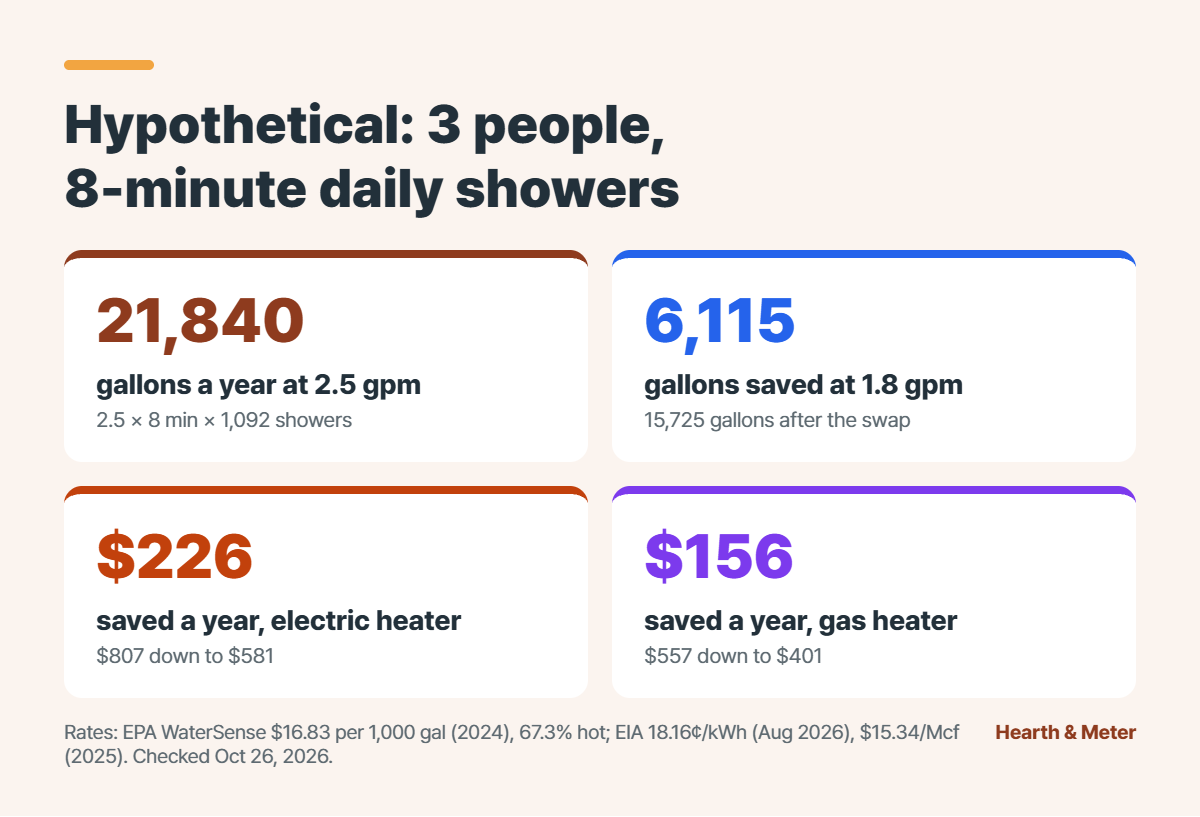
This is a hypothetical household, not a measured one. Three people each shower once a day for eight minutes, which is 21 showers a week or 1,092 a year over 52 weeks. The bowl test caught four cups in six seconds, so the head runs at 2.5 gpm. The rates are the national averages above.
- Water used: 2.5 gpm × 8 minutes × 1,092 showers = 21,840 gallons a year.
- Water and sewer: 21,840 × $16.83 per 1,000 gallons = about $368.
- Hot share: 21,840 × 67.3% = about 14,698 gallons heated.
- Electric water heater: 14,698 × 0.16452 = 2,418 kWh × $0.1816 = about $439. Total with water and sewer: $807 a year.
- Gas water heater instead: 14,698 × 0.00084 = 12.35 Mcf × $15.34 = about $189. Total: $557 a year.
Now replace the head with a 1.8 gpm model and keep everything else the same. Use drops to 15,725 gallons, water and sewer to about $265, and heating to about $316 with electricity or $136 with gas. The household saves about 6,115 gallons a year, worth about $226 with an electric heater ($103 water and sewer plus $123 energy) or about $156 with gas ($103 plus $53). A 2.0 gpm WaterSense head at the federal label limit would save less, about $162 a year with electric water heating by the same math.
If you want to try your own numbers, the calculator below uses the same EPA and EIA inputs. It returns exactly the figures above when you enter 2.5 gpm, 8 minutes, 21 showers a week and an electric water heater.
Shower water and energy cost calculator
Use the flow rate from your six-second bowl test and your household’s total showers per week. Prices are U.S. averages, so your bill can differ.
How it works: gallons a year = gpm × minutes × showers per week × 52. Water and sewer = gallons × $16.83 per 1,000 gallons (EPA WaterSense 2024 national residential estimate). Hot water = 67.3% of shower water (EPA weighted national average). Energy per hot gallon = 0.16452 kWh (electric) or 0.00084 Mcf (gas), from EPA’s WaterSense data page. Prices from EIA: electricity 18.16 cents per kWh (U.S. residential, August 2026), natural gas $15.34 per Mcf (U.S. residential, 2025 average). Basis as of Oct 26, 2026. Gallons, kWh and dollars are rounded to whole numbers (Mcf to 0.01), totals add the rounded dollars, and savings subtract rounded totals. Not covered: fixed monthly utility fees, tiered or seasonal rates, heat pump or tankless water heaters, propane, regional water temperatures, and water wasted while waiting for hot water. Estimate only.
Shorter showers or a lower-flow head?
Both work, and the arithmetic shows which one moves more. In the example household, cutting every shower from eight minutes to seven at 2.5 gpm saves 2,730 gallons and about $101 a year with electric water heating. The 1.8 gpm head saves more than twice that volume without anyone changing a habit. The usual worry about low-flow heads is that people will stand under them longer. In the WRF study, average shower length held steady at 7.8 minutes between the 1999 and 2016 surveys while the average flow rate fell by 0.1 gpm, so in that data the lower flow did not show up as longer showers.
Six seconds in a bowl, times 10, gives you gallons per minute. Gallons per minute times your minutes is the whole shower.
The savings land on two bills. The water and sewer part shows up on your water bill, while the larger share in an electric-heated home shows up on the electric bill as fewer kWh. If you track your bills, the line-by-line method in how to read your electric bill shows where a drop of about 56 kWh a month would appear. EPA’s own figure for an average family switching to WaterSense heads is 2,700 gallons and more than 330 kWh a year, smaller than our example because the average family uses less than three daily eight-minute showers at 2.5 gpm.
If your water heater is near the end of its life anyway, our guide on how long a water heater lasts covers the age and repair-cost signals worth checking before a replacement quote.
What to check before you swap the showerhead
- The label. A WaterSense label means the head was independently certified at 2.0 gpm or less with spray force and coverage tests. EPA’s WaterSense product search lists labeled models with their flow rates.
- Rebates. Some utilities offer rebates or free vouchers for labeled heads; EPA’s rebate finder searches by ZIP code.
- The flow restrictor. Federal rules require the restricting insert to be mechanically retained so it takes at least 8 pounds of force to remove. Drilling it out puts you back above the rating and erases the savings.
- The washer. EPA suggests checking and replacing the washer or O-ring inside the head when you swap it, since a worn one leaks at the arm.
- Renters. In a rental the showerhead usually belongs to the landlord, so ask before changing it and keep the old head to put back.
Unscrewing a head from the shower arm is a simple job, but a drip that continues with the handle off, or water showing up behind the wall, points to the valve or supply piping. Those are jobs for a licensed plumber, and the meter test in our water bill guide will tell you whether something is still running when every fixture is off.
Toilets are the other usual suspect when the meter keeps moving with every tap off. Our running toilet guide covers the two free tank tests and what a silent flapper leak costs in a month.
Tonight, before anyone showers, run the six-second bowl test and write the cups on a sticky note. If the catch is more than 3.2 cups, the head is above 2.0 gpm, and the calculator above will show what a swap is worth at your shower length.
This article is general information, not professional advice. Water, sewer and energy prices vary by utility and season, and the figures here are national averages checked Oct 26, 2026; use the rates on your own bills for a closer estimate. Hire a licensed plumber for valve, supply line or water heater work, and a licensed contractor for any gas or electrical work. Check local codes and your lease before changing fixtures.
Leave a Reply