
A puddle in the drain pan, or a shower that turns lukewarm halfway through, is usually what sends people searching for how long a water heater lasts. The Department of Energy’s answer is 10 to 15 years for most storage tank models and more than 20 years for tankless units. Your own heater’s age, the kind of trouble it shows, and the price of the fix decide whether you are looking at a repair or a planned replacement.
This guide works as a decision path. Find the age first, then follow the branch that matches what the heater is doing. Cost ranges come from Angi’s 2026 project data and energy figures from ENERGY STAR and EIA, all checked on October 24, 2026. Anything that involves a gas burner, gas valve, venting, or electrical wiring is described so you can talk to a plumber, not as a do-it-yourself procedure.
How long does a water heater last? The short answer by type
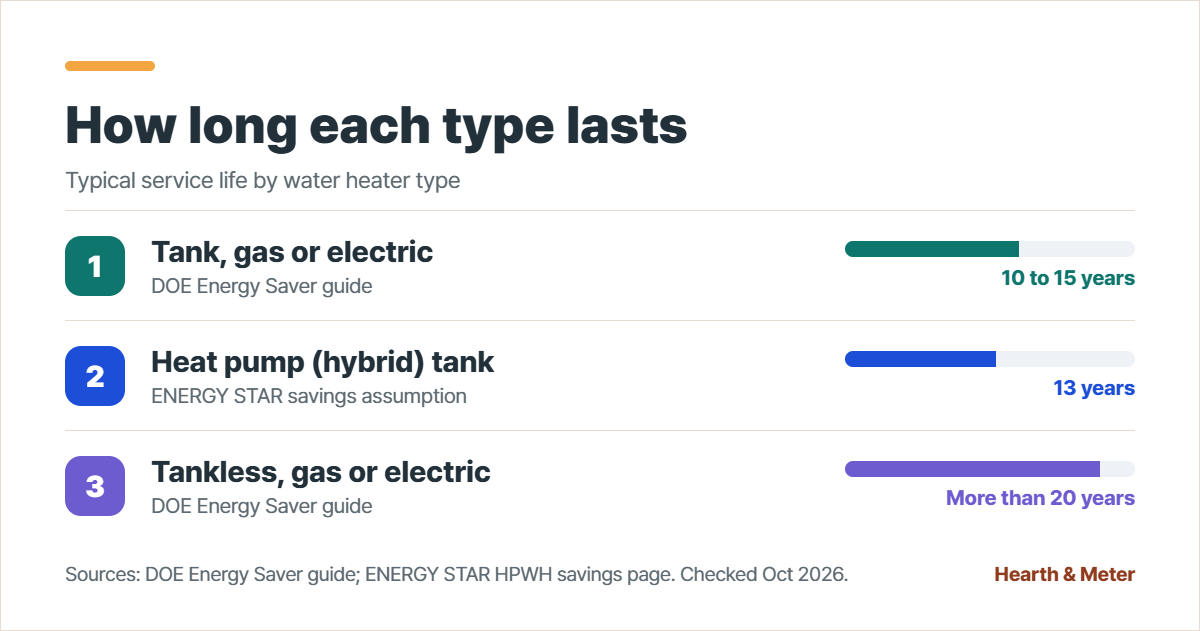
The age range depends mostly on whether water sits in a tank. A storage tank holds 30 to 80 gallons of heated water around the clock, and the steel slowly corrodes from the inside. DOE’s Energy Saver guide puts most storage water heaters at 10 to 15 years, and its 2024 efficiency rule used an average of about 15 years for storage models. Tankless units have no tank to rust through, and the same DOE guide puts their life at more than 20 years. ENERGY STAR’s savings math for heat pump water heaters assumes a 13-year life.
| Type | Typical life | Installed cost (Angi, 2026) | Notes |
|---|---|---|---|
| Tank, gas or electric | 10 to 15 years (DOE) | Most jobs $882 to $1,826; average $1,348 | Found in about 90% of homes, per Angi |
| Tankless (gas or electric) | More than 20 years (DOE) | $1,400 to $3,900 | Repairs run $100 to $1,300 vs $100 to $500 for a tank |
| Heat pump (hybrid) tank | 13 years assumed by ENERGY STAR | $1,200 to $3,500 | Needs room air, a condensate drain, and often a 240-volt circuit |
Treat these as averages, not expiry dates. Angi’s own guide says the average heater lasts about ten years, which sits at the short end of DOE’s range. Sediment is one reason a tank falls short: Angi’s repair guide notes that untreated sediment can lead to leaks, heating element failure, or a dead unit, which is why upkeep gets its own section at the end.
Step zero on the path: find the heater’s age
The rating plate on the side of the tank lists a model and serial number, and manufacturers commonly encode the build month and year inside that serial number. The format differs by brand, so look up your brand’s serial decoder on the manufacturer’s support site or call the number on the label. Some installers also write the install date on the tank or on a sticker near the gas or electrical connection, and a permit record from your city may show the year too.
Write the year on a strip of tape on the tank once you know it. That one number sorts you into a branch below: under 10 years, 10 to 15, or past 15.
If water is leaking from the tank itself
This branch is short. Angi’s repair guide says that when water sits in the drain pan or pools under the unit, the tank itself is likely compromised, and that kind of internal corrosion cannot be repaired. A leak at a fitting or valve on top is different and may only need tightening or a new part, so have a plumber confirm where the water starts before you buy anything.
Until the plumber arrives, close the cold-water supply valve above the heater and turn off its power at the breaker if it is electric. Leave gas controls alone unless the manufacturer’s label tells you how to shut the unit down. A slow leak with no obvious source is harder to pin down, and the two-hour water meter test can show whether water is escaping somewhere you cannot see. Waiting has a price: Angi lists water damage repair at $3.75 to $7 per square foot, with most homeowners spending $1,300 to $5,550.
Gas burners, gas valves, thermocouples, venting, and electrical wiring are jobs for a licensed plumber or electrician. If you smell gas, do not touch switches or use a phone nearby; leave the house and call 911 from a neighbor’s home or another spot well away from the leak, as PHMSA advises.
If it still holds water but acts up
ENERGY STAR’s 2025 heat pump water heater fact sheet lists the common warning signs for a heater that is 10 or more years old: corrosion around the water lines or on the unit, water leaking from joints or seams, rust in the hot water, running out of hot water sooner as sediment takes up tank space, and rumbling or banging noises. Each points toward a different likely cause and price. The part costs below are from Angi’s repair guide, updated August 24, 2026, and the plumber’s labor comes on top.
- Lukewarm water or no hot water on an electric tank: often a heating element ($15 to $60 for the part) or a thermostat ($20 to $400). Element work involves the unit’s wiring, so it belongs on a plumber’s or electrician’s ticket.
- Pilot stays lit but the burner will not fire on a gas tank: Angi points to the thermocouple, usually about $150 or less with a pro. A gas valve runs $70 to $200 for the part. Both are licensed-pro jobs.
- Rumbling, popping, or less hot water than before: sediment. A professional flush runs around $200, per Angi.
- Rusty hot water: ENERGY STAR says rust usually means the inside of the tank is corroding. A plumber can check whether the anode rod, the sacrificial metal rod that protects the tank, is used up; the part runs $25 to $75.
- Steady trickle from the relief valve pipe: a pressure or valve problem. A plumber replaces the valve for up to $200 and should check why pressure climbed.
Angi puts the national average repair at $616, with most jobs between $228 and $1,017. On a young tank almost every item on that list is worth fixing. On an old one, run the numbers in the next section before you say yes.
Water heater repair or replace when a quote lands
One way to compare a repair with a replacement is cost per year of hot water each one buys. The household below is hypothetical, and the figures come from the sources named above.
The setup: a family of four has a 50-gallon electric tank that turned 11 this fall. The water runs lukewarm, and a plumber quotes $450 to replace both heating elements and the upper thermostat. That quote sits inside Angi’s typical repair range of $228 to $1,017.
What the repair buys
DOE’s 10 to 15 year range means an 11-year-old tank has somewhere between zero and four years left. Four more years would put the repair at $450 ÷ 4 = $112.50 per year. A tank that rusts through twelve months later turns the same $450 into the price of one year of hot water. Either way, the replacement bill still arrives, only later.
What a like-for-like replacement costs per year
Angi’s national average for a water heater replacement is $1,348. Spread across DOE’s 10 to 15 year life, that is $1,348 ÷ 15 = about $90 per year at the long end and $1,348 ÷ 10 = about $135 per year at the short end. A new tank also starts a fresh warranty and stops the guessing.
The same quote on a six-year-old tank
Change one input. Make the tank six years old instead. It would have roughly four to nine years left, and the $450 repair would cost $450 ÷ 9 = $50 to $450 ÷ 4 = $112.50 per year. That is at or below the replacement’s $90 to $135 per year, so the repair wins. The quote did not change; the age did.
For an electric household, there is a third option worth pricing before you agree to a repair on an aging tank, which the next section covers.
If you replace: what moves the price, and the heat pump option
Angi’s replacement cost data, updated October 16, 2026, lists most replacements at $882 to $1,826. The total climbs with tank size, a switch from one type to another (moving from tank to tankless can double labor and needs new plumbing), permits of $25 to $300, and hauling away the old unit for $100 to $500. Swapping like for like in the same spot keeps the bill near the low end.
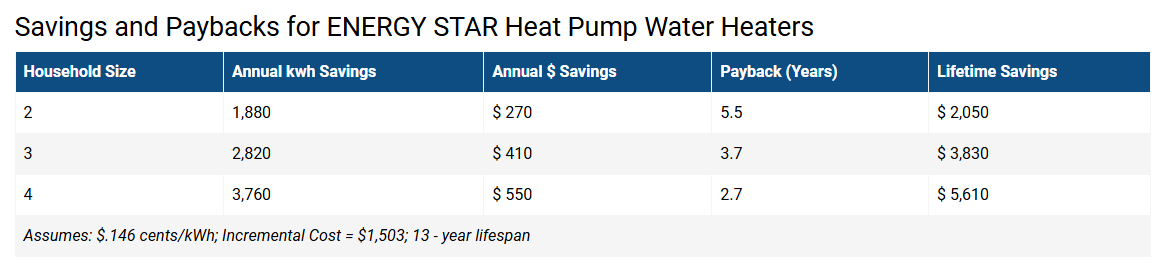
If you heat water with electricity, ENERGY STAR’s table above is the number to weigh. It assumes 14.6 cents per kWh. EIA’s Electric Power Monthly puts the U.S. average residential price at 18.16 cents per kWh for August 2026, so the same 3,760 kWh a household of four saves would be worth 3,760 × $0.1816 = about $683 a year today. Against ENERGY STAR’s assumed $1,503 extra cost over a standard electric tank, the payback works out to about 2.2 years. A two-person home saving 1,880 kWh would keep about $341 a year at that price. Your own rate on your bill is the one that counts.
A heat pump model is not a drop-in swap everywhere. Consumer Reports’ buying guide notes these units are taller than standard tanks, need surrounding air space and a condensate drain, make more noise, and cool the room they sit in; 120-volt versions exist for spaces without a 240-volt circuit. On incentives, the federal 30% credit for heat pump water heaters covered equipment installed from January 1, 2023, through December 31, 2025, so a 2026 installation does not qualify. Utility and state rebates still exist in many areas, and the ENERGY STAR rebate finder searches them by ZIP code.
Hot water use also drives what a heater costs to run. Our breakdown of how much water a shower uses shows what the heated share of a shower costs.
If it is younger than 10 and working fine
The goal here is to reach the long end of the range. DOE’s Energy Saver guide suggests draining about a quart of water from the tank every three months to remove the sediment that blocks heat transfer, following the manufacturer’s directions. A stiff drain valve, a gas unit, or a manual you are unsure about are all reasons to book the plumber’s flush instead; it runs around $200, per Angi. Ask the plumber at the same visit to check the anode rod, since replacing a worn rod costs far less than replacing a tank.
Water heating is the second-largest energy expense in most homes, about 18% of energy use according to the same DOE guide, so a tank that heats efficiently also shows up on the bill. Tankless owners in hard-water areas have their own task: Consumer Reports, quoting Rheem, says the heat exchanger should be descaled every year.
While you are next to the heater, find the house’s main water shutoff and make sure it turns; the frozen-pipe prep guide covers why that valve matters before the first hard freeze, and the winter home maintenance checklist puts it in order with the other fall jobs.
Your next step takes five minutes: read the serial number on the rating plate, decode the year on the maker’s website, and write it on the tank. A result of 10 years or more is your cue to start collecting replacement quotes now, while the heater still works and you can compare prices instead of taking the first plumber who answers.
This article is general information, not professional advice. Costs and energy prices vary by region, home, and installer; confirm figures with written quotes and your own utility bill. Hire licensed contractors for gas, electrical, plumbing, roof, and HVAC work, and check local codes and permit rules before replacing a water heater.
Leave a Reply