
Picture an October water bill, a hypothetical one, that shows 17 CCF for a 30-day period against 12 CCF for the same period last year. The house has four people, and nobody started watering a lawn or filling a pool. That is the classic “why is my water bill so high” moment, and this guide follows that one bill from the usage line to a dollar figure before getting to the general rules.
The first move is not a call to dispute the bill. Read your own water meter twice, two hours apart. If the numbers on your water meter move while every tap, toilet, and sprinkler is off, the water left through a pipe or fixture on your side of the meter, and the bill is probably right.
The meter test takes two hours of waiting, a flashlight, and a phone camera. The steps below come from the EPA WaterSense leak guidance and two water utilities’ published instructions, with the numbers checked on October 22, 2026.
The example bill: 17 CCF instead of 12
Here is the example bill worked through, using EPA’s conversion of 748 gallons per CCF and a meter test run the way the next sections describe. The test result is part of the example too: the sweep hand moved 1.5 turns in two hours with all water off.
| Step | Math | Result |
|---|---|---|
| Usage this period | 17 CCF × 748 | 12,716 gallons |
| Same period last year | 12 CCF × 748 | 8,976 gallons |
| Extra water | 5 CCF × 748 | 3,740 gallons (about 125 a day) |
| Meter test: sweep hand moved 1.5 turns in 2 hours | 1.5 × 7.48 | 11.2 gallons, or about 135 a day |
| Extra water cost at EPA’s sample rate | 3,740 × $0.00295 | about $11 per 30 days, water charge only |
| If the leak runs a full year | 135 gal × 365 × $0.00295 | about $145 a year, before any sewer charge |
The meter test and the bill agree: a steady leak of roughly 125 to 135 gallons a day. That is far bigger than a dripping faucet, which EPA puts at about 3,000 gallons a year (about 8 a day) for one drip per second. For a leak this size, check toilets, irrigation, and the line from the meter first. The $0.00295 rate is the sample uniform rate on EPA’s bill page, not your price, so redo the last two rows with the per-gallon or per-CCF rate printed on your own bill.
To redo the example with your own meter test and the rate on your own bill, enter them below.
Water meter leak test calculator
Enter what your meter did during the no-water test and the rate on your bill. The calculator turns it into gallons a day, a 30-day and yearly total, and what that water costs, the same way the example bill is worked out above.
How it works: gallons in the test = cubic feet × 7.48 (one cubic foot is 7.48 gallons). Gallons a day = test gallons ÷ test hours × 24, assuming the leak runs at the same rate all day. 30-day and yearly totals = gallons a day × 30 or × 365. Bill comparison: extra CCF × 748 gallons (EPA’s conversion), divided by the days billed. Cost = gallons × your rate, after converting a per-CCF rate (÷ 748) or a per-1,000-gallon rate (÷ 1,000) to a per-gallon rate. The example rate of $0.00295 per gallon is the sample uniform rate on EPA’s Understanding Your Water Bill page, not a real local price. Test method from EPA WaterSense (Fix a Leak Week); leak benchmarks from EPA WaterSense: a faucet dripping once per second wastes about 3,000 gallons a year, and 9% of homes have leaks wasting 50 gallons or more a day. Figures checked Oct 22, 2026. Gallons a day and 30-day gallons are rounded to whole numbers, test gallons to 0.1, 30-day and bill costs to the cent, yearly cost to the dollar. Not covered: increasing block, seasonal or drought rates, fixed monthly charges, sewer caps or winter averaging, leaks that run only part of the day (such as irrigation, which leaks only while it runs), and utility leak adjustments. Estimate only.
Why is my water bill so high? Read the usage line first
In the example, usage clearly rose. On a real bill, a higher total can come from more water, a higher price, or a longer billing period. Separate those three before you hunt for leaks. Look for the usage figure, the number of days billed, and the rate lines in the “summary of charges” box.
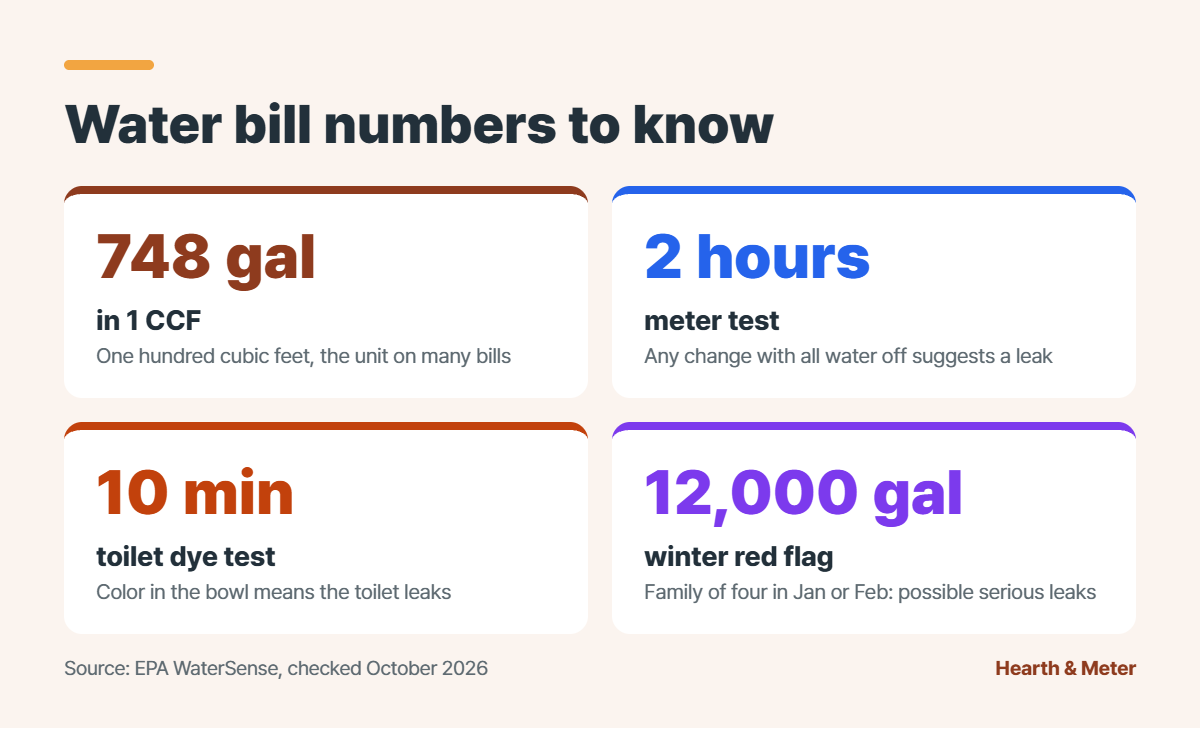
Many utilities bill in CCF, short for one hundred cubic feet. According to EPA’s Understanding Your Water Bill page, one CCF equals 748 gallons, so a jump from 12 to 17 CCF means about 3,740 more gallons. The same page puts typical use at around 82 gallons per person per day, or about 10,000 gallons in 30 days for a family of four.
Price can also move without any change in your habits. EPA lists increasing block rates, seasonal rates, and drought rates, all of which charge more per gallon once you cross a threshold or enter a peak period. Some utilities also bill sewer on the water that enters the house, so one leak can raise two lines on the same bill. If your usage in CCF or gallons is flat and only the dollars rose, the cause is the rate or the number of days in the period, and no leak test will change that.
When usage itself went up, compare it with the same billing period last year. EPA’s rule of thumb for a cold month: if a family of four uses more than 12,000 gallons in January or February, there could be serious leaks.
The two-hour water meter test
EPA’s instruction is short: check the meter before and after a two-hour period when no water is being used. If it changes at all, you probably have a leak. Here is how to run it without false alarms, the same way the example family would.
- Find the meter. Most sit near the curb in a box under a concrete or metal lid, according to Cal Water.
- Confirm it is yours. Covington Water District tells customers to match the meter number with the one printed on the bill, which matters in duplexes and townhouses with a row of meters.
- Stop all planned water use. Turn off irrigation timers, skip the dishwasher and washer, and wait until the toilets finish refilling. Cal Water’s high-bill checklist also flags water softeners, so make sure yours is not mid-regeneration.
- Photograph the register. Capture every digit plus the small low-flow indicator (on Covington’s meters, a blue pinwheel to the left of the dial). On many meters, one full turn of the sweep hand equals one cubic foot, or 7.48 gallons.
- Wait two hours. Overnight works well because nobody in the house is using water.
- Photograph it again and compare. Any change in the digits or the sweep hand means water moved through the meter. A spinning low-flow indicator during the wait points the same way.
- Split inside from outside. When the meter did move, close the house’s main shutoff valve and watch for 15 minutes, the time Cal Water suggests for a sweep-hand check. Still moving means the leak is between the meter and the house, such as the service line or an irrigation line that branches off before the valve. Stopped means it is inside.
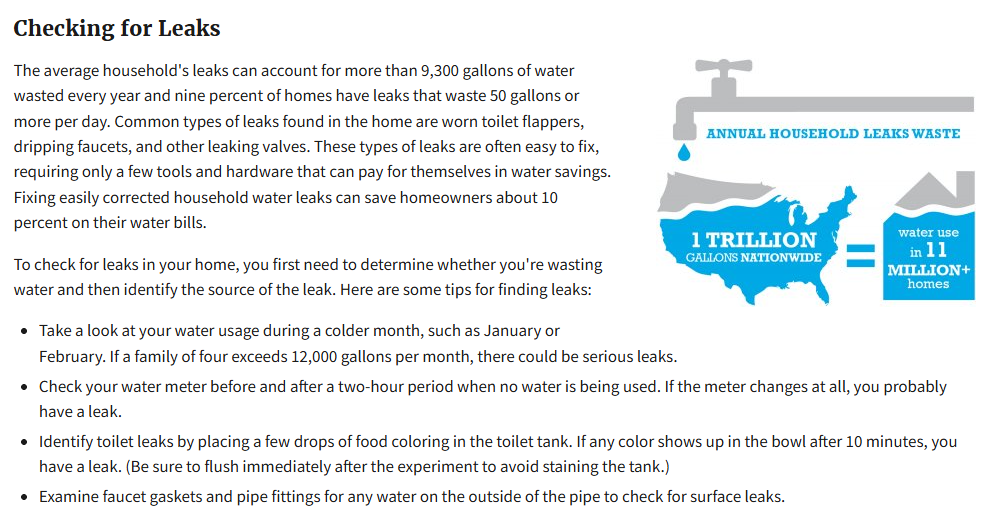
“Check your water meter before and after a two-hour period when no water is being used. If the meter changes at all, you probably have a leak.” EPA WaterSense, Fix a Leak Week
If you have never found your main valve, our fall frozen-pipe checklist explains why tagging it before winter pays off. If you ever need the valve at the meter itself, go gently. Covington’s page says most of its meters need only a quarter to half turn, and forcing one past the on or off position can damage the meter.
Fall is a convenient time to run this test, since freeze prep already takes you to the main shutoff; our winter home maintenance checklist pairs the two jobs in one step.
Which leak fits the numbers, and where to look
The example leak, about 125 to 135 gallons a day, already narrows the search before you open a single cabinet. Published leak rates show which fixtures can waste that much.
How much water common leaks waste in a month
EPA and Cal Water publish leak rates in different units (per year, per day, per month). The table below puts them on a 30-day footing so you can hold them up against the jump on your bill.
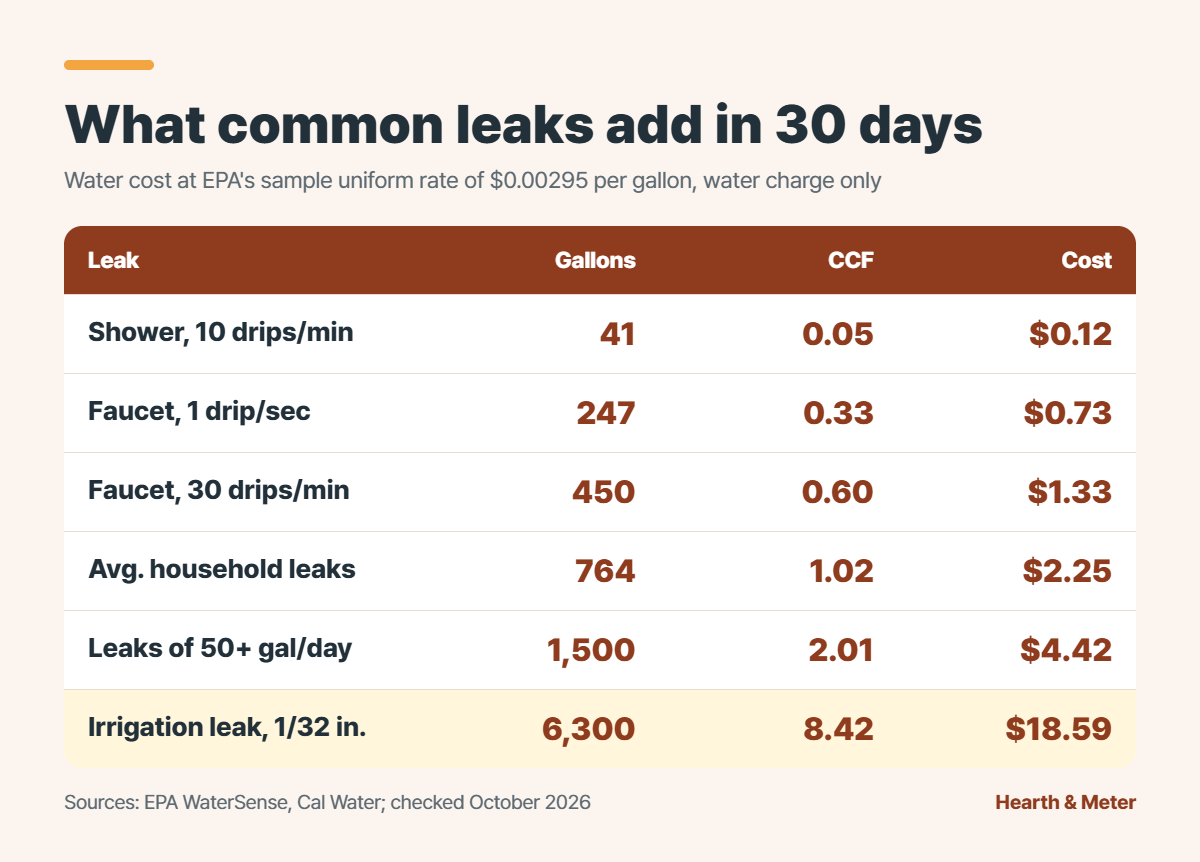
A faucet drip barely registers on a bill. EPA’s figure for the average household’s leaks, more than 9,300 gallons a year, works out to about one CCF a month. Nine percent of homes, EPA says, have leaks wasting 50 gallons or more per day. A bill that jumped by several CCF, like the 5 CCF in the example, points to a leak in that larger group, or an irrigation problem like the 1/32-inch break EPA says can waste about 6,300 gallons a month.
Finding the source, room by room
Once the meter test says water is moving, work from the cheapest checks to the hardest.
- Toilets. Put a few drops of food coloring in the tank. If color shows up in the bowl after 10 minutes without a flush, the toilet leaks; flush afterward so the tank does not stain. EPA says a worn flapper is a common cause and suggests replacing the flapper at least every five years. Bring the old one, or a photo, to the store so the size matches.
- Faucets and showerheads. Look for water on the outside of pipes and fittings. EPA says a showerhead dripping 10 times a minute wastes more than 500 gallons a year and can often be fixed by tightening the connection with pipe tape.
- Outdoor spigots and hoses. Check the hose washer at the spigot. In late October, also look at hose bibs you plan to shut down for winter.
- Irrigation. Cal Water notes that a system can leak only while it runs, so a clean meter test does not clear it. Run one zone at a time and walk the lines.
- Equipment and the yard. Cal Water’s high-bill checklist adds water softeners, under-sink filter systems, hot tub and pool float arms, recirculating hot water units, and wet spots on the lawn or on walls and ceilings.
Wet spots on a ceiling or a stain spreading down a wall mean the leak is inside the structure. That is a plumber’s job, not a weekend project.
If the dye test points at a toilet, our guide to a toilet that keeps running shows how to tell a worn flapper from a fill valve set too high, and what each kind of leak adds to the bill.
If the meter test finds no leak, daily habits are the next suspect. Our guide to how much water a shower uses works through the gallons and the cost of a typical shower.
When to call a plumber or your water utility
Call a licensed plumber when the meter still moves after toilets and faucets check out, when the leak is between the meter and the house, or when you see water stains on walls and ceilings. Covington, for one, states that a leak on your side of the meter is yours to repair, along with the water it used.
If the meter test points indoors, look at the water heater as well. A puddle in its drain pan or under the tank usually means the tank itself is corroding, while a drip at a fitting on top may be a simple repair; our guide on how long a water heater lasts and when to replace it explains how to tell the two apart.
Call the utility after the repair, not before. Some utilities offer a leak adjustment, a partial credit for water lost to a leak you fixed, and the rules are local. Covington Water District’s published policy is one example of how strict they can be:
| Covington Water District rule | What it means for you |
|---|---|
| Use must be more than 25 CCF above the same billing period last year | Small drips will not qualify; a large or long-running leak might |
| The form is due within two billing cycles (120 days) | Do not wait for a second high bill to start |
| Repair receipts or invoices are required | Keep the plumber invoice or parts receipt |
| The meter must show no movement after the repair | Repeat the two-hour test and keep the photos |
| One credit every five years, unless the whole service line is replaced | Ask before you use it on a small leak |
EPA notes that CCF is also the most common unit on natural gas bills, so the same reading habits help with your heating bill; our guide to winter heating bills covers that side.
Tonight, after the last shower and the dishwasher cycle, take a photo of your water meter, and take another before anyone gets up. Those two photos tell you whether to call a plumber, the utility, or nobody at all.
This article is general information, not professional advice. Hire a licensed plumber for repairs inside walls, under slabs, or on the service line, and check your water utility’s own rules and local codes before acting on a bill dispute or leak adjustment.
Leave a Reply