
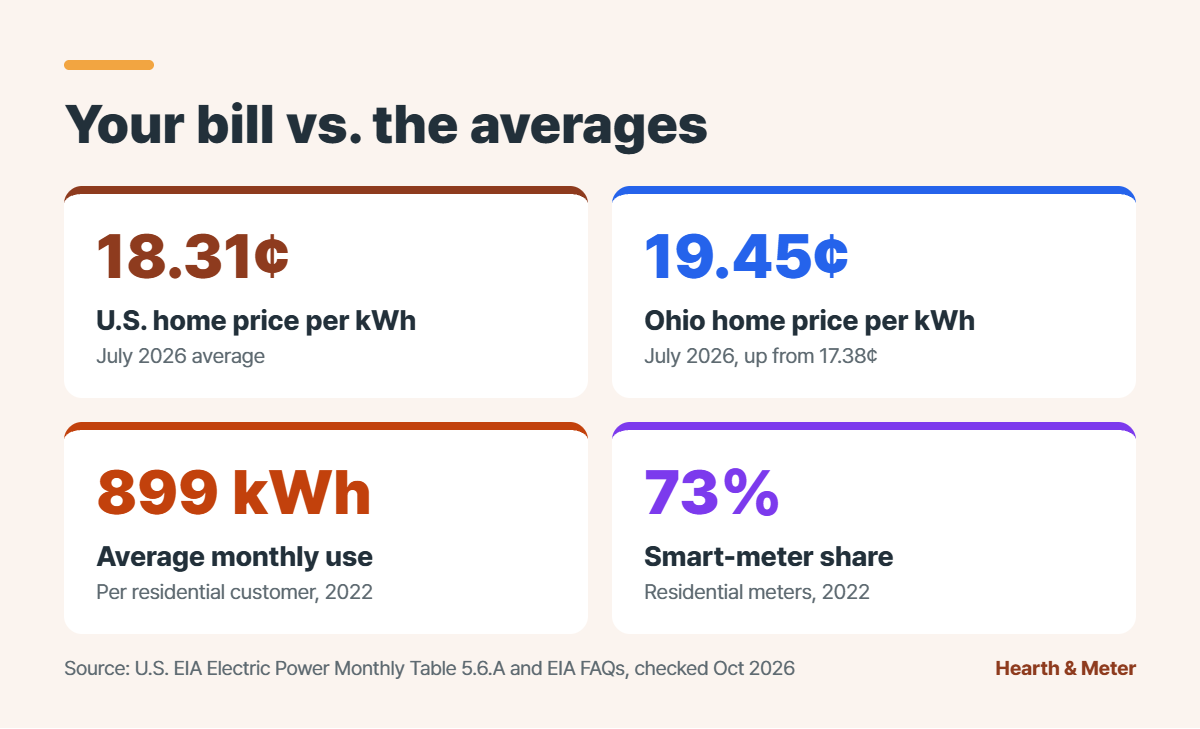
Divide the bill total by the kilowatt-hours you used. That one division tells you more than the dollar figure at the top of the page, because it folds the customer charge, delivery lines, riders and taxes into a single price you can hold up against your state’s average. In July 2026, U.S. households paid an average of 18.31 cents per kWh and Ohio households paid 19.45 cents, according to EIA’s Electric Power Monthly, Table 5.6.A (released Sept. 24, 2026).
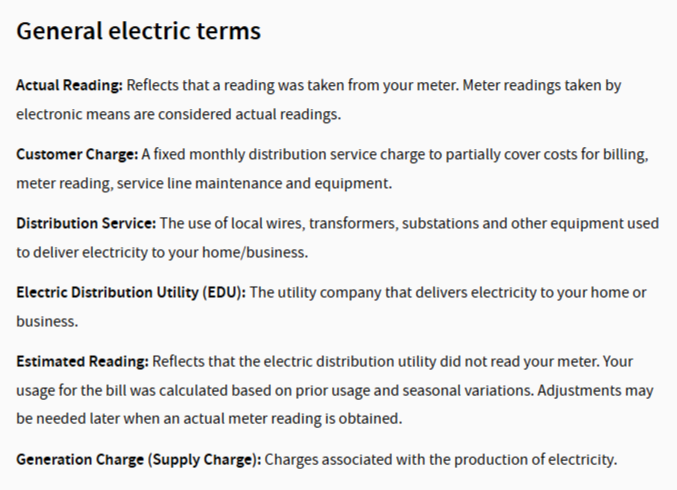
The rest of this guide covers how to read your electric bill line by line, using a hypothetical Ohio house so you can see every number move. The labels below follow the Public Utilities Commission of Ohio bill glossary. A co-op or city utility may print one combined energy charge instead of separate supply and delivery lines, but the same division still gives you a cents-per-kWh figure to compare.
How to read your electric bill: five numbers to find first
Ignore the marketing panels and the amount due for a minute. These five items, usually on page one or in the “usage” box, explain almost every bill:
- Service period and number of days. A bill covers the time between two meter reads, so its length shifts from month to month. More days means more kWh even if your habits did not change.
- Meter readings and read type. Look for “actual” or “estimated” next to the readings. PUCO defines an estimated reading as one where the utility did not read your meter and calculated usage from prior usage and seasonal patterns, with adjustments possible after the next actual read. Smart meters count as actual reads; EIA says about 73% of U.S. residential meters were advanced (smart) meters in 2022.
- Total kWh used. This is the current reading minus the previous one. For scale, PUCO’s glossary notes that a 100-watt bulb running for 10 hours uses 1 kWh, and EIA puts the average residential customer at about 899 kWh a month (2022 data).
- Fixed charges. The customer charge is a flat monthly fee that, per PUCO, partially covers billing, meter reading, service line maintenance and equipment. It stays the same whether you use 300 kWh or 3,000.
- Per-kWh charges. Everything else is usually priced per kWh: supply (generation), distribution, transmission, and a set of riders and taxes that vary by state.
Supply vs. delivery: what each line pays for
Most bills in states with retail choice split into two halves. Supply pays for producing the electricity. Delivery pays the local utility for moving it to your meter. EIA notes that in those states the distribution utility still delivers the power and charges for that service no matter which supplier you pick, and that retail choice is generally limited to customers of investor-owned utilities. The table below combines PUCO’s definitions with EIA’s explanation of what drives each cost.
| Bill line | What it pays for | Changes with kWh? | Can you shop it? |
|---|---|---|---|
| Customer charge | Billing, meter reading, service line upkeep, equipment (PUCO) | No, fixed each month | No |
| Distribution | Local wires, transformers and substations (PUCO) | Usually yes | No, set by the state commission |
| Transmission | High-voltage lines from power plants to the local utility (PUCO) | Usually yes | No |
| Supply / generation | Producing the electricity (PUCO); EIA calls generation the largest part of the average U.S. price | Yes | Only where retail choice exists (EIA) |
| Riders and taxes | Commission-approved add-ons and credits, plus state and local taxes | Often yes | No |
Seasonal price swings start on the generation side. EIA says prices are usually highest in summer, when more expensive power plants run to meet demand, and that some utilities offer time-of-day pricing to cut demand in the afternoon and early-evening peak, when supply costs run highest. If your bill shows “on-peak” and “off-peak” kWh, you are on that kind of plan, and the timing of your laundry and dishwasher matters as much as the total.
A worked example: one Ohio bill, line by line
Here is a hypothetical gas-heated house near Columbus. The bill covers 33 days and 930 kWh. The rates are invented for illustration and do not come from any utility’s tariff; they were chosen so the result lands near Ohio’s July 2026 residential average.
| Line | Rate (hypothetical) | Math | Amount |
|---|---|---|---|
| Customer charge | $9.00 per month | fixed | $9.00 |
| Distribution | 4.5¢ per kWh | 930 × $0.045 | $41.85 |
| Transmission | 1.5¢ per kWh | 930 × $0.015 | $13.95 |
| Supply (generation) | 10.5¢ per kWh | 930 × $0.105 | $97.65 |
| Riders and taxes | 1.0¢ per kWh | 930 × $0.010 | $9.30 |
| Total | $171.75 |
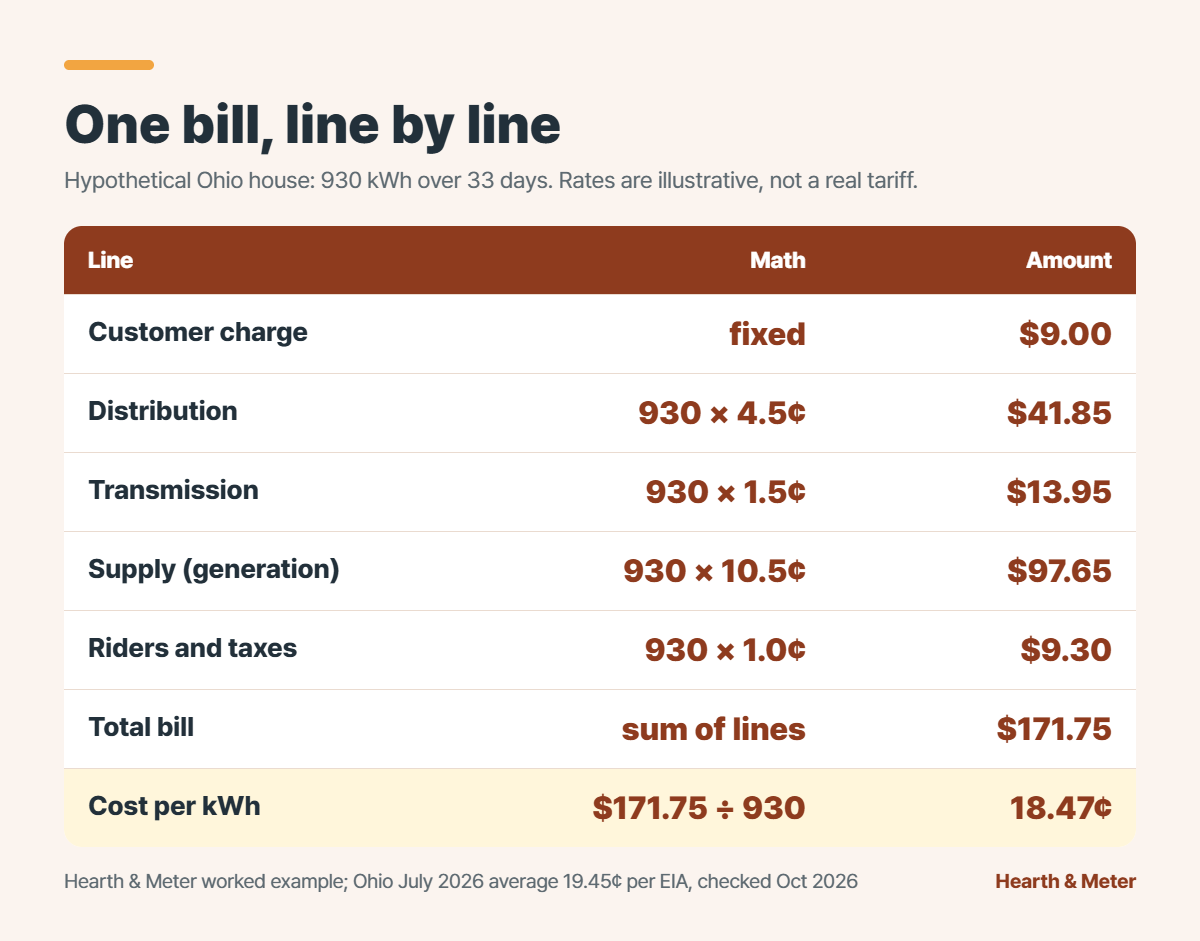
Now run the division. $171.75 ÷ 930 kWh = 18.47 cents per kWh, a little under Ohio’s 19.45-cent July average. Supply makes up $97.65, or 56.9% of the bill, and the four delivery-side lines make up the other $74.10 (43.1%). That split is why a supplier offer can only move part of your bill.
The same table also shows what conservation is worth. Cut 100 kWh and you avoid every per-kWh line, which here adds up to 17.5 cents (4.5 + 1.5 + 10.5 + 1.0). That saves $17.50, and the bill drops to $154.25. The $9.00 customer charge stays put. Sealing drafts is one of the cheaper ways to trim winter use; our step-by-step plan for sealing air leaks lists where to look first.
Compare cents per kWh, not the total. Total bill ÷ kWh used gives you one number you can check against EIA’s state average and against last year’s bill for the same month.
Why the total moved: billing days, estimates and seasons
Say the previous bill for the same hypothetical house covered 870 kWh over 29 days. At the same rates it came to $161.25 ($9.00 plus 870 × $0.175). The new bill is $10.50 higher, which looks like the household used more power. Per day, though, usage fell from 30.0 kWh (870 ÷ 29) to 28.2 kWh (930 ÷ 33), a 6.1% drop. The bigger bill came from four extra days in the period.
- Write down kWh and days from your current bill and the one before it.
- Divide kWh by days for each bill to get kWh per day.
- If daily use rose, look for a new appliance, a space heater, more people at home, or colder weather.
- If daily use held steady but the cents-per-kWh figure rose, a rate changed. Check the bill’s messages or your state commission’s site for a new supply price or rider.
- If the read is marked estimated, expect the next actual read to correct it, either up or down, as PUCO describes.
Winter adds its own pattern. Electric heat, heat pumps and furnace blowers all show up in kWh, and our look at what EIA expects for winter heating bills this season covers the fuel-by-fuel outlook. If you are weighing a heat pump, the cents-per-kWh number from this exercise is the input our heat pump vs. gas furnace cost comparison asks for.
The fall jobs that keep those winter kWh in check, from the furnace tune-up to air sealing, are laid out in the order they come due in our winter home maintenance checklist.
Checking the supply line against the price to compare
In Ohio and other retail-choice states, the bill shows a price to compare (PTC). PUCO defines it as the utility’s per-kWh price for generation service under its standard service offer, and its guide to how generation rates are set says the PTC is the amount per kWh you stop paying the utility if you switch to a competitive supplier. Delivery charges stay with the utility either way.
Offers are rarely as simple as a lower rate. PUCO’s glossary lists two terms worth hunting for in the fine print: a monthly fee some suppliers add on top of the per-kWh rate, and an introductory price that lasts between one and three billing cycles before a different price takes over. Run a hypothetical offer of 9.9 cents per kWh plus a $4.95 monthly fee against a 10.5-cent PTC. The rate saves 0.6 cents per kWh, so you need 825 kWh a month ($4.95 ÷ $0.006) just to break even.
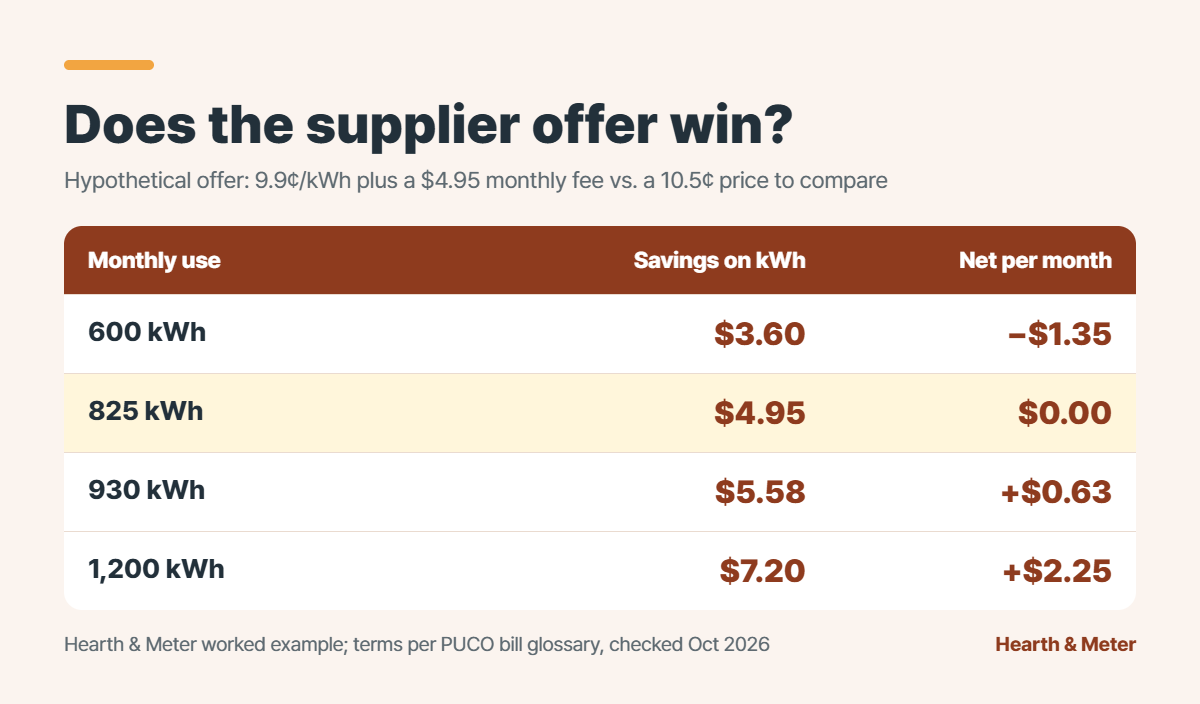
At 930 kWh the switch is worth 63 cents a month. At 600 kWh it costs you $1.35 more than staying put. PUCO also warns that contracts can carry an early termination fee, so read the terms before you cancel one supplier to chase another.
Electric bill questions people search
Why is my electric bill delivery charge so high?
Delivery covers the fixed customer charge plus the per-kWh cost of local wires and the high-voltage grid. EIA explains that residential customers pay more per kWh than industrial ones partly because it costs more to distribute power to many small users. In the worked example above, delivery was 43% of the bill. If the delivery rate itself went up, your state utility commission’s website is the place to look for recent rate decisions.
What does an estimated reading mean on my bill?
It means the utility did not read your meter that cycle and calculated usage from your history and the season. The next actual read usually corrects the difference. If several bills in a row are estimated, ask the utility for an actual read or to check the meter’s communication.
What if I cannot pay this month?
Call the utility before the due date. PUCO notes that distribution utilities offer payment plans, and the federal Low Income Home Energy Assistance Program (LIHEAP) helps eligible households with home energy costs through state agencies. Budget billing, which many utilities offer, evens out monthly payments over the year but does not lower the price per kWh.
Before your next bill arrives, open the last 12 bills in your utility account and put three columns in a notebook or spreadsheet: kWh, days, and total. Add kWh per day and cents per kWh for each. Twelve rows will show you whether a high bill came from usage, rates, or the calendar, and which one is worth fixing first.
This article is general information, not professional, legal or financial advice. Rates, riders and retail-choice rules differ by state and utility, so confirm figures on your own bill and your state commission’s website. Hire licensed contractors for any gas, electrical, roof or HVAC work, and check local codes and permits.
Leave a Reply