
If your furnace is getting old or your central AC needs replacing, the heat pump vs gas furnace cost question really involves two bills. One is what you pay once to install the system. The other is what you pay every winter to run it, and national averages hide most of that answer because gas and electricity prices swing widely between states.
Fuel and electricity prices pulled from EIA on October 20, 2026.
This guide is for homeowners with ductwork and a gas line who are collecting replacement quotes this fall. It uses U.S. Energy Information Administration (EIA) price data and ENERGY STAR efficiency ratings to turn both fuels into one number you can compare: dollars per million Btu (MMBtu) of heat delivered to your rooms. Each section puts the two systems next to each other: running cost, install cost, one worked house, eight states, and five common situations, plus a calculator for your own bills.
Heat pump vs gas furnace cost: the 2026 numbers
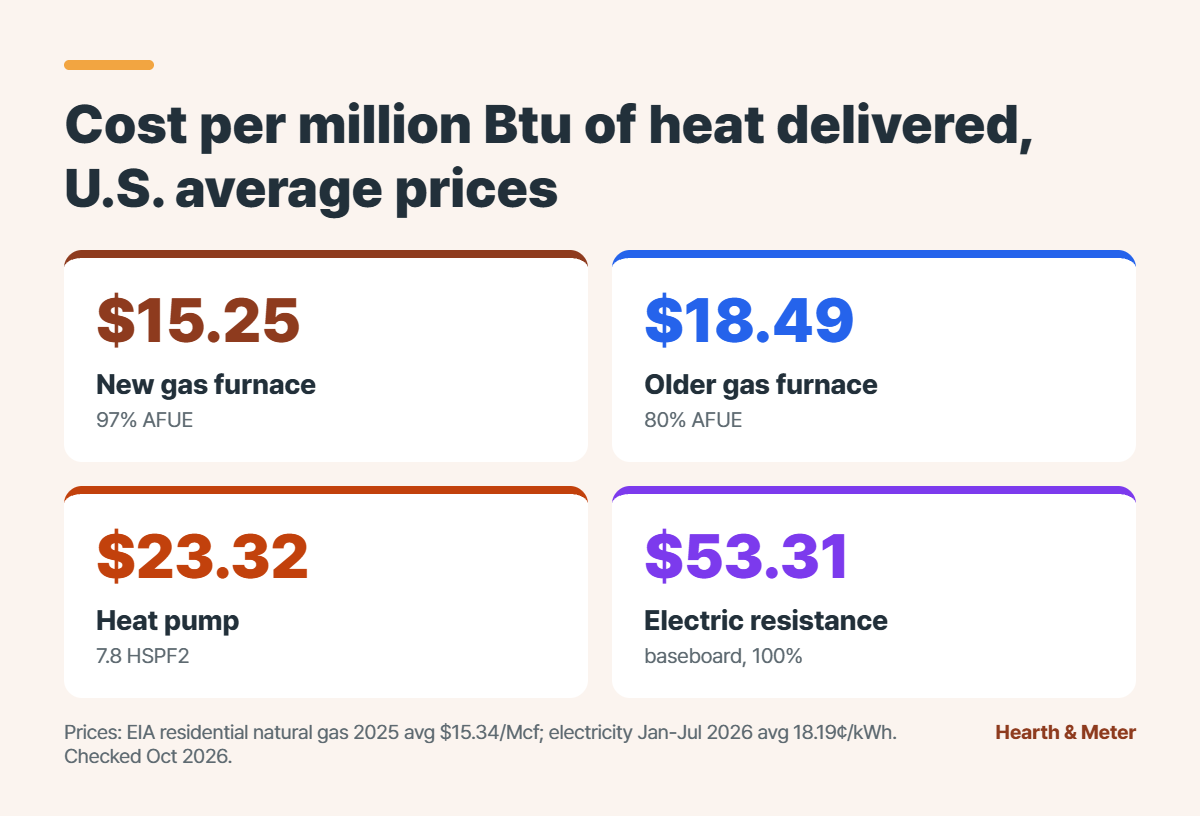
At U.S. average prices, a new 97% AFUE gas furnace delivers heat for about $15.25 per MMBtu. A heat pump at the ENERGY STAR minimum of 7.8 HSPF2 comes out near $23.32. So on a national basis, gas is still cheaper to run. That changes state by state, as the table further down shows.
Here is where those numbers come from. EIA lists the average residential natural gas price for 2025 at $15.34 per thousand cubic feet (Mcf) on its natural gas price table. Its Electric Power Monthly Table 5.6.B puts the U.S. residential electricity price for January through July 2026 at 18.19 cents per kWh. To put both on the same footing, EIA’s conversion FAQ says 1 Mcf held about 1.037 MMBtu in 2025, and its Btu conversion page lists 1 kWh as 3,412 Btu.
Efficiency comes from the ENERGY STAR criteria. Certified gas furnaces must reach 97% AFUE in the U.S. North and 95% in the U.S. South. Certified split-system heat pumps need at least 7.8 HSPF2, and the cold-climate label for ducted systems asks for 8.1 HSPF2 plus a coefficient of performance (COP) of at least 1.75 at 5°F. HSPF2 is measured in Btu of heat per watt-hour of electricity, which is why it plugs straight into the math.
Two caveats keep these figures honest. HSPF2 is a seasonal test rating, so a heat pump in a very cold city will average less than its label, especially when electric backup strips run (straight resistance heat costs about $53.31 per MMBtu at the same electricity price). And EIA averages fold in fixed monthly customer charges, so the price you pay for each extra therm or kWh can differ from the average.
Those backup strips are also what the “EM HEAT” setting runs on its own, with the outdoor unit shut off. Our guide to heat pump emergency heat and what an hour of it costs shows when that setting makes sense and how to price an hour from EIA’s state electricity figures.
Heat pump vs furnace cost to install, side by side
HomeAdvisor’s cost pages, updated in June 2026, give these national ranges. Treat them as a starting point; your quote moves with home size, duct condition, brand, efficiency tier, and local labor rates.
| Job | Typical installed range | Source (updated) |
|---|---|---|
| Air-source heat pump (heats and cools) | $4,236 to $7,942 | HomeAdvisor, Jun 19, 2026 |
| Gas furnace replacement | $2,823 to $6,896 | HomeAdvisor, Jun 17, 2026 |
| Central AC installation | $3,887 to $8,073 | HomeAdvisor, Jun 17, 2026 |
| New ductwork, if needed | $3,000 to $7,500 | HomeAdvisor heat pump page, Jun 19, 2026 |
| Building permit (heat pump) | $50 to $300 | HomeAdvisor heat pump page, Jun 19, 2026 |
| Old furnace removal and disposal | $150 to $330 | HomeAdvisor furnace page, Jun 17, 2026 |
The fair comparison is often a heat pump against a furnace plus a new AC, because one heat pump does both jobs. Adding the furnace and AC ranges above gives roughly $6,710 to $14,969 for the pair. If your AC still has years left, the comparison is the heat pump against the furnace alone, and the furnace usually wins on upfront price.
Is a heat pump or gas furnace cheaper to run? One Ohio house, four options
This is a hypothetical household, built from real 2025 and 2026 Ohio averages. The house has an older 80% AFUE furnace and burned 700 therms for heating last winter, a figure the owners got by adding up their December through March gas bills and subtracting a typical summer month for the water heater and stove. Ohio prices: gas averaged $13.85 per Mcf in 2025, about $1.34 per therm after dividing by 10.37. Electricity averaged 18.70 cents per kWh from January through July 2026.
- Find the heat the house actually used. 700 therms × 0.80 = 560 therms, or 56 MMBtu delivered to the rooms.
- Keep the old furnace. 700 therms × $1.336 = about $935 for the winter.
- Install a new 97% AFUE furnace. 56 MMBtu ÷ 0.97 = 577 therms, which costs about $771.
- Install a 7.8 HSPF2 heat pump. 56,000,000 Btu ÷ 7.8 Btu per watt-hour = 7,179 kWh. At $0.187 per kWh that is about $1,343.
- Install a cold-climate 8.1 HSPF2 heat pump. 6,914 kWh, or about $1,293, before any hours on backup heat.
In this house the heat pump runs roughly $520 to $570 a winter more than a new furnace. Electricity would need to cost about 10.7 cents per kWh to tie the new furnace, or 13.0 cents to tie the old one. That does not settle the decision on its own. If the AC is failing too, the gap in install cost can be larger than several winters of extra running cost, so price both paths.
Quick rule: a 7.8 HSPF2 heat pump costs less to run than a new 97% AFUE furnace when your electricity price in cents per kWh is below about 8 times your gas price in dollars per therm. Against an old 80% furnace, the multiplier is about 9.75.
To run the Ohio math with your own gas bills and utility rates, enter them below.
Heat pump vs gas furnace running cost calculator
Start with last winter’s heating therms from your gas bills, as in step 1 of the Ohio example. The calculator turns them into the heat your house used, then prices that heat four ways.
How it works: heat delivered (MMBtu) = therms × current AFUE ÷ 10, since 1 therm is 100,000 Btu. Furnace therms = heat ÷ AFUE. Heat pump kWh = Btu ÷ HSPF2 (Btu per watt-hour) ÷ 1,000. Break-even electricity price (cents per kWh) = gas $ per therm × HSPF2 ÷ furnace AFUE. Efficiency figures are the ENERGY STAR minimums (gas furnaces 97% AFUE U.S. North, 95% U.S. South; split-system heat pumps 7.8 HSPF2; cold-climate ducted 8.1 HSPF2). Unit conversions from EIA: 1 kWh = 3,412 Btu, and 1 Mcf held about 10.37 therms in 2025. The Ohio example uses EIA averages: gas $13.85 per Mcf (2025), electricity 18.70 cents per kWh (January to July 2026). Basis as of Oct 24, 2026. Therms, kWh and dollars are rounded to whole numbers, differences use the rounded dollars, and break-even prices are rounded to 0.1 cent. Not covered: hours on electric backup heat, heat pump output dropping below its rating in very cold weather, fixed monthly utility fees, cooling, water heating, install cost and rebates. Estimate only.
State by state: where a heat pump wins
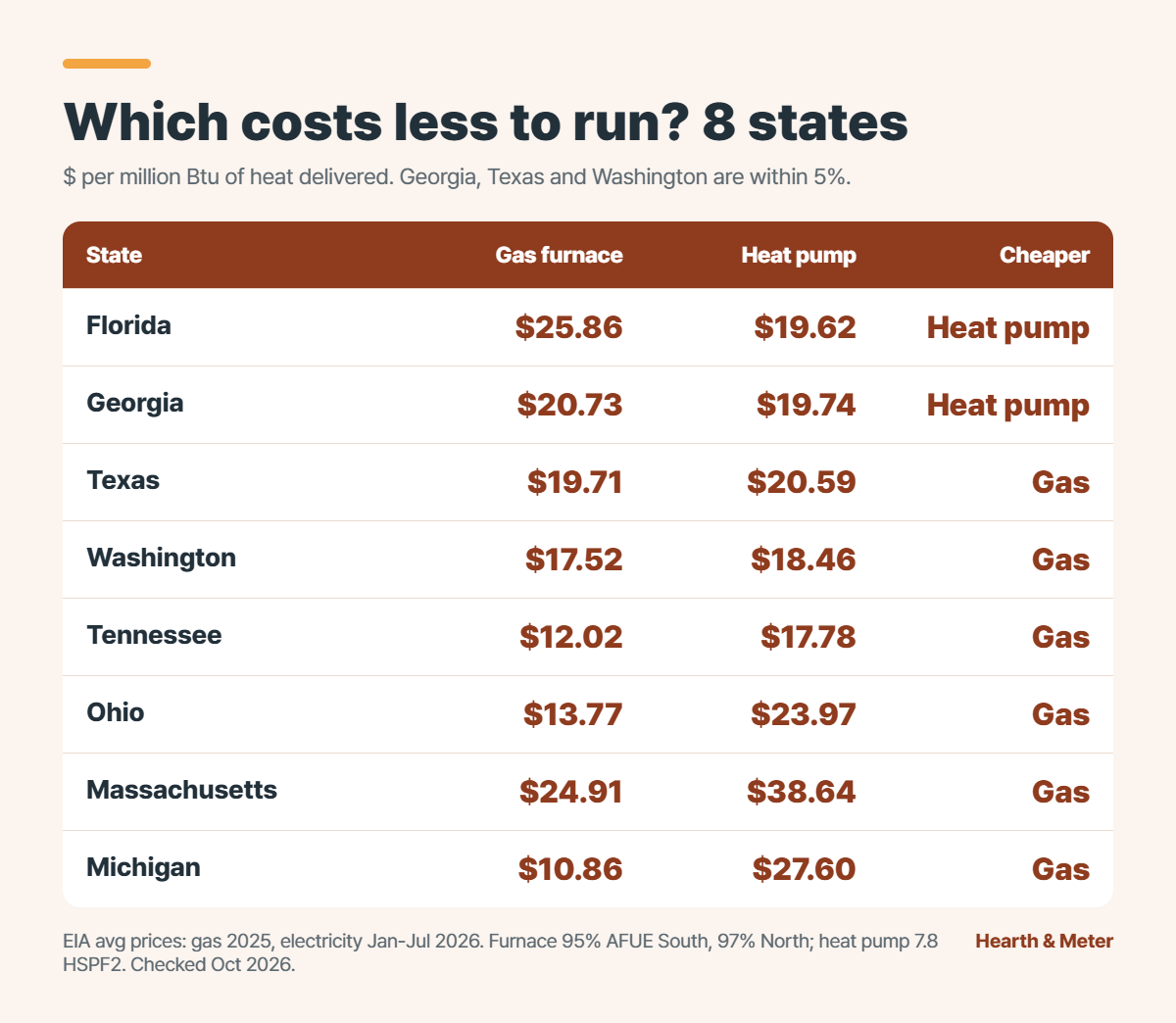
We ran the same math for eight states, using a 95% furnace in the U.S. South and a 97% furnace in the U.S. North to match the ENERGY STAR regions. Florida comes out clearly in favor of the heat pump because its residential gas averaged $25.48 per Mcf while electricity sat at 15.30 cents. Michigan is the opposite case: gas at $10.92 per Mcf and electricity at 21.53 cents make the furnace far cheaper to run.
Georgia, Texas and Washington land within about 5% of each other. In those states a higher-rated heat pump, a time-of-use rate, or your own marginal prices can flip the result. EIA showed no 2025 annual gas price for six states (Connecticut, Maine, Maryland, North Carolina, Rhode Island and South Carolina), so they are left out here.
How to check your own rates on EIA
These steps match the EIA pages as they appeared on October 20, 2026. No login is needed.
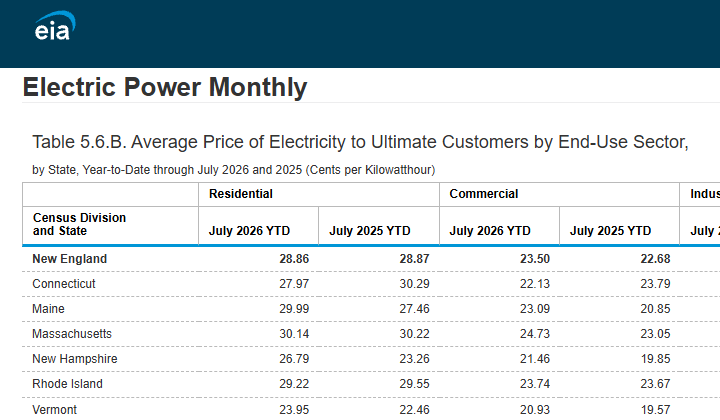
- Open EIA Electric Power Monthly Table 5.6.B. The heading reads “Average Price of Electricity to Ultimate Customers by End-Use Sector, by State, Year-to-Date through July 2026 and 2025.” The page says the next release is October 23, 2026, so the months covered may have moved on.
- Scroll to your state and read the first column, “July 2026 YTD” under “Residential.” That is cents per kWh.
- Open the EIA natural gas price table and read the 2025 column for your state. The page is titled “Average Residential Price,” and the unit is dollars per thousand cubic feet. Divide by 10.37 to get dollars per therm.
- Better still, pull your own bills. Add the per-kWh supply and delivery charges, and the per-therm charges, and leave out fixed monthly fees.
- Multiply your therm price by 8 (or 9.75 if you would keep an 80% furnace). If your cents-per-kWh price is lower, the heat pump should cost less to run.
Which one fits your house: five situations
- Both systems are near the end. Price a heat pump against a furnace plus AC. One install can close much of the running-cost gap.
- Gas is cheap where you live. In states like Michigan, Ohio and Tennessee, a new high-efficiency furnace is usually the lower-cost option to run.
- You have no gas service. The comparison is a heat pump against electric resistance or delivered fuel, and at U.S. average electricity prices a 7.8 HSPF2 heat pump delivers heat for less than half the cost of resistance heat.
- Winters are harsh. Ask for a unit that carries the ENERGY STAR cold-climate designation and ask how much backup heat the design expects to use.
- You want both. A dual-fuel setup pairs a heat pump with a gas furnace and switches to gas below an outdoor temperature you set with the installer. It costs more upfront, and the switch point should come from your own price ratio.
Incentives changed this year. The IRS page for the Energy Efficient Home Improvement Credit says the credit (up to $2,000 a year for qualified heat pumps) covers improvements made through December 31, 2025, so a system installed in 2026 does not qualify. Utility and state rebates still exist in many areas; enter your ZIP code in the ENERGY STAR Rebate Finder before you sign.
What to ask the HVAC contractor
Safety: leave installation to licensed pros. Gas piping, furnace venting, refrigerant handling and new 240-volt circuits require licensed trades and usually a permit. If any fuel-burning appliance stays in the house, keep working carbon monoxide alarms.
- Will you do a room-by-room load calculation (Manual J) instead of matching the old unit’s size?
- What are the HSPF2 and SEER2 ratings of the exact matched system, and what is its AHRI certificate number?
- How much heating capacity does the heat pump keep at 5°F, what type of backup heat is included, and at what temperature does it turn on?
- Do the ducts need changes, and is that in the price?
- For a high-efficiency furnace: does the quote include new venting and a condensate drain?
- Are the permit fee and old equipment removal included?
If you decide to keep your current furnace a few more years, a yearly furnace tune-up helps it run as efficiently as it can. Cutting the heat load first also shrinks the bill under either system; our guide on sealing air leaks covers the cheapest steps.
If you are not replacing anything this year, the seasonal jobs in our winter home maintenance checklist start with a heating tune-up, and that technician’s report is useful evidence for a later repair-or-replace decision.
Before the first quote: what to gather
- Add up last winter’s heating-season therms from your gas bills.
- Note your per-kWh and per-therm charges, excluding fixed fees.
- Run the 8x rule (9.75x if you would keep an 80% furnace).
- Check whether your AC also needs replacing within a year or two.
- Get at least two quotes that list HSPF2, SEER2 or AFUE and the AHRI number.
- Look up rebates by ZIP code before signing.
Related guide: what EIA expects for winter heating bills in 2026–27.
Your next step: pull your gas bills from last December through March tonight and run step 1 of the Ohio example with your own therm total, so you walk into the first quote knowing your break-even electricity price.
This article is general information, not professional advice. Hire licensed contractors for gas, electrical, roof and HVAC work, and check local codes and permit requirements before any installation.
Leave a Reply