
Hypothetical example: Dana and Marcus own a two-story house built in 2004, with three bedrooms upstairs, a finished basement with no bedroom, a gas furnace and gas water heater in the basement, and an attached garage. On a Saturday in October 2026 they set out to settle when to replace smoke detectors and the CO alarm in their house, one unit at a time. Their audit is the kind of job most owners have never done, so it opens this guide.
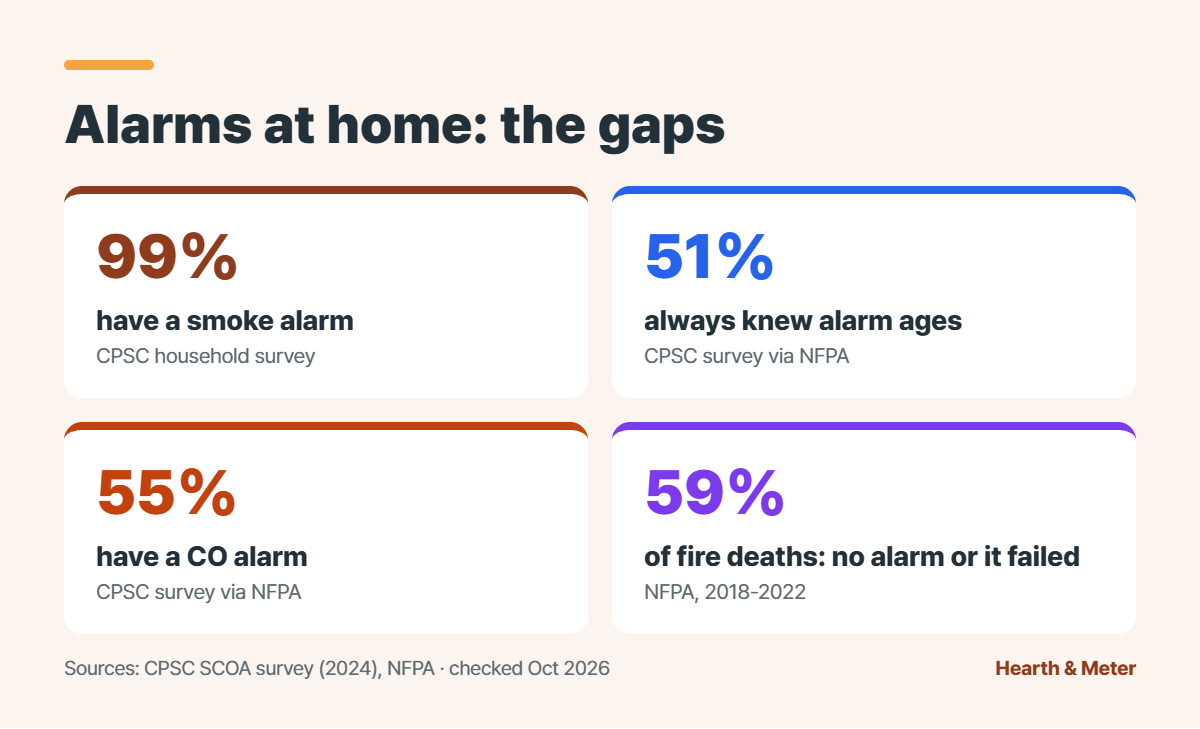
The rule they were checking against comes from the U.S. Fire Administration is 10 years from the manufacture date printed on the back, not 10 years from the day you moved in. Most people have never looked at that date. In a national in-home survey summarized by NFPA, only 51 percent of households were always right about how old their alarms were.
This guide is for homeowners and renters who want to check every alarm in one afternoon this fall. The example comes first, including a carbon monoxide (CO) alarm that sat in the wrong room. The rules behind each decision follow, then 2026 prices, CO placement, and the mistakes that leave a house unprotected, so you can run the same sort on your own alarms.
The example house: seven alarms, one afternoon
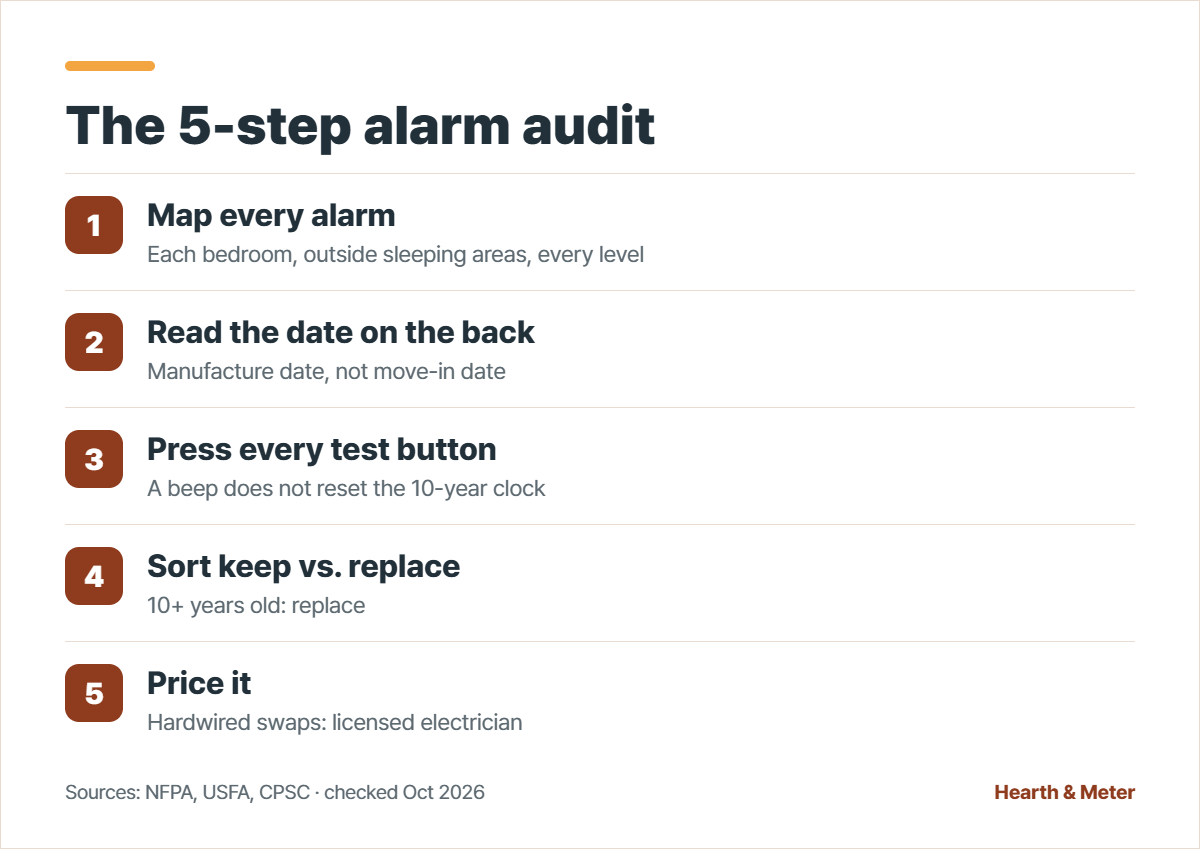
They started by mapping every alarm. Walking each floor with a notepad, they found six smoke alarms and one plug-in CO alarm: one smoke alarm in each bedroom and one in the hallway upstairs, one near the stairs on the main floor, and in the basement a battery unit on the ceiling at the bottom of the stairs, which is where NFPA says basement alarms belong.
Next came the dates on the back. The basement battery alarm twisted off its base and said 2016, and the plug-in CO alarm said 2018. They left the hardwired units alone and asked an electrician to read those labels during an estimate visit: four said 2004 and one bedroom unit said 2019. When they pressed every test button, all seven sounded. That did not change the plan, because age decides replacement, not the beep.
Sorting took a few minutes. The four 2004 units are 22 years old and go. The 2016 basement unit reached 10 years this year and goes too. The 2019 bedroom unit stays and gets a fresh backup battery.
The CO alarm was the surprise. It was plugged in next to the kitchen range, and CPSC does not recommend CO alarms in kitchens or above fuel-burning appliances; it wants them on each level and outside sleeping areas. So the plan became two combination smoke and CO alarms, one in the upstairs hallway and one on the main floor.
That left the price. Four hardwired replacements (two of them combination units) need an electrician, while the basement battery alarm is a simple swap they can do themselves. The cost section below runs their numbers.
Their basement question is common. CPSC says CO alarms should not go in basements unless the basement includes a sleeping area, so the furnace room did not get its own alarm. If your basement has a bedroom, the answer changes. Local codes can also add rules, and CPSC notes that many states and cities now require CO alarms in homes.
When to replace smoke detectors: the rules behind each decision
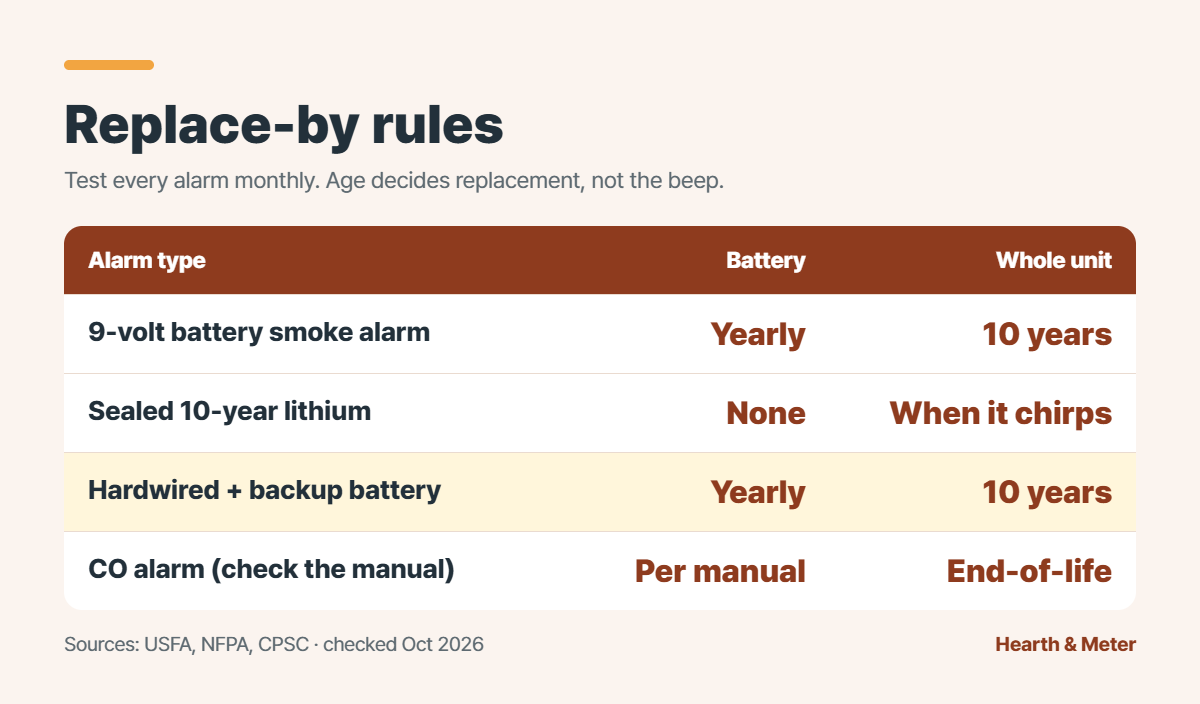
Every alarm has two clocks. One is the battery and one is the sensor itself. The sensor clock is the one people miss, because a 15-year-old alarm can still beep when you press the button. The table below, current as of October 2026, comes from the USFA maintenance guidance and NFPA’s installing and maintaining smoke alarms page.
| Alarm type | Test | Battery | Replace the whole unit |
|---|---|---|---|
| Battery alarm with a 9-volt cell | Monthly | At least once a year | 10 years from manufacture date |
| Sealed 10-year lithium alarm | Monthly | Not replaceable | Per the manufacturer, or right away when it chirps for low battery |
| Hardwired alarm with backup battery | Monthly | Backup battery at least once a year | 10 years from manufacture date |
| CO alarm (any power type) | Per the manual | Per the manual | At the manufacturer’s replacement age or when the end-of-life signal sounds |
The CO row is vaguer on purpose. CPSC says CO alarms have a recommended replacement age listed in the product literature, and newer models give an end-of-life signal. CPSC also notes that the test button checks the circuitry, not the accuracy of the sensor. A CO alarm that passes the button test can still be past its useful life.
Rule of thumb: if the date on the back is more than 10 years old, the smoke alarm comes down, even if the test button still works. Source: U.S. Fire Administration.
What replacement costs in 2026
Two sources give useful numbers. The USFA lists starting prices for the alarms themselves. Angi (updated August 30, 2026) puts the national average for installation at $120 per unit, with most homeowners spending $70 to $150. Angi breaks it down by type:
| Alarm type | Alarm price | Installation |
|---|---|---|
| Battery-operated | $10 to $40 | $20 to $60 |
| Hardwired | $25 to $60 | $75 to $150 |
| Interconnected | $40 to $90 | $100 to $200 |
| Combination smoke and CO | $30 to $80 | $60 to $180 |
| Smart (Wi-Fi) | $50 to $150 | $100 to $250+ |
USFA’s floor prices for the alarm alone: $6 and up for a basic ionization or photoelectric unit, $24 and up for dual-sensor, $30 and up for a microprocessor model, and $40 and up for wireless interconnected alarms. Some fire departments give out free or reduced-price battery alarms and will even install them. Call the non-emergency number to ask.
For Dana and Marcus, adding Angi’s alarm and installation columns gives a rough range. Two hardwired smoke alarms come to $200 to $420. Two hardwired combination units come to $180 to $520. That is $380 to $940 before any minimum service fee, plus a basement battery alarm from $6 upward. Region, labor rates, and whether the old wiring can be reused move the number. Ask each electrician to quote per unit and to say whether the alarm itself is included.
Hardwired alarms are an electrician job
Safety: only qualified electricians should install hardwired smoke alarms (USFA and NFPA). Do not open junction boxes or change wiring yourself. Battery-only alarms are the DIY part of this job.
Questions worth asking before you book:
- Will the new alarms connect to the existing wiring and still interconnect, so one alarm sets off all of them?
- Does my city require a permit for this work? Angi notes permits are sometimes required for hardwired or interconnected installs.
- Is the quote per alarm, and does it include the alarm, the backup batteries, and disposal of the old units?
- Can you add combination smoke and CO units where CO alarms are required by local code?
- Will you test every alarm with me before you leave?
On alarm type, USFA recommends either both ionization and photoelectric alarms or dual-sensor alarms, because no one can predict which kind of fire will start. Your city or state may require a specific type, so check with the local fire marshal before you buy.
CO alarms: placement and what to do when one sounds
CO comes from incomplete burning of fuels such as natural gas, propane, oil, and wood. CPSC estimates that more than 200 people in the U.S. die each year from CO produced by non-automotive consumer products, including furnaces, water heaters, and portable generators. Yet NFPA reports that only 55 percent of surveyed households had at least one CO alarm.
Placement rules from CPSC: put CO alarms on every level and outside sleeping areas, choose units with battery backup if they plug in or are hardwired, and keep them away from heating vents and anywhere furniture or curtains could cover them. Buy alarms that meet the UL 2034 standard. EPA adds that a CO alarm is not a substitute for a smoke alarm, so you need both kinds of protection.
If a CO alarm sounds, do not try to find the source. Move everyone outside to fresh air right away and call 911 or the fire department from outside. Source: CPSC Carbon Monoxide Fact Sheet.
The alarm is a backstop. The appliances are where CO starts, which is why the annual furnace check matters. Our furnace tune-up checklist covers what a technician should look at, including the heat exchanger and venting.
Mistakes that leave a house unprotected
The 2024 CPSC household survey found a gap between owning alarms and maintaining them. Per NFPA’s summary, 99 percent of households had at least one smoke alarm, yet 16 percent of households that believed every alarm worked had at least one problem when tested, such as a dead battery. NFPA’s Smoke Alarms in US Home Fires report puts the stakes in numbers: in 2018 to 2022, 59 percent of home fire deaths happened in homes with no smoke alarms or alarms that failed to operate.
- Pulling the battery during cooking. USFA says to open a window, press the hush button, and fan the air instead. A smoke alarm with no battery protects no one.
- Mounting too close to the stove. NFPA says keep smoke alarms at least 10 feet from a cooking appliance to cut nuisance alarms.
- Wall-mounting too low. The top of a wall-mounted alarm should be no more than 12 inches below the ceiling.
- Ignoring a chirp on a sealed alarm. On a 10-year sealed unit, a low-battery chirp means replace the whole alarm now.
- Trusting the move-in date. The day you got the keys says nothing about how old the alarms are. Read the label.
Ready.gov notes that a fire can become life-threatening in about two minutes, which is the whole reason the monthly button press matters.
Alarms warn you after a fire starts; some appliances can be kept from starting one. NFPA names failure to clean as the leading cause of home clothes dryer fires, and our guide to the signs of a clogged dryer vent shows what to look for and how often to clean the duct.
Reading alarm dates fits the same weekend as booking a furnace tune-up, and our winter home maintenance checklist lays out the rest of the season’s jobs in order.
Smoke and CO alarm checklist for your own house
- Count alarms: inside each bedroom, outside each sleeping area, and on every level including the basement.
- Write down the manufacture date on the back of each alarm.
- Replace any smoke alarm 10 or more years past that date.
- Change 9-volt and hardwired backup batteries once a year.
- Put CO alarms on each level and outside sleeping areas, not in the kitchen.
- Book a licensed electrician for any hardwired replacement.
- Write the install date on each new alarm.
- Press every test button once a month.
Related guide: heating season also raises the bill, and our winter heating bills guide for 2026-27 shows what EIA expects by fuel.
Tonight, do what Dana and Marcus did first: take down one battery alarm and read the date on the back. A date of 2016 or earlier puts it on the replacement list.
This article is general information, not professional advice. Hire licensed contractors for gas, electrical, roof, and HVAC work, and check local codes and permit rules before you start. Alarm prices and requirements vary by state and city.
Leave a Reply