
How to winterize a sprinkler system: shut off its water supply, then get the water out of the pipes with drain valves or a compressed-air blowout before the first hard freeze.
Which of those two you can rely on depends on your climate and on what is buried in your yard. Colorado State University Extension tells cold-climate owners not to trust drain valves at all. Clemson’s extension service says most South Carolina systems need little more than a drained pump. This guide sets the three methods side by side, shows where the official advice splits, and prices a 5-zone yard using cost guides checked on October 29, 2026.
How to winterize a sprinkler system: three methods compared
Every method starts with the same two moves. Rain Bird’s homeowner guide says to shut off the water supply to the irrigation system and switch the controller to its “rain” mode, which stops the signals to the valves. CSU Extension adds that the controller should stay plugged in over winter, because heat from its transformer helps keep moisture and corrosion out of the box. After that, the paths split three ways.
| Method | How the water leaves | Where it fits | The main warning | Pro price range |
|---|---|---|---|---|
| Manual drain valves | You open valves at the low points of the lines and gravity empties them | Systems built with a drain valve at the lowest point of each line | Rain Bird: wear eye protection, because the line stays pressurized until a zone valve is opened | $75–$150 (HomeGuide) |
| Automatic drain valves | Spring-loaded drains on heads or pipes open every time the system shuts off | Lines laid to an even slope toward the drains | Rain Bird: constant puddling around a head can mean a drain is stuck open | No separate charge, since they drain on their own (HomeGuide) |
| Compressed-air blowout | A compressor pushes air through one zone at a time until only mist comes out of the heads | Cold-winter systems, and any system with electric valves (CSU) | Too much pressure, or too long on one zone, can crack fittings or melt parts | $50–$150 for up to 12 zones, plus $5–$10 per extra zone (HomeGuide) |
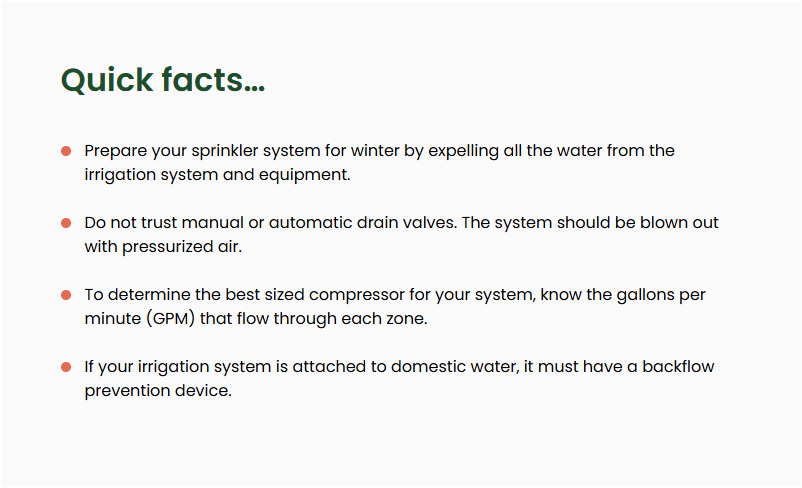
Gravity methods only work if the pipe was laid to an even grade and stayed that way. CSU’s fact sheet explains the catch: buried pipe shifts over the years, nobody can see whether a low spot still holds water, and electric valves keep water sitting above the valve diaphragm that only air can push out. That reasoning is why the fact sheet’s quick facts include the line “Do not trust manual or automatic drain valves.”
Where the guides disagree, and which advice fits your yard
Read three official sources on this job and you will find three different levels of caution. The difference mostly comes down to two things: how deep frost reaches in your area, and who is holding the air hose.
Cold-winter states: plan on a blowout
Where the ground freezes down to the lines, leftover water is the whole risk. CSU notes that water grows by about one-eleventh in volume as it turns to ice, so 11 cubic feet of water becomes roughly 12 cubic feet of ice, which is enough force to split pipe, crack valves and burst sprinkler cases. Its advice for the blowout itself is two short passes per zone rather than one long one, and no third pass once a zone runs dry, since air moving through empty pipe builds heat from friction.
The South: a lighter job with the same weak spots
Clemson’s Home & Garden Information Center says winterizing an irrigation system is generally not required in South Carolina. Its reasons: piping usually sits about 12 inches below ground, where it will not freeze in that climate, and most systems drain over time through their lowest head. The exception is a pump that draws from a pond or other surface water. Clemson says as little as 1/4 inch of water left in a pump casing has been known to freeze and crack it.
The parts above ground still need attention anywhere a freeze is possible. Oklahoma State University Extension lists the main shutoff valve, exposed pipes and the backflow preventer as the pieces to insulate. Rain Bird adds one detail people miss: insulation tape on a backflow preventer must not block its air vents or drain outlets.
Doing the blowout yourself
This is where the sources split hardest. Rain Bird’s blow-out guide says a homeowner can do it with specialty equipment and walks through a procedure. Oklahoma State’s extension column says the opposite about the air method: “This isn’t something a homeowner should do on their own.” The University of Minnesota turfgrass program draws the line in the middle. It leaves the early steps to owners, such as running each zone to find broken heads, shutting off the water and opening valves to release pressure, and hands the blowout to a certified irrigation professional.
The equipment gap explains part of that split. HomeGuide reports that contractors use compressors rated at 80 to 100 CFM. CSU explains what happens with too little air volume: the air rides over the top of the water, and what is left drains back into low spots to freeze. Pressure limits also depend on the pipe. CSU caps rigid PVC at 80 psi and flexible black polyethylene at 50 psi, while Rain Bird’s homeowner steps set the regulator at 50 psi and run each zone no longer than 2 minutes at a time.
Safety box. Compressed air can throw nozzles and debris. Rain Bird says to wear eye protection and never stand over heads, valves or pipes during a blowout. CSU warns that pressure vacuum breaker (PVB) and reduced pressure (RP) backflow devices must never be blown out with compressed air, because their rubber seals can melt. If you cannot name the device in your yard, leave the air step to a certified pro.
What a pro blowout costs: a 5-zone yard worked through
Take a hypothetical house with a 5-zone system in a cold-winter suburb, booked for one fall visit and one spring visit. The two national price guides bucket the work differently, so line them up before reading any quote.
- Fall blowout: HomeGuide (February 3, 2026) puts winterization at $50 to $150 for systems up to 12 zones. HomeAdvisor (updated June 17, 2026) gives an average of $93, with most owners paying $56 to $137, and lists 5 to 6 zones at $100 to $130.
- Spring startup: HomeGuide lists $60 to $125.
- Two separate visits: using HomeGuide’s ranges, $50 + $60 = $110 at the low end and $150 + $125 = $275 at the high end.
- Bundled plan: HomeGuide prices a winterization plus spring restart plan at $140 to $180 for systems with 1 to 5 zones.
So the bundle lands inside the two-visit range. It beats booking two visits at the high end and costs more than two at the low end. Ask any company that offers a plan to quote both ways, and check whether its spring visit includes a leak check, because HomeGuide’s startup description covers checking the backflow device and piping for leaks before raising the pressure.
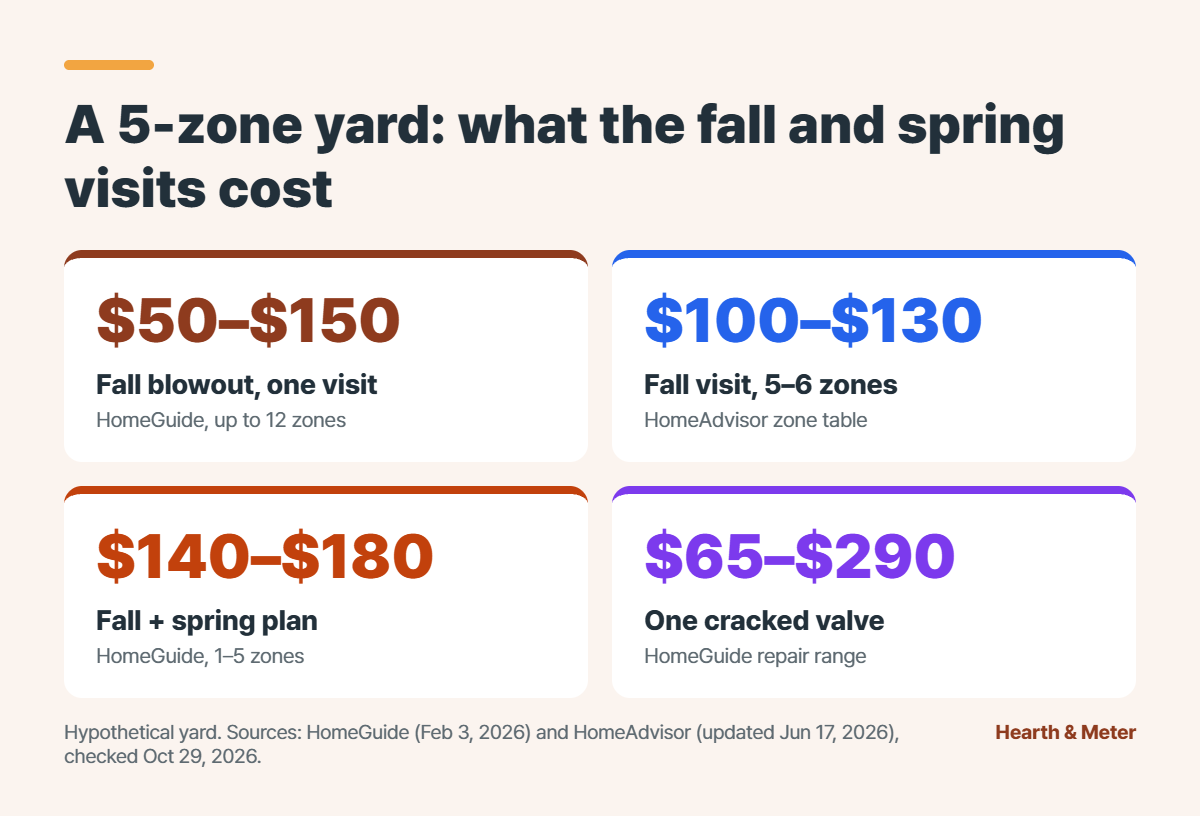
Skipping the fall visit moves the money to spring. HomeGuide lists sprinkler valve replacement at $65 to $290, sprinkler head replacement at $130 to $275, and leaking PVC pipe replacement at $1 to $3 per linear foot. A full new system runs $3,000 to $10,000 in the same guide. For a yard with 7 to 8 zones, HomeAdvisor’s table moves the fall visit up to $150 to $250. A cracked line that goes unnoticed in spring also shows up on the water bill; the meter test in our guide to a water bill that suddenly jumps can confirm a hidden leak before you dig.
Before the crew comes: zones, backflow device, and a certified pro
Two facts set both the method and the quote: how many zones you have and which backflow device protects your drinking water. The zone count is the number of stations in use on your controller. For the device, UMN says the irrigation shutoff sits between the water supply and the backflow preventer, so look in the basement, the crawlspace, or an underground valve box near where the irrigation line leaves the house. A clear photo of it lets a crew tell a PVB from an RP before anyone arrives.
For finding someone qualified, UMN points to WaterSense certified or Irrigation Association certified professionals. As of October 29, 2026, EPA’s WaterSense Find a Pro directory searches by ZIP code with a 25-mile default radius. It filters by certification (Irrigation System Audit, Irrigation System Installation and Maintenance, Irrigation System Design), by residential customers, and by whether the pro is available for hire. EPA says the directory is updated quarterly, so a newer certification may not show yet.
When you call, these four questions separate a careful crew from a rushed one:
- Will you drain or blow out my system, and what pressure will you set for my pipe type?
- Do you winterize the backflow device and insulate the parts above ground, or only the zones?
- Is the spring startup included, or priced as its own visit?
- If my water utility requires a yearly backflow test, can you do it? HomeGuide lists that test at $60 to $150 where required.
The sprinkler is one of several freeze jobs that land in the same weeks. Hose bibs and exposed pipes are covered in how to prevent frozen pipes before the first hard freeze, and the full fall sequence is in our winter home maintenance checklist.
This weekend, count the stations on the controller and photograph the backflow device. Send both photos with your quote requests, and book a date before your 10-day forecast shows the first hard freeze.
This article is general information, not professional advice. Irrigation systems differ by installer, pipe type and local code, and some states require plumbing, irrigation or landscaping credentials for this work. Hire a certified irrigation professional for blowouts, check your water utility’s backflow rules, and follow the manufacturer’s instructions for your equipment.
Leave a Reply