
The usual mistake is waiting until the chimney looks dirty. So how often should you clean your chimney? The answer in the national standard has two parts. NFPA 211, the standard most chimney sweeps work from, says chimneys, fireplaces and vents shall be inspected at least once a year, with cleaning done if necessary. The Chimney Safety Institute of America (CSIA) then sets the cleaning trigger: sweep a masonry fireplace flue at 1/8 inch of sooty buildup, or sooner if any glazed creosote is present.
Standards quoted below come from the Chimney Safety Institute of America and NFPA pages as they read on Oct 25, 2026. Prices are from HomeGuide’s cost guides dated February 9, 2026.
So the inspection is yearly and fixed, while the sweep depends on what the inspection finds. Most of the bad decisions people make about chimneys come from five beliefs that sound reasonable and do not hold up against what CSIA and NFPA actually publish. They are taken one at a time below, followed by what the work costs and what to ask when you book it. Everything here is checked against those published sources, and none of it replaces a certified sweep looking at your own flue.
How often should you clean your chimney? Inspect yearly, sweep at 1/8 inch
CSIA’s homeowner FAQ quotes NFPA 211 word for word: “Chimneys, fireplaces, and vents shall be inspected at least once a year for soundness, freedom from deposits, and correct clearances. Cleaning, maintenance, and repairs shall be done if necessary.” The cleaning thresholds depend on what kind of system you have, and CSIA separates them clearly.
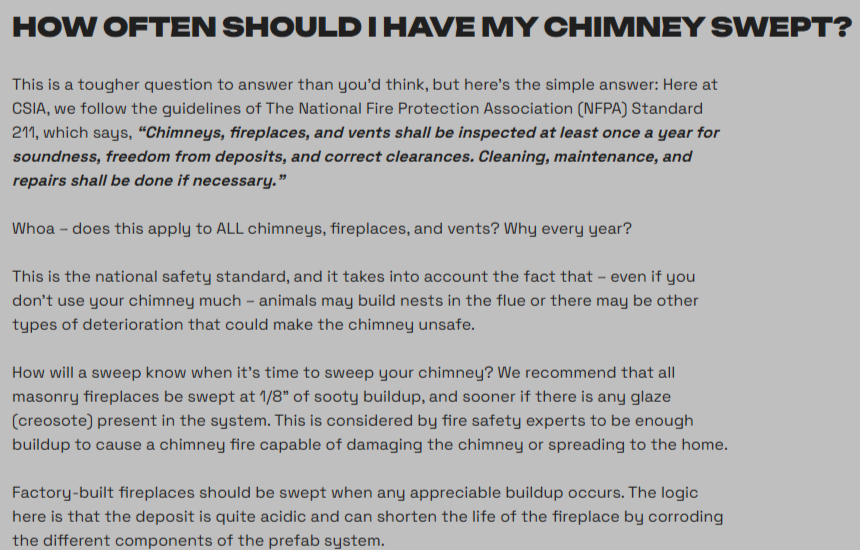
Factory-built (prefab) fireplaces get a stricter rule: sweep when any appreciable buildup occurs, because CSIA says the deposit is acidic enough to corrode the metal parts of a prefab system. For wood stoves and other appliances on a masonry chimney, CSIA’s Level 1 inspection procedure (revised April 2019) tells sweeps to sweep, or recommend sweeping, any chimney with 1/8 inch or more of buildup. The table below puts those rules next to typical cleaning prices so you can see what each setup usually means for your budget.
| Your setup | When it needs a sweep | Typical cleaning cost* |
|---|---|---|
| Masonry chimney, wood fireplace | 1/8 inch of soot, or any glazed creosote | $150 to $375 |
| Factory-built (prefab) fireplace | Any appreciable buildup | $90 to $175 |
| Wood or pellet stove | 1/8 inch or more found at inspection | $130 to $300 |
| Gas fireplace or gas furnace flue | When inspection finds debris, nests or venting problems | $80 to $150 (gas fireplace) |
*Cleaning ranges from HomeGuide’s chimney sweep cost guide (Feb 9, 2026); HomeGuide says they include a Level 1 inspection. Sweep triggers from CSIA Homeowner FAQs and the CSIA Level 1 procedure, checked Oct 25, 2026. Every row still gets the yearly inspection.
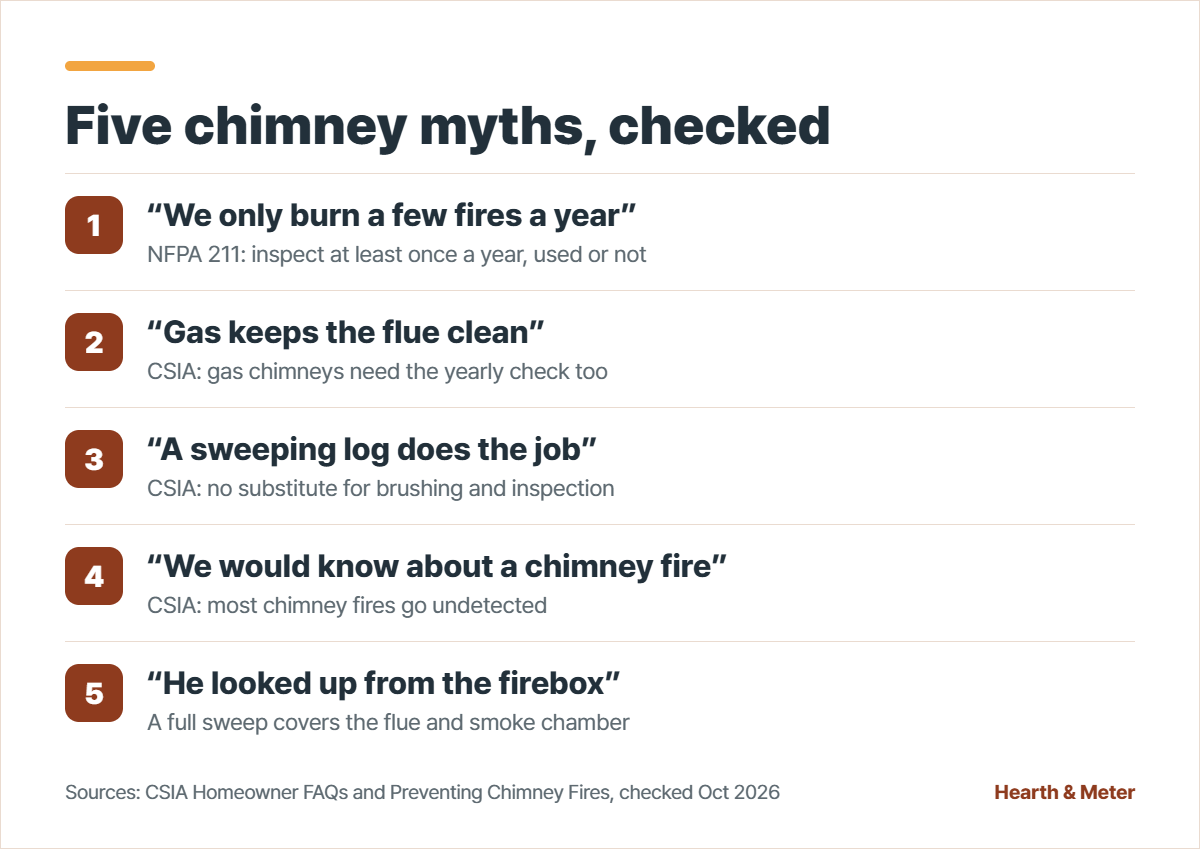
“We only light a few fires a year”
Light use lowers the odds of heavy creosote, but it does not change the inspection interval. CSIA answers this directly: the yearly standard accounts for the fact that, even if you rarely use the chimney, animals may build nests in the flue or the masonry may deteriorate in ways that make it unsafe. An idle flue with no cap is an easy place for a bird or squirrel to move in over the summer.
What light use can change is how often the sweep finds enough buildup to clean. Burning dry wood helps most. EPA’s Burn Wise guidance (an archived page that EPA stopped updating on Oct 30, 2025) says to season firewood for at least six months and that wood burns best below 20 percent moisture, measured with a wood moisture meter. CSIA lists unseasoned wood, a restricted air supply and a cool flue as the conditions that speed up creosote.
“It’s a gas furnace, so the chimney stays clean”
CSIA’s FAQ answers “I heat with gas. Should my chimney be checked too?” with “Without a doubt.” Gas burns cleanly, but a bird nest or fallen debris can still block the flue, and CSIA notes that modern high-efficiency furnaces can run into trouble when they vent through an older flue built for older equipment. A blocked or poorly matched flue can send carbon monoxide back into the house without leaving any visible soot.
CSIA’s carbon monoxide page cites Consumer Product Safety Commission figures of more than 200 deaths a year from CO caused by problems venting heating systems. It also points at tighter houses, which leave less air for the burner and can pull air down an unused flue. If you have been sealing air leaks around the house this fall, mention it to whoever checks the furnace venting. The chimney check pairs naturally with the yearly furnace tune-up, and a working CO alarm on every level is the backstop if venting fails between visits. Our guide on when to replace smoke detectors and CO alarms covers the dates printed on the back.
Safety first. A loud rumble or popping in the chimney, dense smoke or flames from the top, or a sudden hot smell can mean a chimney fire. Get everyone out and call 911 from outside. If a CO alarm sounds, move everyone to fresh air and call 911. Do not climb onto the roof or run a brush up the flue yourself; chimney sweeping, liner work and gas venting belong to a certified sweep or a licensed gas contractor.
“A creosote sweeping log will handle it”
Chemical cleaning logs and powders are sold on the promise that they loosen creosote as you burn them. CSIA’s position is that these products are not an adequate substitute for a professional sweep and inspection, and that marketing claims may give owners a false sense of security. Professional sweeps do use chemical treatments on hard, glazed creosote, but as a step before mechanical brushing.
The physical reason is simple. Many fireplace and wood stove chimneys have a smoke shelf, a baffle or an offset rather than a straight run to the sky. If a product makes deposits flake off, those flakes land on the shelf or in the bend and still have to be removed by hand. A log also cannot tell you that a flue tile has cracked, which is the main point of the yearly inspection.
“If we’d had a chimney fire, we would know”
Some chimney fires are loud enough for the neighbors to notice. CSIA’s chimney fire page says most are not: slow-burning chimney fires often go undetected until a later inspection, yet they can reach temperatures high enough to crack flue tiles and damage nearby framing. In a masonry chimney, CSIA puts chimney fire temperatures at around 2,000°F. Factory-built metal chimneys damaged by a chimney fire should no longer be used and must be replaced, according to the same page.
The signs a sweep looks for include puffy or honeycombed creosote, a warped damper or metal connector, cracked or missing flue tiles, a discolored rain cap, creosote flakes on the roof or ground, and smoke escaping through mortar joints. CSIA’s Level 1 procedure tells sweeps to photograph any evidence of a chimney fire and recommend a Level 2 inspection before going further. The scale is real: in USFA’s report on 2017 to 2019 data, fires confined to a chimney or flue made up about 49 percent of residential building heating fires. NFPA’s home heating safety page adds that fires involving fireplaces or chimneys that spread beyond the flue were 6 percent of heating equipment fires in 2020 to 2024 but caused nearly one fifth (19 percent) of the property damage.
“The sweep looked up from the fireplace, so we’re done”
A look into the firebox with a flashlight is not a sweep. CSIA’s FAQ describes a homeowner whose sweep only brushed the firebox brick and did not touch the flue, and its answer is that a complete chimney sweeping includes the chimney flue and the smoke chamber. CSIA suggests asking for “a Level 1 chimney inspection and a chimney sweeping” by name, and finding someone else if the sweep does not know what Level 1 means.
Level 1 covers the readily accessible parts of the appliance, the chimney and the connection between them, and the sweep has to confirm the flue is not blocked. A Level 2 inspection goes further, typically with a camera through the flue and a look in the attic or crawl space. CSIA’s procedure treats Level 1 as the right choice when nothing is changing, such as a yearly check or swapping in an appliance of the same type, and it calls for a Level 2 recommendation when there are signs of a chimney fire. HomeGuide describes Level 2 as the usual pick when buying a home or changing fireplace connections, and Level 3, which can mean removing a cap, bricks or drywall, as rare and reserved for suspected structural damage.
What a chimney sweep and inspection cost, with a two-flue example
HomeGuide’s inspection cost guide (Feb 9, 2026) lists these national averages for wood-burning setups: Level 1 at $100 to $250, Level 2 at $250 to $600 for up to two flues, and Level 3 at $900 to $5,000. Its sweep guide prices cleaning by number of flues: $100 to $250 for one, $250 to $400 for two, and $400 to $700 for three. Steep roofs, multiple stories, heavy buildup and city locations push the price up. HomeGuide also says late spring and summer bring lower demand than fall, so October bookings may wait longer.
A worked example (hypothetical)
Take a two-story house with one masonry chimney holding two flues: a wood-burning fireplace and a gas furnace. Using HomeGuide’s two-flue range, the yearly sweep and Level 1 check comes to $250 to $400. Spread over twelve months, that is about $20.83 to $33.33 a month, and $1,250 to $2,000 across five years.
If you were buying that house, the first visit would be a Level 2 inspection instead, at $250 to $600 for up to two flues. Repairs that the camera turns up are harder to budget for in advance. HomeGuide prices a new chimney liner at $1,500 to $4,000 and crown repair at $150 to $1,500, and a camera inspection is how you learn about cracked tiles before the heating season instead of after a chimney fire.
Before you call: what to ask when you book
Book this week if you plan to light the first fire or start the furnace soon. CSIA keeps a searchable list of certified sweeps, which is a fair place to start. On the phone, ask four things. Will the visit include a Level 1 inspection plus a full sweep of the flue and smoke chamber? Is every flue in the chimney covered, including the furnace or water heater flue, and at what price per flue? Will you get a written report with photos or camera footage of anything they flag? If they recommend a Level 2 inspection or a liner, can they show you the specific finding that led to it?
Write the date of the visit somewhere you will see it next fall, and keep the report. If the sweep measured less than 1/8 inch of buildup and no glaze, you have your answer for this season. For the rest of the cold-weather jobs and the order they come due, our winter home maintenance checklist lays them out from late October to March.
This article is general information, not professional advice. Chimney, gas, venting and roof work should be done by certified or licensed professionals; check your local codes, permits and your appliance manufacturer’s instructions.
Leave a Reply