
A toilet that keeps running has one of two problems: water is coming in too high and spilling down the overflow tube, or water is leaking out of the tank past a worn flapper. Two free tests, about 10 minutes each, tell you which one you have before you buy a single part.
It is worth the 20 minutes. EPA WaterSense says household leaks waste about 180 gallons a week in the average home and that toilets are often the culprit, mostly because of old or worn flappers. Below is the order to check things, what each answer means, and how to put a dollar figure on the leak.
Toilet keeps running? Start with two quick tests
Lift the tank lid and set it somewhere flat. You are looking at three parts: the fill valve (the tall valve on one side, fed by the supply line), the overflow tube (the open pipe in the middle), and the flapper (the rubber seal at the bottom that lifts when you flush).
- Overflow check. Watch the tank refill after a flush. Fluidmaster’s troubleshooting guide starts here: if the water keeps rising until it drains into the overflow pipe, the problem is on the fill side.
- Drop test. With the tank full, turn off the supply valve behind the toilet and mark the water line with a pencil. Wait 10 to 15 minutes. A line that sinks below your mark means water is escaping into the bowl, and the flapper is the usual cause.
- Dye test. EPA’s version: add a few drops of food coloring to the tank and wait 10 minutes without flushing. Color in the bowl means a leak. Flush afterward so the dye does not stain.
The dye test catches slow, silent leaks that you never hear. The drop test tells you roughly how fast it is going.
If water spills into the overflow tube
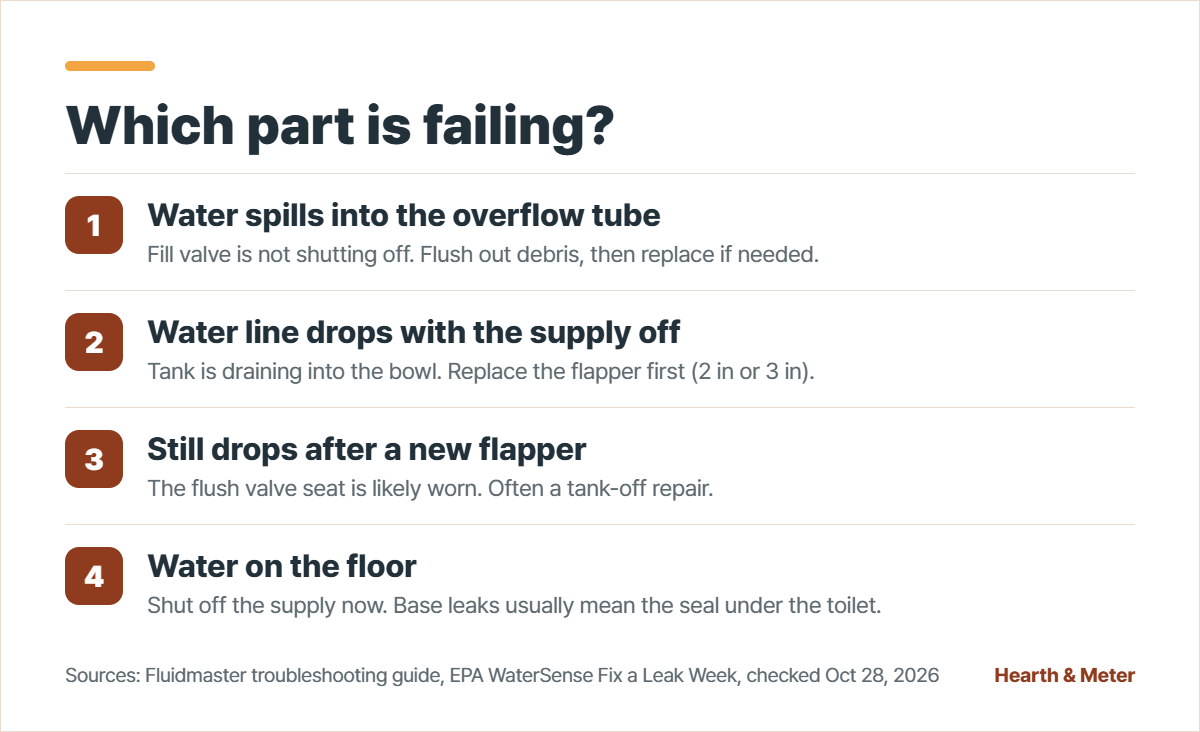
When the level climbs into the overflow, the fill valve is not shutting off. Fluidmaster’s guide says debris lodged in the valve is a common cause and walks through flushing it out: water off, remove the valve cap, hold a cup over the opening, and run the supply for 10 to 15 seconds. The exact cap removal differs by model, so follow the instructions for the valve in your tank.
If cleaning does not stop it, the guide’s next step is a new fill valve. That is a common homeowner repair, but it means disconnecting the supply line, so make sure the shutoff valve actually closes first. If it is seized or drips at the stem, that is your cue to call a plumber rather than force it.
When the water line drops with the supply off
A falling water line with the supply off means the tank is draining into the bowl. Both Fluidmaster and EPA point to the flapper first. EPA’s Fix a Leak Week page says flappers should be checked periodically and replaced at least every five years, and that a worn one can make a toilet flush on its own or silently leak thousands of gallons a year.
Flappers come in 2-inch and 3-inch sizes. EPA suggests bringing the old one, or a photo of it, to the store and noting whether it has a foam float. Buying the wrong size is the most common reason a “fixed” toilet keeps running.
Turn the supply valve off before you reach into the tank, and flush once so the tank is mostly empty. It keeps the job dry and shows you whether the valve still works.
A new flapper did not stop the leak
Repeat the drop test after the new flapper is in. Should the level still fall, Fluidmaster’s next step is replacing the flush valve, the seat the flapper seals against. A pitted or cracked seat will defeat any new flapper. On most two-piece toilets that job means separating the tank from the bowl, which is where many homeowners decide to hand it off.
Water on the floor is a different job
A running sound plus water on the floor needs a faster response. Fluidmaster’s guide says to turn off the water immediately and check whether it is coming over the top of the tank or from the lever area. Water around the base of the toilet usually means a failed seal under the toilet, and that repair involves pulling the toilet. Leave the supply off and call a licensed plumber if you are not comfortable lifting and resetting it, since a bad reset can leak into the subfloor.
What a running toilet costs on your water bill
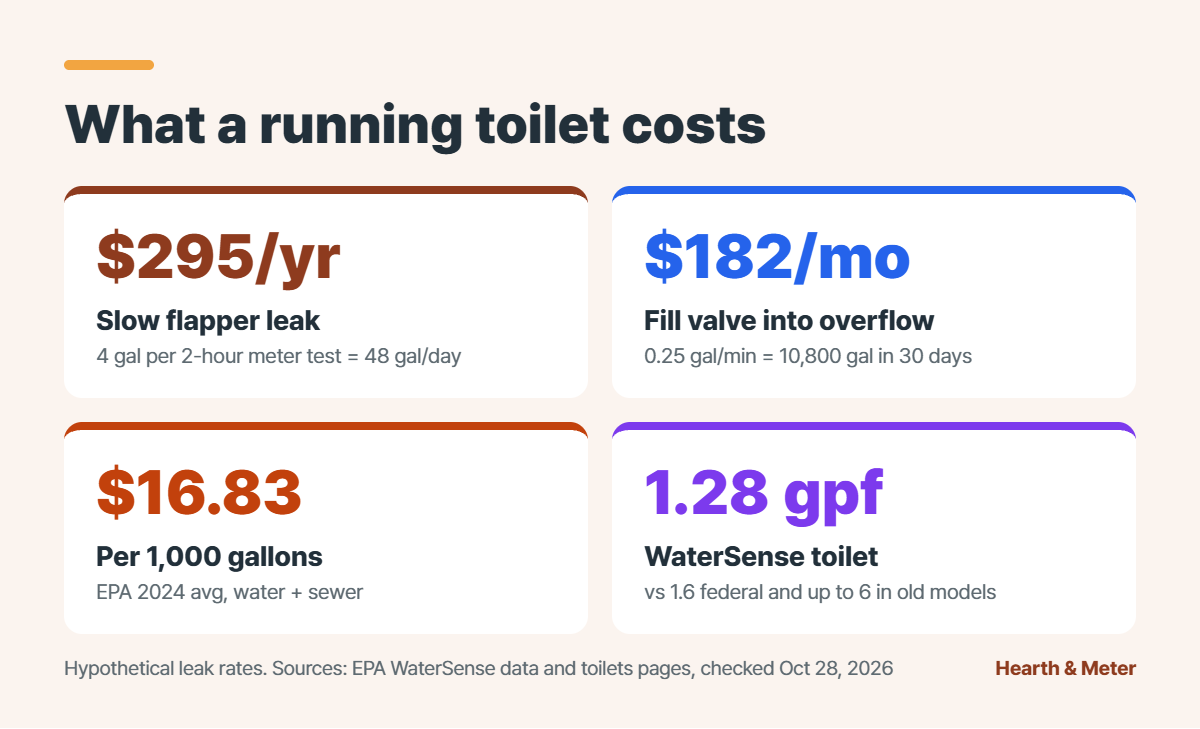
EPA WaterSense puts the 2024 national average residential rate at $16.83 per 1,000 gallons for water and sewer combined. Your utility’s rate may be higher or lower, so swap in the number from your bill. Two hypothetical leaks show the range:
- Slow flapper leak, 4 gallons in a 2-hour meter test: 48 gallons a day, 17,520 gallons a year, about $295 a year at $16.83.
- Fill valve running into the overflow at a quarter gallon a minute: 360 gallons a day, 10,800 gallons in 30 days, about $182 on a single month’s bill.
To measure your own leak rate, use the 2-hour meter reading described in our guide to why your water bill is so high. EPA’s rule of thumb from the same page: a family of four using more than 12,000 gallons a month in January or February probably has a serious leak.
Old toilet: repair it or replace it?
A new flapper fixes the leak, not the flush volume. According to EPA’s residential toilets page, older toilets can use as much as 6 gallons per flush. The current federal standard is 1.6 gallons, and WaterSense labeled models use 1.28 gallons or less. EPA estimates that replacing old, inefficient toilets saves the average family nearly 13,000 gallons and more than $170 a year in water costs.
That makes the decision fairly simple. If your toilet was installed after the 1.6-gallon standard and the bowl and tank are sound, repair it. If it is an older high-volume model that now needs a flush valve or keeps needing parts, replacement deserves a look. Many utilities offer rebates on WaterSense toilets, and EPA keeps a rebate finder you can search by zip code. Showers are the other big indoor use; our breakdown of how much water a shower uses does the same math for that.
Your next 20 minutes
Tonight, after the last flush, do the dye test. Color in the bowl by morning means it is time to mark the water line with the supply off and confirm it drops. Then take a photo of the flapper and the flush valve opening so you buy the right size the first time. A shutoff valve that will not turn, a cracked tank or bowl, or water pooling at the base are all reasons to skip the parts aisle and book a licensed plumber.
This article is general information, not professional plumbing advice. Water rates, toilet designs and local plumbing codes vary. Hire a licensed plumber for work you are not comfortable doing, and check your utility for current rates and rebates.
Leave a Reply