

A load of jeans that used to dry in one cycle now needs two, and the towels come out warm but still damp in the middle. Before you shop for a new dryer, look at the duct behind it. Slow drying and damp clothes are two of the signs of a clogged dryer vent that the U.S. Consumer Product Safety Commission lists in its overheated clothes dryer safety alert, and CPSC ties both to a blocked lint screen or exhaust duct.
The bigger reason to check is fire. In NFPA’s Home Dryer Fires report (June 2020, covering 2014 to 2018), U.S. fire departments responded to an estimated 13,820 home fires a year in which dryers were involved in ignition, and failure to clean was the cause in 32 percent of them. An older U.S. Fire Administration analysis of 2008 to 2010 data found these fires were more common in fall and winter, peaking in January. Late October, before bulky winter laundry starts, is a sensible time to trace the whole path from lint screen to outdoor hood.
This guide covers vented electric and gas dryers in houses. Shared exhaust systems in apartment buildings are usually handled by building management, so ask them. Ventless dryers have no exhaust duct and get a short note further down. The sections below are organized as the questions a slow dryer raises, from symptoms to cost.
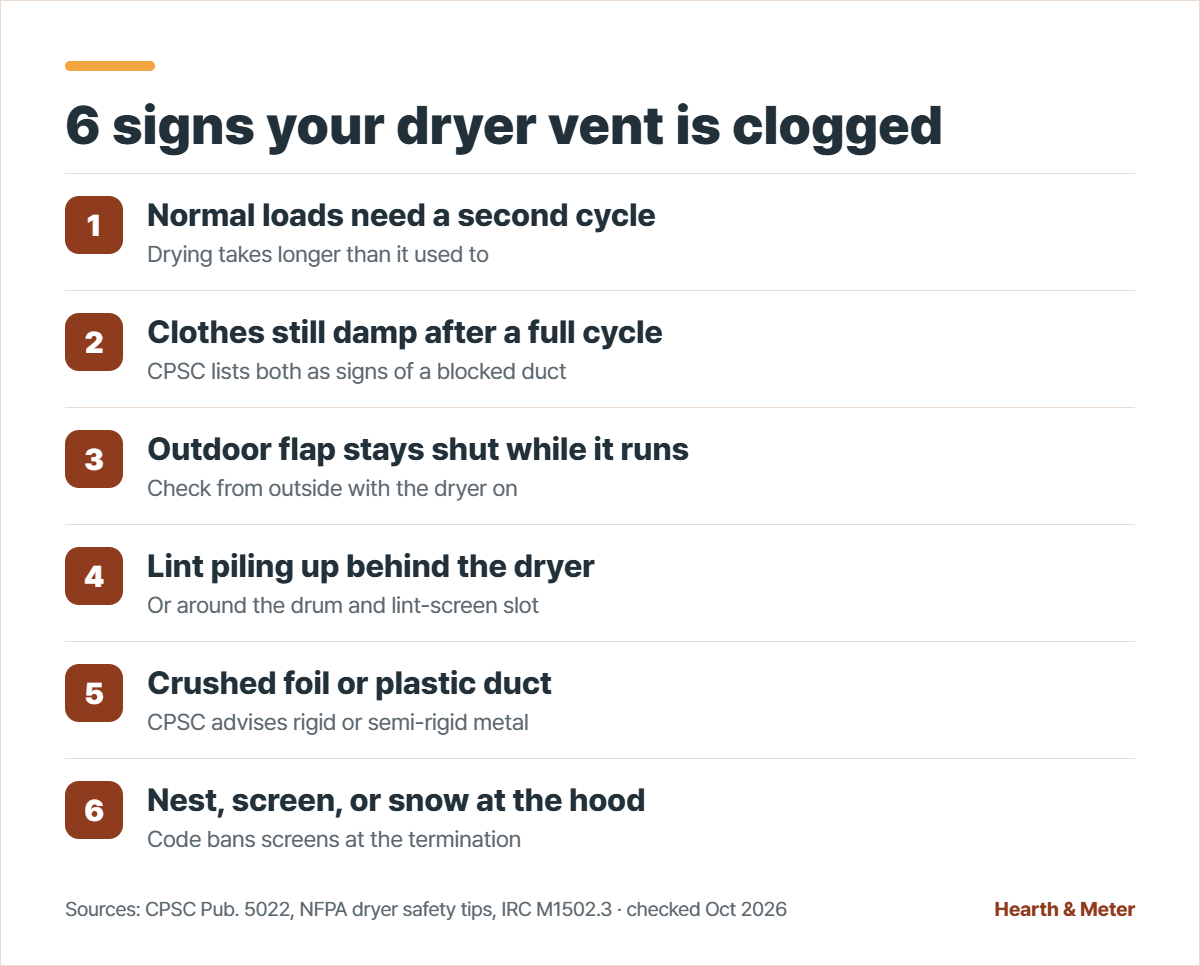
What are the signs of a clogged dryer vent?
One sign on its own can have another cause, such as an overloaded drum. When two or three show up together, the duct is the first suspect.
- Drying takes longer than it used to. CPSC says clothing that is still damp at the end of a typical cycle, or drying that takes longer than normal, may mean the lint screen or the exhaust duct is blocked.
- The outdoor flap stays shut. NFPA’s clothes dryer safety tip sheet says the outdoor vent flap should open when the dryer is operating.
- Lint collects where it shouldn’t. Look behind the dryer, around the drum opening, and in the lint-screen slot. CPSC specifically calls out the area behind the dryer as a place lint builds up.
- The duct behind the machine is crushed. CPSC warns that flexible plastic or foil duct kinks and crushes easily, which can greatly reduce airflow.
- Something covers the hood. USFA lists nests of small birds or other animals as a cause of blocked vents. Screens are another culprit: the 2021 International Residential Code (Section M1502.3) says screens shall not be installed at the duct termination. In winter, NFPA adds snow to the list.
How to test for a dryer vent blockage from outside
- Clean the lint screen first, so you are testing the duct and not the filter.
- Start the dryer on a heated cycle with a few damp towels inside.
- Walk outside to the vent hood. If it exits through the roof, look from the ground only.
- Hold your hand near the opening, not inside it. You should feel a steady stream of warm, moist air and see the flap or louvers open. CPSC recommends exactly this check while the dryer is running.
- If airflow is weak or missing with a clean lint screen, the restriction is somewhere in the duct, the hood, or the short transition duct behind the machine.
What causes a dryer vent blockage, and who fixes each cause?
Lint rides out of the drum with a lot of water vapor. USFA notes that a full load of wet clothes can hold as much as one and a half gallons of water, and the lint the filter misses travels down the vent with that moist air. The Department of Energy’s Building America Solution Center adds that spiral foil ducts trap lint, so the dryer has to run longer and hotter to finish a load. The five usual causes, with the fix and who should handle it:
- Lint packed along the duct. Cycles keep getting longer. Brush out the duct or book a cleaning: a short wall run is a homeowner job, while long or hidden runs go to a pro.
- Foil or plastic accordion transition duct. You see crushed or sagging sections behind the dryer. CPSC says to replace it with rigid or semi-rigid metal, and the IRC caps the transition piece at 8 feet and requires a UL 2158A listing. You can swap it on an electric dryer; on a gas dryer, a pro does it.
- A run that is too long or has too many elbows. Drying stays slow even right after a cleaning. The answer is a reroute, smoother elbows, or the dryer maker’s length table, handled by a licensed contractor.
- A blocked hood: nest, screen, or stuck damper. The flap stays shut and little or no air comes out. Clear it, and replace a screened hood with one that has a backdraft damper; this is yours if the hood is reachable from the ground.
- A duct that ends in the attic, crawlspace, or garage. The space indoors turns damp or linty. The duct has to be extended outdoors, since the IRC requires an outside termination, and that is contractor work.
That last cause ties into air sealing. If you sealed your attic this fall, confirm that no dryer duct dumps into it; our guide to sealing air leaks in your home flags the same problem before you start.
How long can a dryer vent duct be?
The 2021 IRC limits the dryer exhaust duct to 35 feet, measured from the transition duct connection to the outdoor terminal (Section M1502.4.6.1). Every elbow uses part of that budget. A mitered 90-degree elbow counts as 5 feet and a mitered 45 counts as 2 feet 6 inches, while a smooth 90 with a 6-inch radius counts as only 1 foot 9 inches. Section M1502.4.6.2 also lets the dryer maker’s installation instructions set the size and length, so read your manual before assuming 35 feet applies. Your city or county may adopt a different code edition with amendments, and the local building department has the final word.
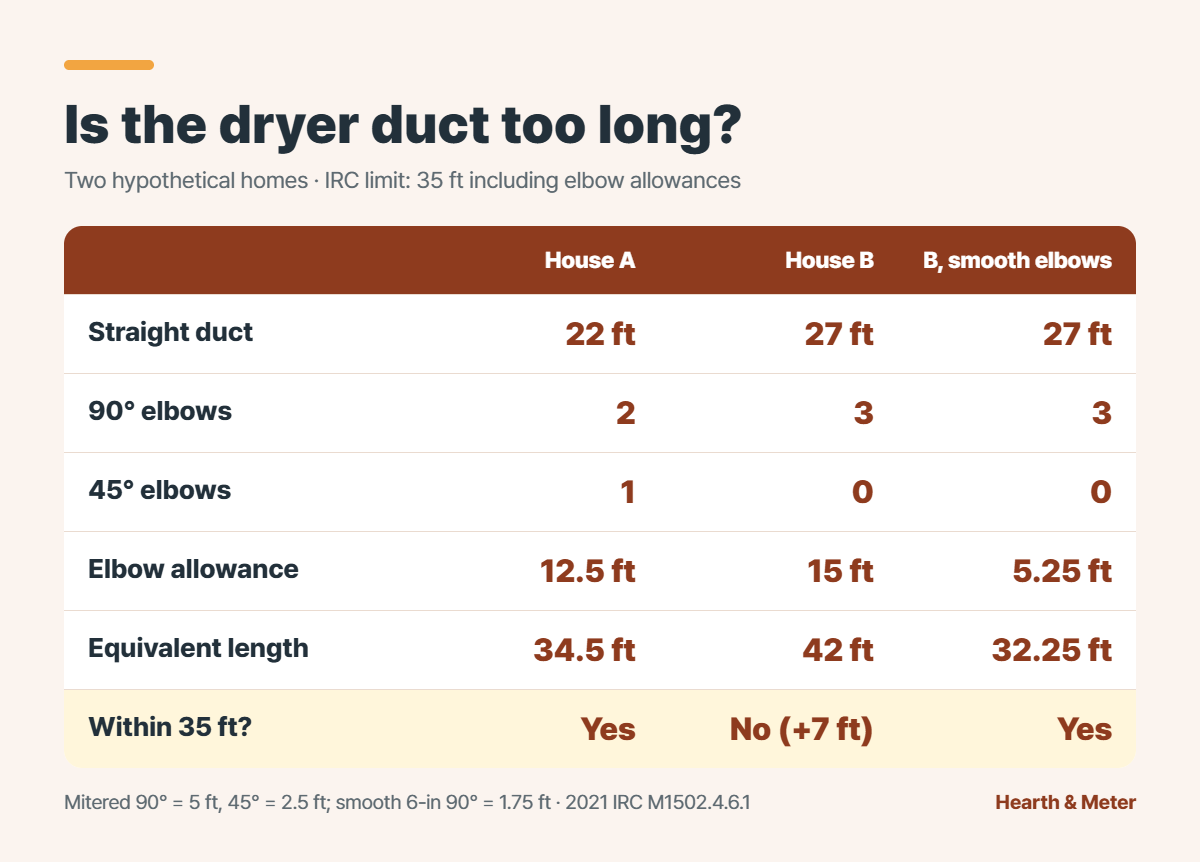
House A (hypothetical) has a first-floor laundry room with 22 feet of rigid duct, two mitered 90s, and one mitered 45. The math is 22 + 5 + 5 + 2.5 = 34.5 feet. It passes with half a foot to spare, which also means a future remodel can’t add another elbow without rerouting.
House B (hypothetical) moved its laundry upstairs. The duct runs 27 feet with three mitered 90s: 27 + 15 = 42 feet, seven feet over. Swapping in three 6-inch-radius smooth elbows brings it to 27 + 5.25 = 32.25 feet, inside the limit. Other routes a contractor may suggest are a shorter path, a longer length the dryer maker’s instructions allow, or a dryer exhaust duct power ventilator listed to UL 705 (M1502.4.4). Domestic booster fans are not allowed in dryer exhaust systems (M1502.4.5). When the equivalent length goes past 35 feet under one of those options, the code requires a permanent label within 6 feet of the duct connection (M1502.4.7).
Even a legal long run collects lint faster than a short one. HomeAdvisor’s cost guide makes the same point: dryers far from an exterior wall need more frequent cleanings.
How often should you clean a dryer vent?
- Lint screen: before or after every load, per both CPSC and NFPA. Never run the dryer without the filter in place.
- Vent pipe: NFPA says once a year, or sooner if clothes start taking longer than normal to dry.
- Inside the cabinet: CPSC suggests having a qualified service person clean the interior of the dryer chassis periodically, since lint also gathers where you can’t see it.
- Gas dryers: NFPA recommends an inspection by a qualified professional to confirm the gas line and connection are intact and free of leaks.
- Ventless and heat pump dryers: ENERGY STAR describes heat pump dryers as a closed loop that reuses air instead of sending moist air out a dryer vent, so there is no exhaust duct to clean. Follow the manual for their filters and condensers.
“The leading cause of home clothes dryer fires is failure to clean them.” NFPA, Clothes Dryer Safety tip sheet
What does dryer vent cleaning cost?
HomeAdvisor’s cost guide (updated June 17, 2026) puts the national average at $145, with most jobs between $104 and $188 and outliers from $75 to $340. Thumbtack’s cost page (updated July 8, 2026) reports a much higher band from its own marketplace data, shown below. Neither page lists exactly which job types fall inside its range, so the gap is best read as a spread between a simple wall vent and a complicated one.
Thumbtack’s typical range runs $186 to $510, with an average of about $307 and a low-to-high spread of $94 to $1,074. Set against HomeAdvisor’s $104 to $188 typical range and $75 to $340 spread, the Thumbtack average sits above HomeAdvisor’s entire typical band.
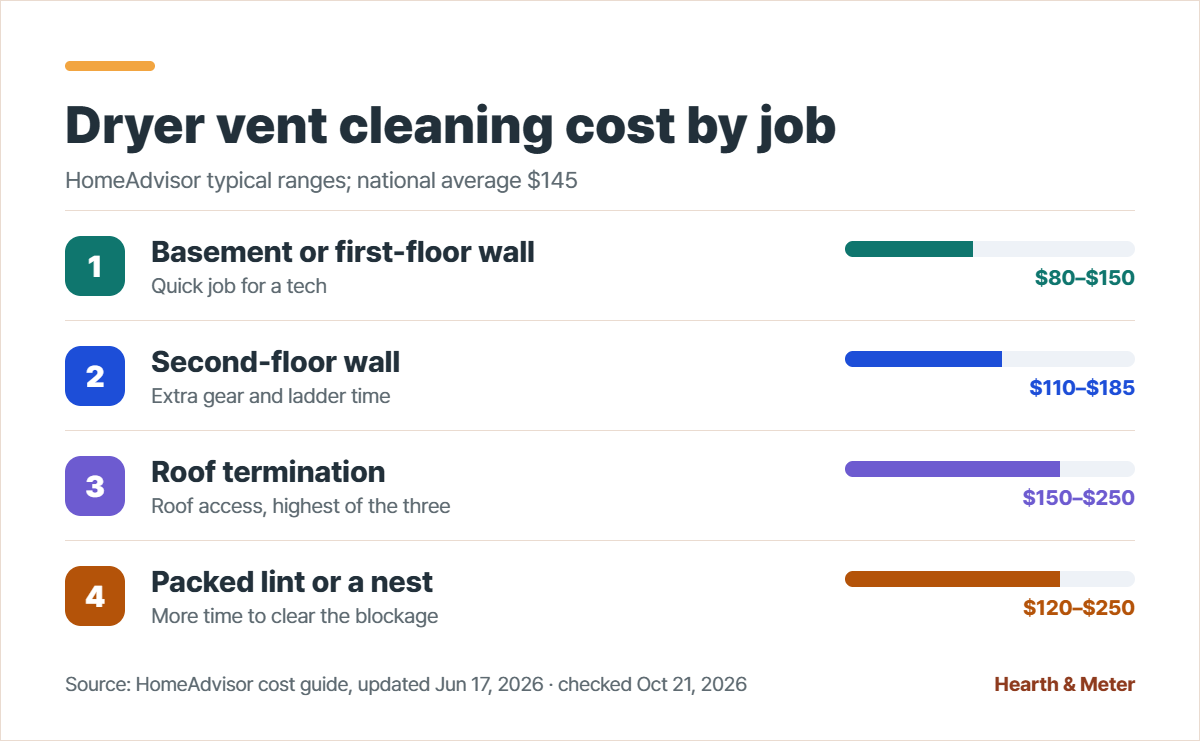
Location moves the price most. HomeAdvisor lists $80 to $150 for a basement or first-floor wall vent, $110 to $185 for a second-floor wall, and $150 to $250 for a roof termination. Packed lint or a nest averages $120 to $250. If the duct itself is damaged or needs rerouting, as in House B, that is separate work that HomeAdvisor prices at $80 to $1,000 depending on placement and materials. Ask for a written quote that separates cleaning from any duct repair.
Which dryer vent jobs can you do yourself?
On an electric dryer with a wall vent you can reach from the ground, the basic upkeep is homeowner work. Unplug the dryer before you pull it out, clean the lint screen slot and the floor behind the machine, check the transition duct for crushed spots, and clear the outdoor hood. CPSC notes that removing a blockage may mean disconnecting the duct from the dryer, and reminds you to reconnect it to the dryer and the outside vent before the next load.
Safety first: leave disconnecting or moving a gas dryer to a qualified technician, and have the gas line and connection inspected. If you smell gas, leave the house and call your gas utility or 911 from outside. A vent that exits through the roof is a roof job; hire it out rather than climbing up. If you smell burning while the dryer runs, stop it and keep it off until the dryer and vent have been checked.
Hand these jobs to a licensed contractor as well: ducts hidden inside walls or ceilings, any reroute or length change, a duct that ends indoors, and a power ventilator install. A working smoke alarm near the laundry area is your backup if lint ever does ignite; our guide on when to replace smoke detectors explains how to read the manufacture date on the back of each unit.
Dryer vent cleaning is step four in our winter home maintenance checklist, which runs from the October heating tune-up to the March heating bills.
What to do before the first cold snap
- This weekend, run the outdoor airflow test above with a clean lint screen.
- If airflow is weak, clean behind the dryer, check the transition duct, and clear the hood, then test again.
- If it is still weak, or the vent exits through the roof, call a dryer vent service. Before they arrive, write down the duct length you can see and the number of elbows so the tech can tell you whether the run fits the 35-foot rule or your dryer manual’s limit.
This article is general information, not professional advice. Hire licensed contractors for gas, electrical, roof, and HVAC work, and check local codes and permit rules before changing a dryer duct. Figures and code sections were checked on October 21, 2026.
Leave a Reply