
Heat pump emergency heat is a manual setting for a heat pump that has stopped working. It shuts the outdoor unit off and heats with electric strips alone, which take roughly twice the electricity for the same warmth, so cold weather by itself is no reason to switch it on.
Picture a 22°F January morning. The thermostat shows “AUX” in small letters, the house feels a little slow to warm up, and the “EM HEAT” option looks like the obvious fix. In most homes it is the expensive wrong move. The right call depends on what the outdoor unit is doing, and the price of an hour on strips is easy to work out from EIA’s state electricity figures.
Heat pump emergency heat vs aux heat: what each label means
Most heat pump systems carry a backup: electric resistance coils, often called heat strips, mounted in the indoor air handler. Both labels on your thermostat refer to that same backup. What differs is who turns it on and whether the heat pump keeps running.
- AUX (auxiliary heat) comes on by itself. The thermostat adds the strips when the heat pump needs help, and the heat pump keeps running alongside them. Carrier describes AUX as normal operation in cold weather.
- EM HEAT (emergency heat) is a setting you pick by hand. It turns the heat pump off and leaves the backup as the only heat source. Lennox’s support FAQ defines it as running the second stage by itself, without the first-stage heat pump.
Dual-fuel homes are the exception: there the backup is a gas or oil furnace instead of strips, and the furnace takes over completely when the second stage is called. That case gets its own section further down.
If the outdoor unit is running and AUX lights up
Leave the thermostat alone. Short AUX periods are expected in three situations, and Jackson EMC, a Georgia electric co-op, listed the same three in an October 14, 2026 member Q&A:
- Deep cold. Every heat pump has a balance point, the outdoor temperature where its output stops covering the house’s heat loss. Carrier notes there is no single temperature for this; its own variable-speed models are rated to heat down to −13°F and −23°F, while one HVAC dealer quoted on the same page says single-stage units may need AUX around 32°F.
- Defrost. The outdoor coil frosts over in damp cold, and the system briefly reverses to clear it. The strips run during that cycle so the vents do not blow cold air.
- A big jump on the thermostat. Raise the setting several degrees at once and the controls call for backup to close the gap fast. Piedmont Electric advises moving a heat pump thermostat in steps of two degrees or less.
The last trigger is why the usual furnace advice of turning the heat way down at night does not carry over cleanly. The DOE Energy Saver Guide (page 16) says not to set back a heat pump thermostat manually if it causes backup electric-resistance heating to come on, and to use a smart or programmable thermostat built for heat pumps if you want setbacks. ENERGY STAR goes further on its heat pump page.
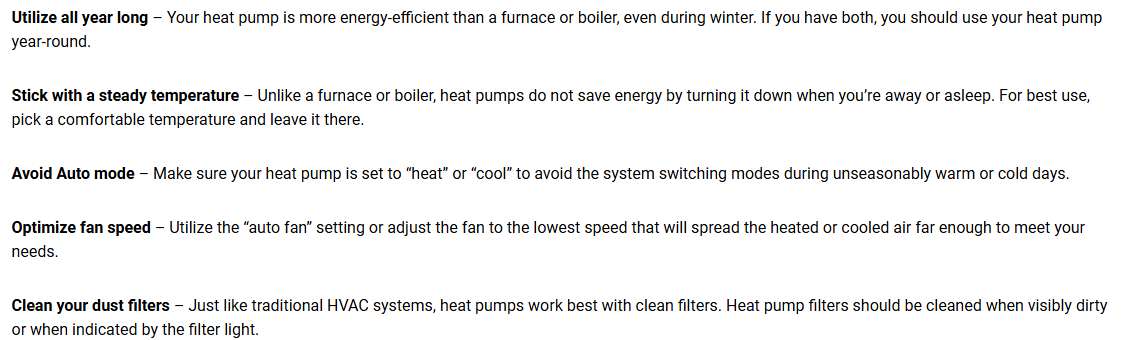
As of November 2, 2026, the “Saving Tips” tab on the ENERGY STAR air-source heat pump page reads: heat pumps “do not save energy by turning it down when you’re away or asleep,” so pick a comfortable temperature and leave it there. The same list says to set the system to “heat” rather than “auto” so it does not flip modes on odd-weather days.
If AUX runs for hours on a mild day
Backup heat that keeps running when it is 45°F outside is a symptom worth a service call. Piedmont Electric tells members to have the system inspected if backup heat operates when outdoor temperatures are not below freezing, and Jackson EMC gives the same advice for AUX that seems to run continuously in mild weather.
Carrier’s FAQ lists the usual causes for AUX in weather above 40°F: a dirty air filter, a refrigerant leak, a failing sensor, or a thermostat that was raised too quickly. Two of those you can rule out yourself in five minutes. Check that nobody bumped the setting up by four or five degrees, and look at the filter. If it is gray and matted, our guide to how often to change a furnace filter and which MERV to buy covers the swap, and the same slot logic applies to most heat pump air handlers. A refrigerant leak or a bad sensor needs a technician.
If the outdoor unit is dead, damaged, or buried in ice
This is the situation EM HEAT exists for. Jackson EMC’s answer limits it to three cases: the heat pump has failed, the outdoor unit is damaged, or a service technician tells you to use it. Carrier adds that emergency heat should not stand in for normal heat pump operation, and that a heat pump that is not working properly needs a qualified HVAC professional.
Signs that point here: the outdoor fan does not spin while the thermostat calls for heat, the unit hums but the air from the vents stays cool, a fallen limb has dented the cabinet, or the coil stays encased in ice long after a defrost should have cleared it. Switch to EM HEAT so the house stays warm, then book the repair. Switch back to normal heat as soon as the technician says the outdoor unit is fixed, because the thermostat will not do it for you.
Safety first: heat strips run on a 240-volt circuit; manufacturer spec sheets call for breakers of up to 60 amps on a 10 kW kit. Do not open the air handler panels, and do not keep resetting a breaker that trips again. Do not chip or pry ice off the outdoor coil; the thin fins and tubing hold refrigerant, and under EPA’s Section 608 rules refrigerant work is for certified technicians. Clear snow from around the cabinet by hand, power off at the thermostat if anything smells hot, and call a licensed HVAC contractor.
What an hour of emergency heat costs
Electric strips turn one kilowatt-hour into one kilowatt-hour of heat. A heat pump moves heat instead of making it, and ENERGY STAR says it can deliver up to three times more heat energy than the electricity it uses. DOE’s guide puts the saving at approximately 50% of heating electricity compared with electric furnaces or baseboard heaters. Flip that around and strips need about twice the power for the same warmth, sometimes more.
The hourly math needs two numbers. The first is the strip size. Manufacturer kits come in steps: Goodman’s HKTS line runs from 3 to 25 kW, and Lennox’s air handler kits come in 5, 7.5, 10, 15 and 20 kW. The size is printed on the air handler rating plate or in the installation paperwork. The second is your price per kWh, which our walkthrough on how to read your electric bill shows you where to find. The table uses three August 2026 residential averages from EIA Electric Power Monthly Table 5.6.A, released October 23, 2026: Louisiana at 12.87¢, the U.S. average at 18.16¢ and New York at 28.65¢.
| Strip size (full output) | Louisiana 12.87¢ | U.S. average 18.16¢ | New York 28.65¢ |
|---|---|---|---|
| 5 kW | $0.64 per hour | $0.91 per hour | $1.43 per hour |
| 10 kW | $1.29 per hour | $1.82 per hour | $2.87 per hour |
| 15 kW | $1.93 per hour | $2.72 per hour | $4.30 per hour |
| 20 kW | $2.57 per hour | $3.63 per hour | $5.73 per hour |
Those are costs for an hour of full output. Strips cycle on and off as the thermostat is satisfied, so on a 35°F day a 10 kW kit may run a fraction of each hour, while on a single-digit night with the heat pump out it can run nearly nonstop. August prices are summer prices; winter rates on your bill may differ, and tiered or time-of-use plans change the math.
A worked example: three days waiting for a part
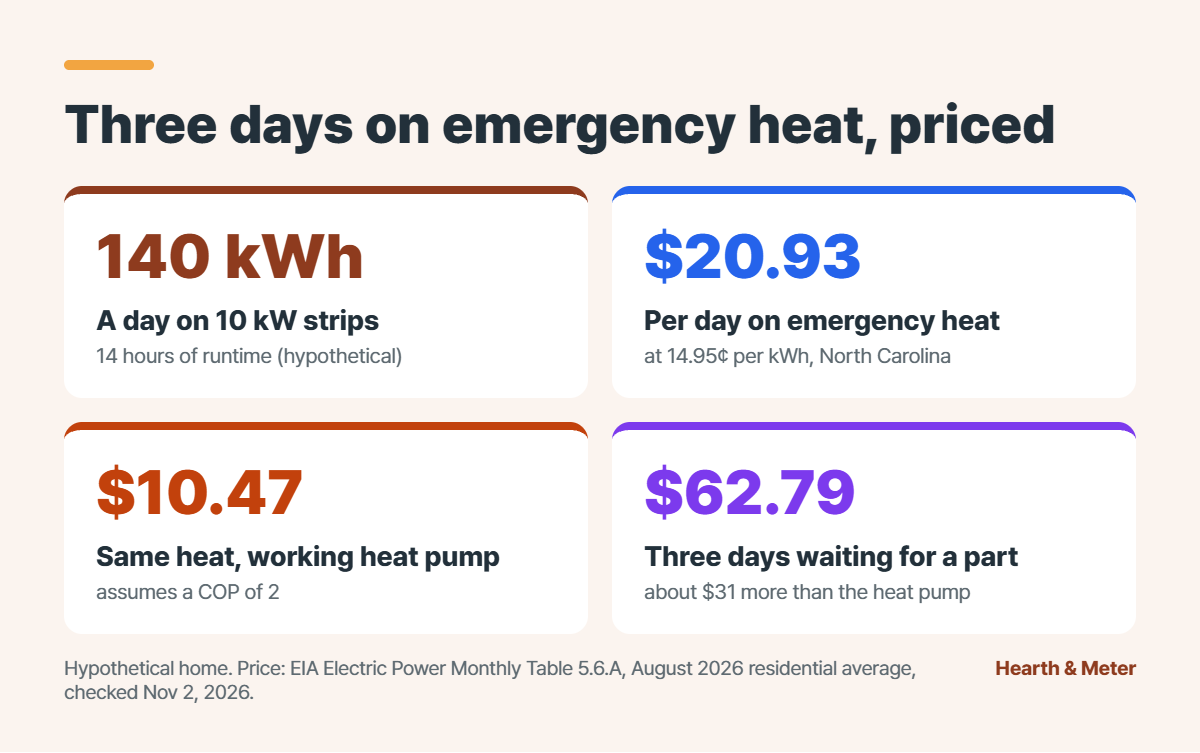
Take a hypothetical house in North Carolina whose outdoor unit quits on a Friday. The air handler has a 10 kW strip kit, and over the weekend the thermostat app reports about 14 hours a day of strip runtime. North Carolina’s August 2026 residential average was 14.95¢ per kWh.
- Energy: 10 kW × 14 hours = 140 kWh a day.
- Cost: 140 kWh × $0.1495 = $20.93 a day, or $62.79 over three days.
- Comparison: if the heat pump had been working at a coefficient of performance (COP) of 2, the same heat would take 70 kWh, about $10.47 a day. The three days on strips cost roughly $31 more.
A COP of 2 is an assumption that lines up with DOE’s 50% figure. Newer cold-climate units do better at moderate temperatures, and ENERGY STAR’s cold-climate label requires a COP of at least 1.75 at 5°F in its key product criteria. Whatever your unit’s COP, the gap between strips and a working heat pump is the reason to get the repair booked on day one. For a whole-season comparison of a heat pump against a gas furnace, see heat pump vs gas furnace cost.
Run your own numbers below. Use the strip size from the label and, if your thermostat app reports backup runtime, the real hours.
Emergency heat running cost calculator
Enter the strip size from the air handler label, how many hours a day the strips actually run, and your per-kWh price. The North Carolina example above uses 10 kW, 14 hours, 14.95 cents and 3 days.
How it works: electric resistance strips turn each kWh into the same amount of heat, so energy used (kWh) = strip kW × hours of runtime. Cost = kWh × price ÷ 100. The comparison line divides the same kWh by 2, a heat pump coefficient of performance (COP) of 2, which matches DOE’s statement that heat pumps cut heating electricity by about 50% compared with electric furnaces. Your own heat pump’s COP depends on the model and the outdoor temperature. Default price figures: EIA Electric Power Monthly Table 5.6.A, August 2026 data, checked Nov 2, 2026. Dollar amounts are rounded to the cent. Not covered: fixed monthly fees, tiered or time-of-use rates, taxes, heater kits wired in stages, and a strip voltage below 240 V (lower output). Estimate only.
If your backup heat is a gas furnace
In a dual-fuel system, AUX or EM HEAT starts the furnace instead of strips, and Lennox notes the heat pump turns off when that second stage runs. The cost per hour then depends on your gas price and furnace efficiency, so the table above does not apply. ENERGY STAR describes dual fuel as a way to use each system where it costs less to run, which is why many of these systems switch to gas automatically below a set outdoor temperature.
A furnace brings combustion into the picture. The CPSC carbon monoxide page recommends battery-operated CO alarms, or plug-in alarms with battery backup, on every level of the home and outside sleeping areas, and says interconnected alarms are best. Test them before the first cold snap pushes the furnace into heavy use.
What to write down before you call for service
A technician can diagnose faster with a few facts, and you can collect them without touching any equipment. Before you call, note:
- The outdoor temperature and the time AUX or EM HEAT showed up.
- Whether the outdoor fan spins and whether the vents blow warm air when the thermostat is on normal heat.
- The strip size and model number from the air handler rating plate, read from outside the cabinet.
- Your thermostat setting and any schedule changes made in the last week.
- The backup runtime figure, if your thermostat app reports one.
Then put the five-line note on the fridge. If the outdoor unit is the problem, switch to EM HEAT, call, and set a reminder to flip the thermostat back to normal heat the evening the repair is done.
This article is general information, not professional advice. Heat pump, refrigerant, gas and electrical work belongs with licensed HVAC contractors and electricians; check local codes and permit rules before any equipment change. Prices are averages from the dated sources linked above and will differ on your bill.
Leave a Reply