
Last checked: October 2026. This guide contains no affiliate links.
A furnace that sat idle all summer usually starts fine on the first cold night. The trouble shows up later: a weak flame sensor that quits in January, a clogged filter that makes the blower work twice as hard, or a crack in the heat exchanger that nobody looked at. A yearly tune-up is the cheap visit that catches those before they turn into a no-heat call at emergency rates.
This guide is for homeowners and renters with a gas, oil, or electric forced-air furnace. You will see what a proper tune-up covers, what it costs in 2026, which parts you can handle yourself, and the questions that separate a real inspection from a quick filter swap.
When to book it
ENERGY STAR recommends a professional check of the heating system every fall, before contractors get busy. An easy reminder is the end of daylight saving time, which falls on Sunday, November 1, 2026. If you have not booked by then, book that week.
Timing also affects price. Angi’s cost data, updated October 13, 2026, says inspections booked from spring to late summer often run $50 to $100, while fall and early winter carry higher demand and mid-winter visits tend to cost the most. October is still a reasonable window. December is not.
What a real tune-up includes
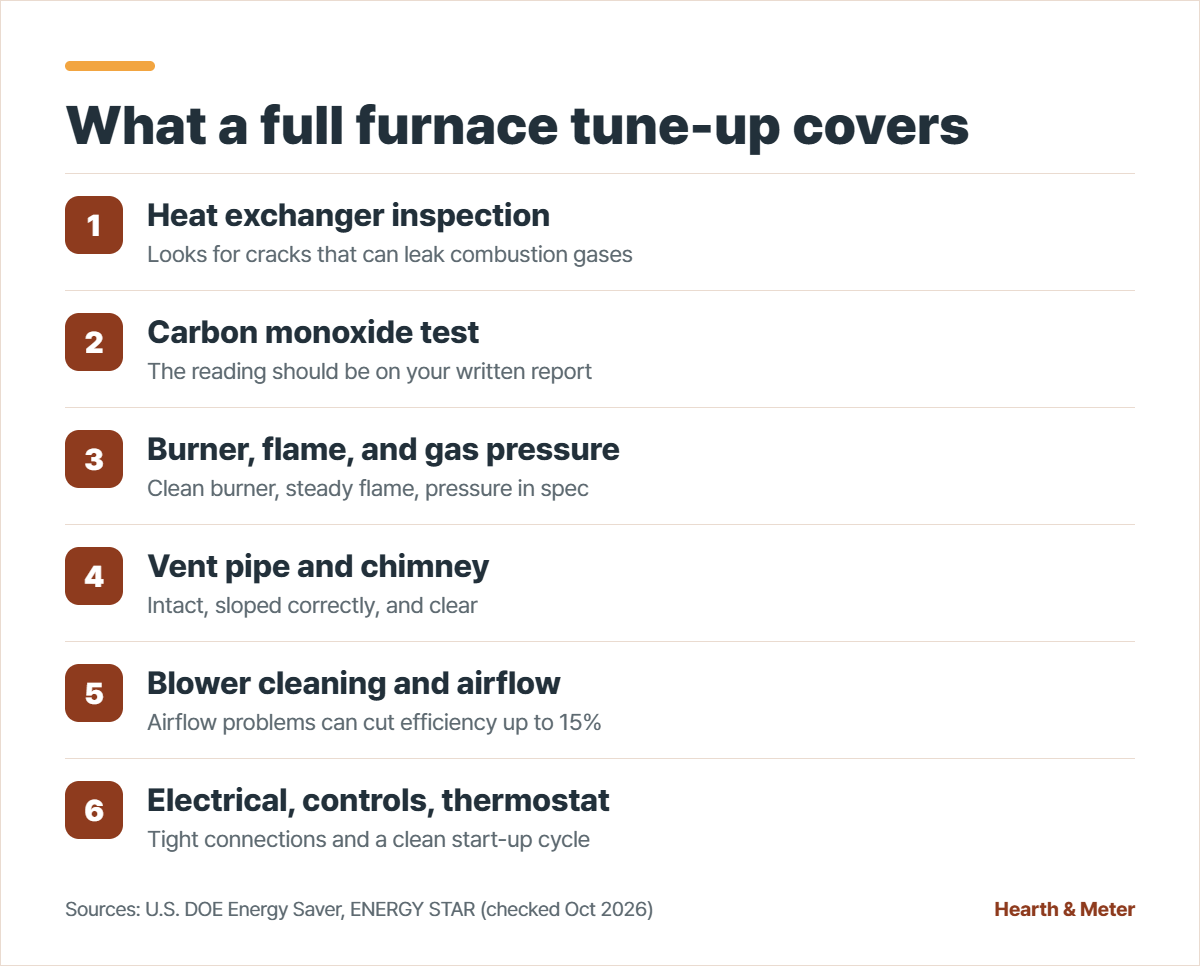
ENERGY STAR’s maintenance checklist spells out what a contractor’s check-up should include, and Angi’s cost guide notes that gas and oil furnace inspections also involve carbon monoxide testing. Put together, a complete visit covers the items below. If the quote or the work order does not mention most of them, you are paying for a lighter visit.
| Check | Why it matters |
|---|---|
| Heat exchanger and combustion chamber for cracks | A leak lets combustion gases, including carbon monoxide, mix with house air |
| Carbon monoxide test | Confirms the burner and venting are not putting CO into the home |
| Vent pipe and chimney condition | Deteriorated venting can spill exhaust indoors and is expensive to fix late |
| Gas (or oil) connections, pressure, and burner flame | Bad connections are a fire hazard; a dirty burner wastes fuel |
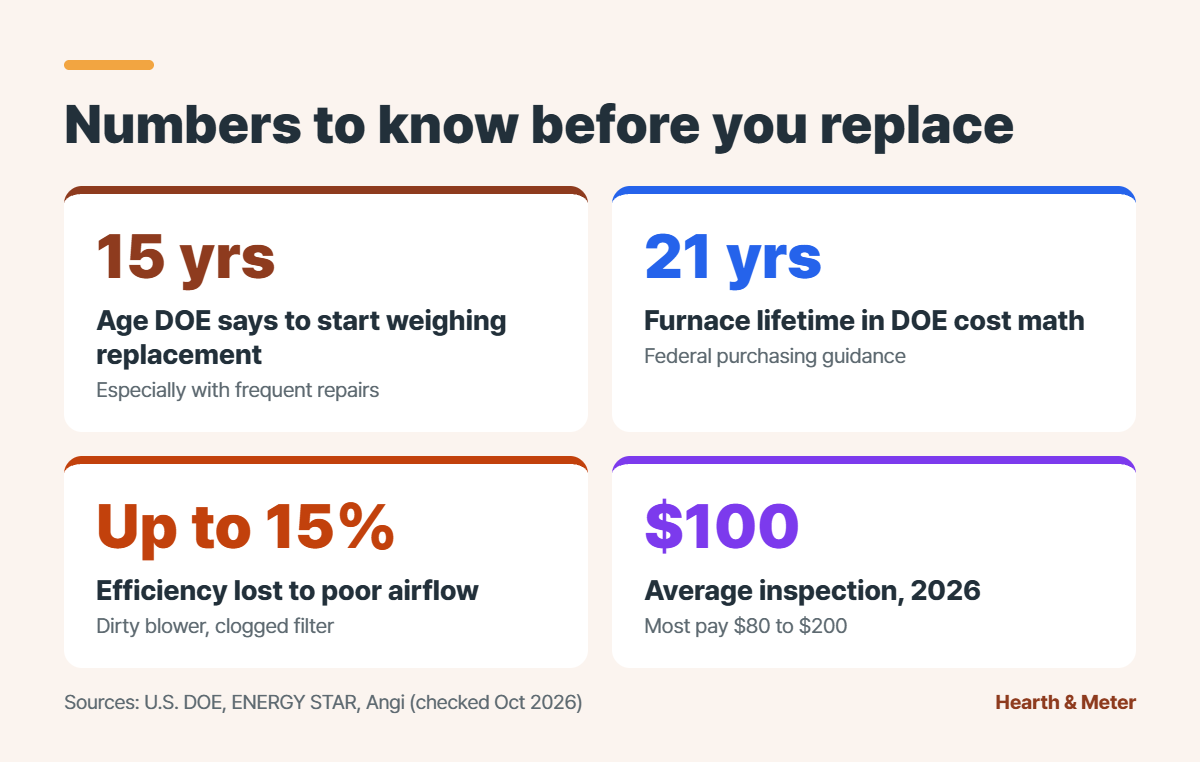
| Blower: clean, lubricate, adjust airflow | ENERGY STAR says airflow problems can cut efficiency by up to 15% |
| Electrical connections, voltage, and motor current | Loose connections shorten the life of motors and controls |
| Thermostat settings and start-up cycle | Makes sure the system starts, runs, and shuts off correctly |
| Condensate drain (high-efficiency units) | A plugged drain can leak water and shut the furnace down |
| Seal duct connections at the furnace | Leaks at the cabinet send heated air into the basement or attic |
The heat exchanger and CO test are the two checks you should never let a technician skip. ENERGY STAR warns that a cracked heat exchanger makes a furnace run less safely, and CPSC says most consumer-product CO poisoning deaths are associated with heating systems.
What it costs in 2026
Angi puts the 2026 national average for a furnace inspection at $100, with most homeowners paying $80 to $200. A basic inspection runs about $80 to $100. An advanced visit that adds light cleaning and a tune-up runs about $125 to $200, and if the furnace has gone several years without service, plan on the higher number.
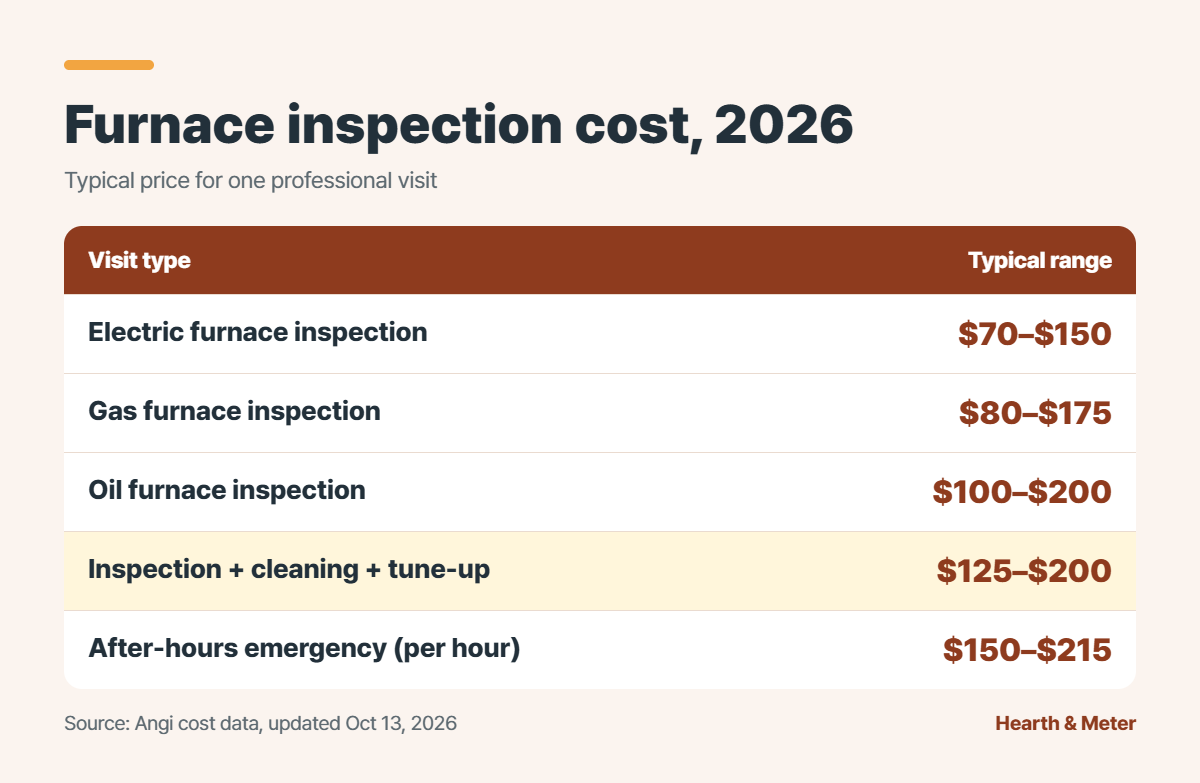
Three things push the price up: the fuel type (gas and oil units need combustion and CO testing), a larger home with a bigger system, and booking during peak season. After-hours emergency service is a different category entirely. Angi lists it at $150 to $215 per hour before any parts, which is the bill a tune-up is meant to help you avoid.
Very cheap promotions can be a fair deal or a sales visit. The way to tell is simple: ask for the written checklist before the appointment, and ask for a written report afterward that includes the CO reading.
What you can do yourself
Most of a tune-up needs instruments and a license. A few jobs are yours, and they matter between visits:
- Check the filter monthly. ENERGY STAR says to inspect it once a month and change it when it is dirty. A clogged filter raises energy use and can damage the blower. Angi’s cost guide suggests a new filter at least every 90 days.
- Keep the area around the furnace clear. No boxes, paint cans, or laundry piled against the cabinet or the return grille.
- Open every supply and return vent. Blocked vents restrict airflow, and ENERGY STAR ties airflow problems to efficiency losses of up to 15%.
- Test smoke and CO alarms. CPSC encourages a CO alarm outside the bedrooms in each sleeping area. Press the test button and replace batteries now.
- Write down the furnace age. The model and serial number on the nameplate usually encode the manufacture date. You will want it if the technician starts talking about replacement.
Leave the burner, gas valve, igniter, flame sensor, and venting alone. Those are licensed-technician jobs.
Red flags in the technician’s report
A tune-up sometimes ends with bad news. Some findings are urgent. Others are a sales pitch. Here is how to read them.
- “Cracked heat exchanger.” This one is serious. Ask to see the crack or a photo, ask for the CO reading, and get a second opinion before paying for a new furnace. If CO was detected, the unit should not run until it is fixed.
- “Your furnace is only 80% efficient.” That is the AFUE rating, which DOE defines as the ratio of useful heat output to fuel input over a heating season. It is a design rating, not a failure. A higher-AFUE replacement can save fuel, but on its own it is not a reason to replace a furnace that works.
- “You need duct work.” Sometimes true. DOE’s Energy Saver guide says ducts that leak into an attic or crawl space can add hundreds of dollars a year to heating and cooling bills, and that sealing ducts in unconditioned spaces is usually very cost effective. Ask where the leaks are and what sealing them would cost.
- “It’s 15 years old, time to replace.” Age is a reason to start planning, not a diagnosis. DOE’s guide suggests considering replacement once a furnace passes 15 years, especially with frequent repairs and rising bills, while DOE’s federal purchasing math assumes an average residential furnace lifetime of 21 years. Replacement makes sense when an older unit also needs a big repair or fails a safety check.
Questions to ask before the technician leaves
- What was the carbon monoxide reading, and where did you measure it?
- Did you inspect the heat exchanger, and how?
- What was the temperature rise, and is it inside the range on the nameplate?
- What filter size and rating should I buy?
- Is anything close to failing that I should budget for this winter?
Ask for the answers in writing or in the invoice notes. Next fall, hand the report to whoever does the next tune-up so they can compare readings.
Quick checklist
- Book the heating tune-up by early November
- Get the checklist in writing before the visit
- Make sure the heat exchanger inspection and CO test are on it
- Expect roughly $80 to $200, more for oil or an overdue system
- Check the filter monthly through the winter
- Test CO alarms outside each sleeping area
- Keep the written report for next year
Your next step: find the furnace nameplate today, note the model number and age, and call two local HVAC companies to compare what their tune-up actually includes.
This article is general information, not professional HVAC advice. Furnace service involving gas, oil, electrical components, or venting should be done by a licensed technician. If you smell gas, leave the home and call your gas utility or 911 from outside. If a CO alarm sounds, get everyone outside and call 911.
Leave a Reply